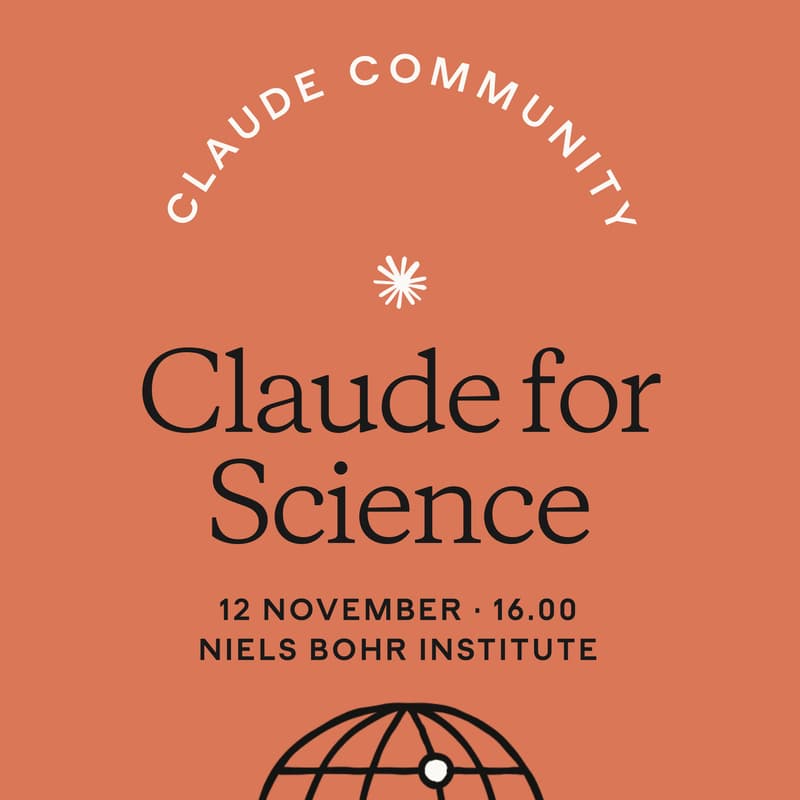


Copenhagen | Claude for Science
Join a Claude Community Event, organized by local enthusiasts for everyone who loves building with Claude!
In September 2026 two AI labs made claims that would have sounded unlikely a year ago. Anthropic reported that Claude agents searched a DNA database for 21 hours and flagged a CRISPR-like enzyme system in bacteriophages. Another well-known, frontier AI lab said one of its models had resolved the blow-up question for the Navier–Stokes equations, one of the seven Millennium Prize Problems. The research community is still examining both claims.
Both cases show where scientific work is heading.
This evening looks at what that means in practice. Four STEM researchers from academia and industry each present one case. What research question they are trying to answer. How they used Claude. What they found. What worked, and what did not.
No product demos. No sales pitches. Researchers showing their work.
The venue
We meet in the historical Auditorium A at the Niels Bohr Institute. The institute opened in 1921. In the 1920s this building was where young physicists worked out quantum mechanics. Bohr gave his lectures in this room. In the 1930s Heisenberg and Pauli sat in the front row. The benches seat about 50, so the evening is small on purpose.
Programme
16:00 Welcome and framing
16:10 Robert Sunderland (Niels Bohr Archive): The Institute and Auditorium A, the history of the room we're sitting in
16:30 Inar Timiryasov (Niels Bohr Institute / Tacent Labs): Theoretical physics, how Claude moved a stalled research project forward
16:50 Daniel Murnane (Niels Bohr Institute / Halfspace): Experimental particle physics, agentic workflows in collider research
17:15 Break with sandwiches and drinks
18:00 Eduard Chelebian (Resolute Bio): Life sciences, agents searching tumour spatial proteomics for drug targets
18:20 Dmitriy Traytel (DIKU, University of Copenhagen): Mathematics, Claude, Isabelle proofs, and what's left to verify
18:40 Closing
Who should come
Researchers, PhD students and R&D professionals in physics, chemistry, biology, mathematics, data science, and related fields who use AI in their research or want to start. Seats are limited and registration needs approval. We aim for an even mix of academia and industry.
Practical
The building houses sensitive research facilities, so guests stay in the auditorium and the rooms next to it all evening. Seating is on the original wooden benches.
Host
Hosted by Jacob Langvad Nilsson, Claude Community Ambassador and co-founder of Applied Futures. The Niels Bohr Institute and University of Copenhagen, provides the venue.