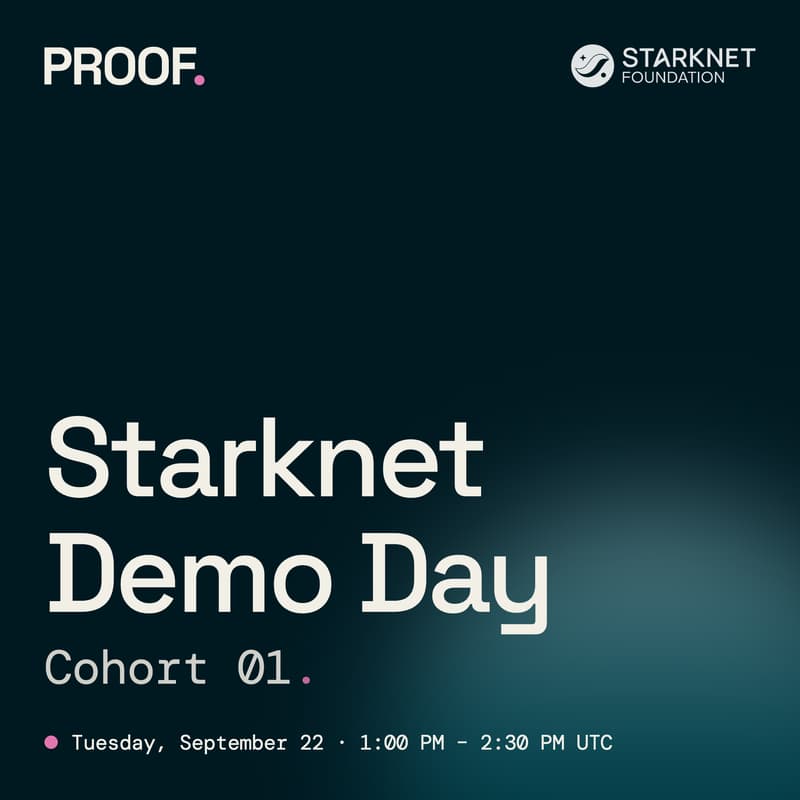

Starknet Demo Day: Proof Cohort 01
PROOF Demo Day
Join us for the Starknet PROOF Demo Day, a virtual event where 7 teams from Cohort 01 will pitch their company, followed by a live Q&A. Cohort 01 has spent the past months learning from mentors and masterclasses with leading VCs, successfully exited founders, global executives, and LPs.
Our judging panel includes Joey Shin from Pantera Capital, Damien Roch from Blockwall, Tony Liu from Primitive Ventures, and Amit Mehra from Borderless Capital.
Pitching Teams
Chance
DeFa by InvoiceMate
ROCA Beneficios
Agama
Haven
CREDI
CREDI is the on-chain infrastructure for private credit, originating, underwriting and servicing short-duration receivables while connecting institutional capital to real-world credit assets.
$16.37M funded across 6,000 invoices & 12,000+ card txns · Zero credit losses · $100M+ pipeline.
Helix Assets
About PROOF
Proof of Privacy is a Starknet accelerator program for builders working on projects with a use case for privacy, supporting teams integrating the STRK20 privacy SDK into their products. The program gives founders technical guidance, ecosystem connections, and go-to-market support through mentorship and masterclasses with leading VCs, exited founders, global executives, and LPs. This is Cohort 01, and Demo Day marks the culmination of the program.
About Starknet
Starknet is a Layer 2 network built on Ethereum, using STARK proofs to scale transaction throughput while inheriting Ethereum's security. Built with Cairo, its native smart contract language, Starknet is designed for developers who need both scale and flexibility, and has become a hub for privacy-focused infrastructure in the broader Ethereum ecosystem.
What is STRK20
STRK20 is Starknet's native privacy framework. It lets any ERC-20 token support shielded balances and private transfers without changing the token contract or asking wallets and apps to rebuild from scratch. Using STARK proofs, STRK20 enables private transfers, swaps, and DeFi activity while keeping a path open for disclosure when compliance requires it, giving users and institutions privacy that works alongside, rather than against, regulatory requirements.