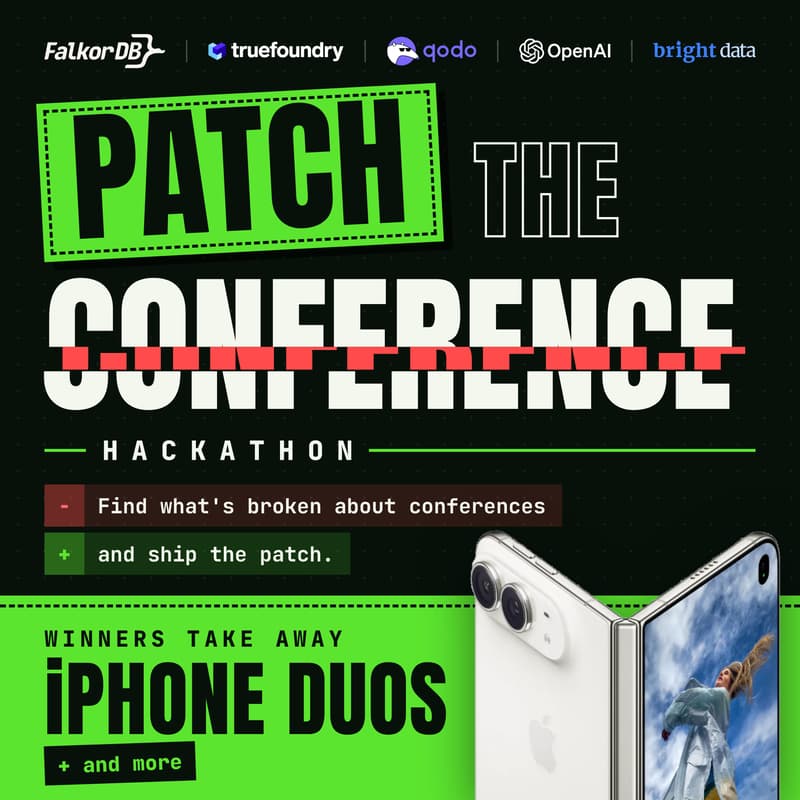

Win iPhone Duos at Patch the Conference Hackathon
Join us for the Patch the Conference Hackathon, right before GitHub Universe, where we're looking for builders who can find what's broken about conferences and ship the patch. If something about conferences has ever bugged you, from finding the right people to meet to working out which talk is actually worth your time, this is your chance to build the fix.
Everyone building gets free OpenAI credits and $50 in Bright Data credits, plus plenty of swag. Pick a track, build something that works, and show it off on stage at the end of the day.
Age Requirement: This event is 21+. Valid government-issued photo ID will be checked at the door, no exceptions. Please come prepared with your ID, as entry will not be granted without one.
🏆 Prizes
Best use of FalkorDB: iPhone Duos
Best use of Bright Data: $1,500
Best use of TrueForge with OpenAI: $1,000
Best use of Qodo: $500
If you win and don't want the phone, you can take the cash prize instead.
🗓️ Agenda
9:00 AM: Doors open
9:00 AM to 10:00 AM: Grab breakfast, get set up, start hacking and get familiar with the tools
10:00 AM to 11:00 AM: Workshops and talks from our sponsors to get you up and running
11:00 AM to 2:00 PM: Back to building
2:00 PM: Pizzas arrive, lunch is served
2:00 PM to 5:30 PM: Keep hacking and submit your project
5:30 PM to 6:30 PM: Presentations and judging, with teams showcasing their projects on stage
6:30 PM: Winners announced and the iPhone Duos handed over
7:00 PM: Event wraps up
🎁 Credits for everyone
OpenAI: free credits so you can use OpenAI models in your project at no cost.
Bright Data: $50 in credits to pull live data from the web.
Details on how to claim them will be shared at the event.
🛠️ Tracks
Track 1: FalkorDB (iPhone Duos)
FalkorDB is an open-source graph database built for AI agents. Agents are only as good as the context they work with, and a graph gives yours connected data it can reason over, a memory it keeps between sessions, and a clear picture of how things relate. It runs locally with Docker, you query it with Cypher, and it works with Python, Node.js, Java, Rust, Go, PHP and C#.
How to use it:
Follow connections across data: let your agent answer questions that take more than one hop, with graph queries as its tools.
Remember across sessions: store conversation history and what the agent has learned, so it picks up where it left off.
Share state between agents: give multiple agents one graph to read and write, so handoffs between them work.
Connect people, projects and decisions: bring knowledge from docs, tickets and chats into one graph.
Show the path behind an answer: trace every answer back to the data it came from.
Ideas to get you started:
A conference concierge that answers "which talks on agents are on after lunch, and who's speaking?" and shows the path through the graph behind its answer.
A networking agent that suggests who to meet based on shared topics and projects, and remembers who you've already spoken to.
A schedule planner where several agents share one graph to plan your day, sort out clashes and send follow-ups after the event.
Judging criteria:
Graph at the core: FalkorDB does real work, like multi-hop queries, memory or shared state between agents, not just storing rows.
Explainable answers: you can show how the project got to its answer through the graph.
Solves a real conference problem: something attendees, speakers or organisers would actually use.
Working demo: it runs live on stage.
Track 2: Bright Data ($1,500)
Conference week runs on live web data: hotel and flight prices that change hourly, side events scattered across sites, attendee info spread across dozens of pages. The hardest of these sites block scripts, so what works once fails at scale.
Bright Data gives your app or agent reliable access to that public data and returns clean, structured results, with blocks, CAPTCHAs, JavaScript rendering and parsing handled for you.
How to use it:
Web Scraper APIs: ready-made scrapers that return structured JSON from sites like Booking, Tripadvisor, Trip.com and Airbnb. No need to build a scraper when you have a ready made template, this is the quickest way to get real data.
Scraper Studio: build a custom scraper for any site without one, with self-healing when layouts change.
Web Unlocker API: fetch pages from sites that usually block bots.
Browser API: run Playwright or Puppeteer on a remote browser for JavaScript-heavy sites.
Bright Data MCP and SERP API: let your agent search the web and read any page as clean markdown, or get structured results from Google and Bing.
Your $50 in credits covers trying any of these.
Ideas to get you started:
A stay finder that compares hotel prices near the venue, tracks flights, and tells you when to book.
A side event radar that pulls events, happy hours and parties around the conference into one feed.
A who-to-meet scout that uses LinkedIn profiles and company data to rank the people worth finding.
A "should I go?" agent that checks a conference's past talks, recordings and reviews before you buy a ticket.
Judging criteria:
Hard-to-get data at the core: the project depends on Bright Data for fresh data from sites a basic script can't reliably reach.
Data quality: the data is accurate, up to date and handled well when a site changes or a request fails.
Usefulness: it saves people real time or money around conferences.
Working demo: it runs live on stage.
Track 3: TrueForge with OpenAI ($1,000)
Build an agent on TrueForge, powered by OpenAI models using your free credits.
TrueForge is TrueFoundry's open-source agent harness, the runtime that turns a model into a working agent. It handles the agent loop for you: calling the model, connecting MCP tools, spinning up a sandbox only when the agent needs to run code, loading skills, and pausing for human approval when you want it to. It comes with a chat UI and a TypeScript SDK, and you can run it locally with one command: npx @truefoundry/trueforge
How to use it:
Run TrueForge locally and connect an OpenAI model with your credits.
Give your agent tools by connecting MCP servers, so it can act on real data and services.
Use the sandbox for anything that needs code to run, skills for repeatable instructions, and approvals before the agent does anything you'd want to check first.
Build your own interface with the SDK, or use the chat UI that comes with it.
Ideas to get you started:
A speaker agent that helps you find open CFPs, draft a talk proposal and track deadlines, and asks before submitting anything.
A follow-up agent that turns the contacts and notes from your day into personalised follow-up emails, and waits for your approval before sending.
A session feedback agent that runs code in the sandbox to analyse attendee feedback and turn it into a clear report for organisers.
Judging criteria:
Built on TrueForge: the agent runs on TrueForge and makes good use of its tools, sandbox, skills or approvals.
Powered by OpenAI: OpenAI models do the heavy lifting in the agent.
Solves a real conference problem: something attendees, speakers or organisers would actually use.
Working demo: it runs live on stage.
Track 4: Qodo ($500)
Qodo reviews your pull requests for bugs, logic errors and code quality issues before you merge. This one is simple: install Qodo on your GitHub repo and build the way you normally would.
How to use it:
Install Qodo on your project's GitHub repo before you start building.
Ship your work through pull requests instead of pushing straight to main.
Read Qodo's review on each PR and fix what it catches before you merge.
Judging criteria:
Qodo in use: it's installed and reviewing real PRs throughout the day.
Good PR workflow: small, clear PRs with sensible descriptions.
Acting on feedback: you fixed what Qodo found, and can show a couple of examples in your demo.
Clean code: the repo is in good shape by the end of the day.
Come solo or form a team of up to 4 people, and don't forget your laptop and charger.