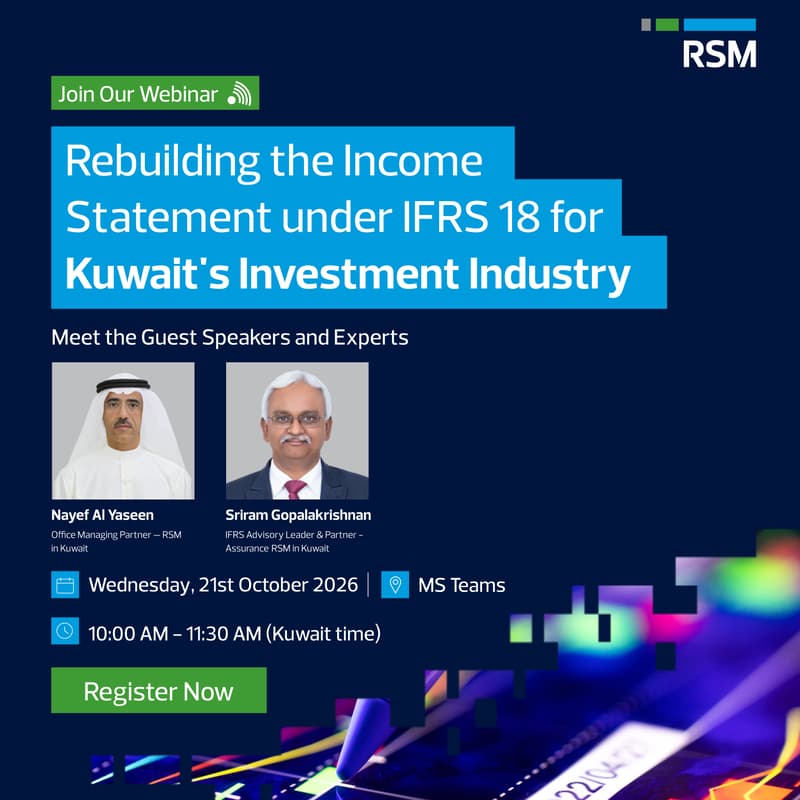

Rebuilding the Income Statement under IFRS 18 for Kuwait's Investment Industry
About the session
IFRS 18 applies from 1 January 2027, so the comparatives being reported now are already in scope. For Kuwait's investment companies, investing in financial assets, funds and property is a specified main business activity, which pulls dividends, fair value movements, portfolio interest and rental income into the operating category. Operating profit becomes the headline number and will carry portfolio volatility, while the results of equity-accounted associates and funds move below it into investing.
This 90-minute session covers the conversion using investment industry fact patterns: FVTPL and FVOCI portfolios; associates, joint ventures and fund holdings; consolidated funds and SPVs; cash flow reclassifications; the Kuwait levies (NLST, Zakat and KFAS); and the MPM note, where adjusted profit, recurring income and fee-based earnings measures now need reconciliations with tax and NCI effects.
Why attend
This sector-specific briefing is designed for CFOs, Group Financial Controllers, Heads of Investor Relations, audit committee members and finance teams at Kuwaiti investment companies, asset and fund managers, brokerages and diversified holding companies with investment portfolios. You will leave with:
→ A clear reclassification map for an investment company P&L: every line, where it lands under IFRS 18
→ The main business activity conclusion: why dividends, portfolio interest and fair value movements now sit in operating profit
→ FVTPL against FVOCI: why two houses holding the same portfolio can report very different operating profits
→ Associates, joint ventures and fund holdings: why equity-accounted results stay below operating profit, and what changes when a fund is deconsolidated
→ The MPM note: how EBITDA, adjusted profit, recurring income and fee-based earnings are reconciled, with tax and NCI effects
→ Kuwait specifics: NLST, Zakat and KFAS classification, CMA and Boursa Kuwait disclosure forms and the CBK overlay
→ Transition mechanics: what is mandatory, what is optional, and why 2026 GL tagging matters
About the speakers
Sriram Gopalakrishnan
IFRS Advisory Leader and Partner, Assurance, RSM in Kuwait
Subject matter expert on IFRS, ISA and related technical areas, with 30 years of experience across Andersen, Deloitte and RSM. His engagements include IFRS audits, IFRS implementation, internal audits and internal control reviews across multinational banks, IT giants and global in-house centres. A frequent corporate trainer to banks, universities and other clients. Past Chairperson, Kuwait Chapter of the Institute of Chartered Accountants of India.
FCA • CPA • CIA • CISA • CIDA
Nayef Al Yaseen
Office Managing Partner, RSM in Kuwait
Office Managing Partner at RSM Al Bazie & Co., holds a Bachelor of Science in Accounting from Bradley University and is a Certified Public Accountant (CPA). With over 33 years of experience, he leads the Firm's strategic and operational management across assurance, tax, and advisory services. His leadership is reflected in the digital transformation of the Firm's operations and the development of a sustainable operating model.
CPA • CVA
Save your seat
The IFRS 18 conversation has now reached the sector-specific implementation stage. For Kuwait's investment companies, asset and fund managers and diversified holdings with investment portfolios, the operating profit that appears on the face of the P&L from 2027 is materially different from what appears today. Join Sriram Gopalakrishnan and Nayef Al Yaseen for a 90-minute practitioner-led session focused entirely on the investment industry fact patterns and the classification calls that make the transition work.
This is an exclusive, invite-only webinar for finance and investment leaders in Kuwait. Register to confirm your place.