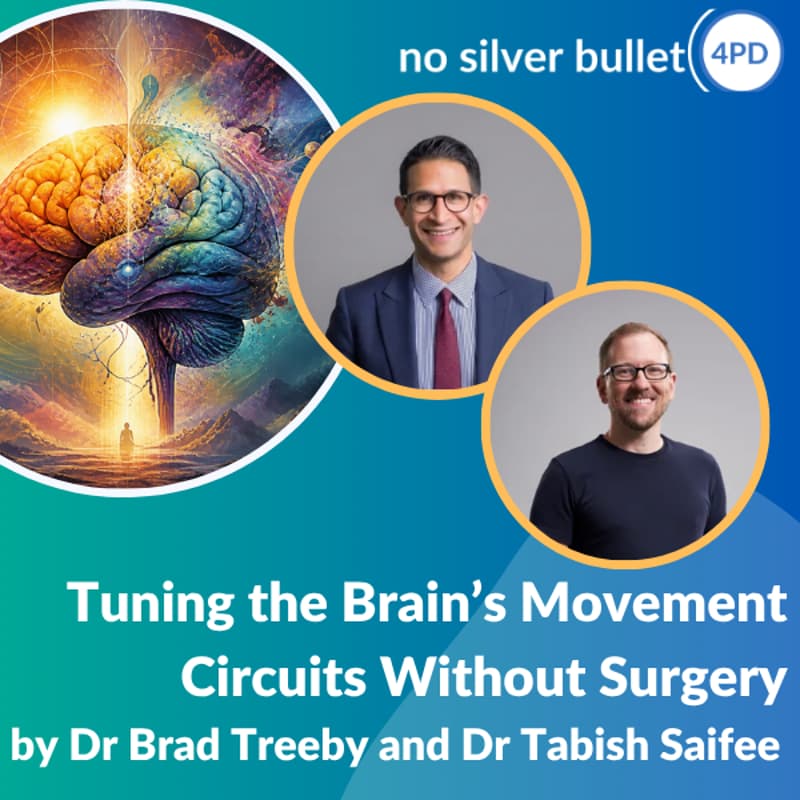

“Tuning the Brain’s Movement Circuits Without Surgery” by Dr Brad Treeby and Dr Tabish Saifee
How can we influence the brain’s movement circuits without surgery?
Join us for an interview with Dr Brad Treeby and Dr Tabish Saifee exploring the science of focused ultrasound, an emerging technology that uses sound waves to target specific areas of the brain without surgical intervention. The approach is non-ablative, reversible and repeatable.
The technology is currently being developed with a focus on essential tremor, with the potential to explore applications in other movement disorders, including Parkinson’s disease, in the future.
Through this conversation, we will explore how the technology works, what current research tells us, and what it might mean for the future of treating movement disorders. There will also be an opportunity for you to ask questions.
Please note that this webinar is scheduled at a different time from usual to accommodate the speakers’ time zones.
About the speakers:
Dr Brad Treeby is a physicist, engineer and entrepreneur who has spent the past decade developing ways to use ultrasound to reach and modulate activity deep within the brain without surgery. Before founding NeuroHarmonics, he was a Professor of Biomedical Ultrasound at University College London (UCL).
His work has focused on one of the fundamental challenges of brain stimulation: how to accurately focus ultrasound through the complex structure of the human skull and deliver it precisely to a specific area of the brain. Along the way, Brad and his colleagues developed k-Wave, an open-source simulation toolbox now used by thousands of researchers around the world, designed new ultrasound transducer arrays, and conducted pioneering human studies demonstrating millimetre-scale targeting of deep brain structures.
What began as a series of physics and engineering challenges has evolved into a much broader ambition. Working closely with clinicians and patients, Brad came to recognise that demonstrating what ultrasound can do scientifically is only part of the challenge. The next step is to establish whether this precision can translate into effective treatments and, ultimately, into technology that real people can use.
Brad left academia to pursue this goal full time and is now CEO of NeuroHarmonics, where he leads a team developing a new platform for non-invasive deep-brain neuromodulation, combining precision engineering with a focus on clinical potential and patient needs.
Dr Tabish Saifee is a Consultant Neurologist specialising in movement disorders. He runs a specialist service at the National Hospital for Neurology and Neurosurgery, Queen Square, London, and is Clinical Director for Neurology and Neurophysiology at London North West University Healthcare.
His research career began with a PhD at University College London investigating the mechanisms underlying tremor. Dr Saifee has extensive experience in clinical trials, serving as Chief or Principal Investigator for studies investigating new treatments for Parkinson's disease and other movement disorders, including novel disease-modifying therapies. He has authored or co-authored more than 65 peer-reviewed publications spanning these areas. He has also served on advisory committees at national level for movement disorders.
He runs a busy specialist clinical service and is closely involved in the clinical assessment for advanced treatments for Parkinson's and tremor, including MRI-guided focused ultrasound.
He is Medical Director of NeuroHarmonics, where he helps lead the clinical strategy and development of a novel non-invasive focused ultrasound platform targeting deep brain circuits. His particular interest is in translating advances in neuroscience and neuromodulation into effective, accessible treatments for people living with disabling neurological conditions.