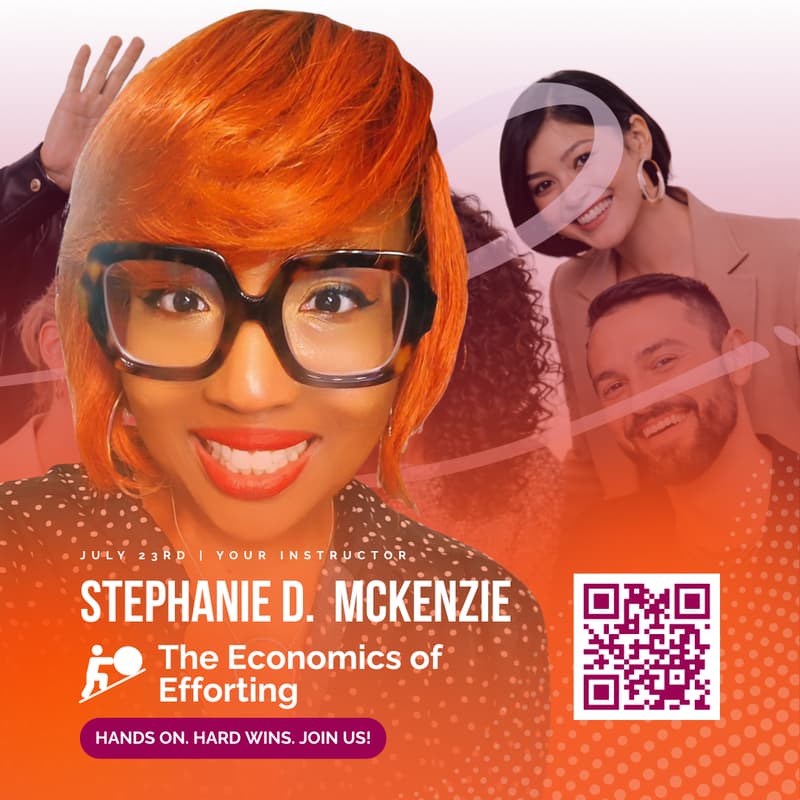

The Economics of Efforting (and Success)
Most founders have been taught that growth comes from adding more:
More hours.
More offers.
More content.
More consistency.
More discipline.
More of your time, energy and attention.
And when the results still do not match the effort, you assume the answer must be to work harder, work smarter or finally figure out how to do everything “the right way.”
But what if the problem is not how hard you are working?
What if the problem is that your effort is being invested at the wrong level?
THERE IS A HIERARCHY TO HOW FOUNDERS GROW.
Seven levels.
And most brilliant, capable and exhausted founders are still operating at the first one:
EFFORTING.
Efforting is not laziness, poor discipline or a lack of ambition. It is a developmental stage where execution carries the entire business.
You are the engine.
You are the strategy.
You are the delivery system.
You are the backup plan.
The business moves because you move.
And that may be enough to start a business. It is not enough to sustainably grow one.
The structure of Efforting rewards activity, not necessarily value. It can keep you working, producing and responding without helping you build greater profitability, stronger positioning or actual business equity.
That is the difference we are going to examine during The Economics of Effort.
WHAT IS THE ECONOMICS OF EFFORT?
The Economics of Effort is a free, live class designed to help founders evaluate what their work is actually producing.
We will examine how founders often cycle through without realizing each one requires a different approach.
The goal is not to eliminate effort.
The goal is to stop spending it carelessly.
DURING THIS CLASS, YOU WILL LEARN HOW TO:
- Identify whether you are currently Efforting, Over-Efforting or producing Valuable Effort.
- Evaluate the relationship between the energy you invest and the business value that investment creates.
- Recognize when additional work is creating diminishing returns rather than meaningful growth.
- Separate execution that keeps the business operating from strategic effort that makes the business more valuable.
- Identify where your business is overly dependent on your personal labor, availability or expertise.
- Begin redirecting your effort toward stronger revenue, positioning, systems and brand equity.
By the end of the class, you should be able to look at your current workload and answer three questions with greater honesty:
What is this work producing?
What is this work costing me?
Is this effort building the business—or merely keeping me busy inside it?
WHO IS THIS CLASS FOR?
You have an offer.
You have expertise.
You have customers, clients, an audience or proof that your work creates value.
But the revenue, stability or freedom within the business does not reflect what you have invested in it.
You are working.
The business may even be growing.
But too much of that growth still depends on you doing more, and becoming more efficient at holding an increasingly heavy bag.
You know something has to change.
WHO THIS CLASS IS NOT FOR:
This is not a class for people looking for applause disguised as strategy.
I am not going to tell you that every action matters simply because you worked hard to complete it.
Some of your effort is valuable.
Some of it is necessary but should be reduced, delegated or redesigned.
And some of it is expensive motion that your business can no longer afford.
This class requires honesty about your habits, your numbers, your decisions and the work you keep calling strategic simply because it takes a lot of time.
I will be honest with you first. That is the deal.
ABOUT STEPHANIE D. MCKENZIE
Stephanie D. McKenzie is a fractional CMO, TEDx speaker, Amazon bestselling author and 10-time founder of The College of Empowerment.
She is the creator of the McKenzie Success Hierarchy, a seven-stage framework for entrepreneurial development published on SSRN, and has spent more than 15 years helping founders build stronger businesses, brands and learning systems.
Her work examines the difference between effort that merely produces activity and effort that creates sustainable value.
Stop measuring your commitment by how much your business is allowed to take from you.