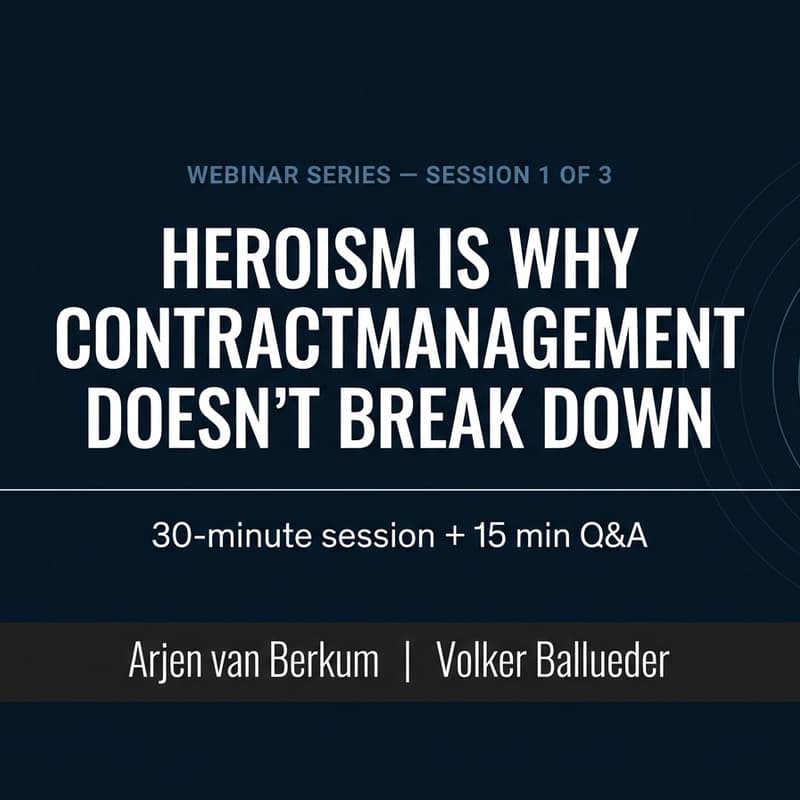
Webinar 1: Heroism is Why Contract Management Doesn't Break Down
There is a person in almost every organisation who holds the contract together. You know who they are. They are the ones who get called on a Friday afternoon when something goes wrong. They are the ones who remember what was agreed three years ago because no one documented it properly. They are the ones who stay late, who follow up when no one else does, who catch the issues before they escalate into something that lands in the boardroom. They are the heroes of contract management, and most organisations would fall apart without them.
That is exactly the problem.
In this webinar, Volker Ballueder and Arjen van Berkum take a direct look at what is actually happening inside contract management teams across industries. Not in theory. Not based on frameworks or ideals. Based on what they see every day when working with leaders, commercial managers and contract professionals who are doing their best in systems that were never designed to support them properly.
The conversation starts with a simple but uncomfortable question: why does contract management so rarely break down completely? The answer, in most organisations, is not that the process is strong. It is not that leadership has invested in the right infrastructure. It is not that the culture around contracts is healthy and well-structured. The reason contracts do not completely collapse is because someone made it their personal mission to hold it all together.
This is heroism. And heroism is not a strategy.
Volker and Arjen will walk through what heroism looks like in practice. It is the contract manager who takes ownership of everything because the mandate is unclear and no one else will step up. It is the commercial manager who personally renegotiates a clause at midnight because there is no documented process for escalation. It is the team lead who has built their entire professional identity around being indispensable, around being the person who knows things, around being the one who saves the day. These are not bad people making bad decisions. These are capable, motivated professionals doing what any reasonable person would do when the alternative is watching something important fail.
But the consequences of building a contract management function on heroic individuals are serious, and they compound over time.
When one person holds critical knowledge, that knowledge leaves when they leave. When one person is the informal checkpoint for quality, quality becomes inconsistent the moment they are unavailable. When one person is absorbing the pressure that should be distributed across a proper system, that pressure accumulates. It does not disappear. It builds. And eventually, it breaks the person carrying it.
The webinar will explore the specific patterns that emerge in organisations where heroism has become the default mode of operation. These include knowledge silos that develop organically as individuals protect their areas of expertise not out of selfishness but out of necessity. They include informal networks that get things done but are completely invisible to leadership and therefore impossible to scale or replicate. They include a culture where asking for help is seen as weakness and where raising structural problems is discouraged because everyone is too busy solving today's crisis to think about tomorrow's prevention.
Volker and Arjen will also address something that rarely gets said out loud in professional settings: heroism is addictive. For the individuals involved, there is genuine satisfaction in being the one who saves the day. There is professional recognition, even if informal. There is a sense of purpose and urgency that can be energising, at least in the short term. This is not a character flaw. It is a very human response to an environment that rewards firefighting and provides no visible reward for preventing fires in the first place.
The cost, however, is substantial. Burnout in contract management roles is not unusual. Neither is high turnover in teams that are structurally over-reliant on individual performance. When the hero finally steps back, whether through resignation, illness, or simply exhaustion, the organisation discovers very quickly that what looked like a healthy function was actually a single point of failure wearing a professional title.
This is the central message of the first session in this series: heroism is not a sign of organisational strength. It is a signal of structural weakness that has found a human workaround. The fact that contracts are not completely breaking down is not evidence that the system works. It is evidence that certain people are working themselves to the limit to compensate for a system that does not.
The organisations that are most at risk are not the ones where everything is visibly on fire. They are the ones where everything looks fine from the outside because someone capable is quietly absorbing every problem before it becomes visible. That person is not fine. That person is managing an unsustainable load in an environment that has no mechanism to recognise, distribute or reduce it.
Volker Ballueder brings extensive experience in leadership, coaching and organisational change. Arjen van Berkum brings deep expertise in contract management methodology and professional development. Together they create a conversation that is both technically grounded and human in its focus.
This 30-minute session, followed by 15 minutes of open questions, is designed for leaders, contract managers and commercial managers who recognise something of this picture in their own organisations. It is not a comfortable conversation. But it is a necessary one.
Because heroism, as a long-term strategy for managing contracts, does not just fail the organisation. It fails the people who were good enough and committed enough to try to make it work. It breaks them. And when they are gone, the system that depended on them does not suddenly become stronger. It simply starts looking for the next person willing to carry a weight that no single person should ever have to carry alone.
That is where the series begins. With the human cost of a structural problem. And with an honest examination of why so many organisations prefer to celebrate their heroes rather than address the conditions that created the need for heroism in the first place.