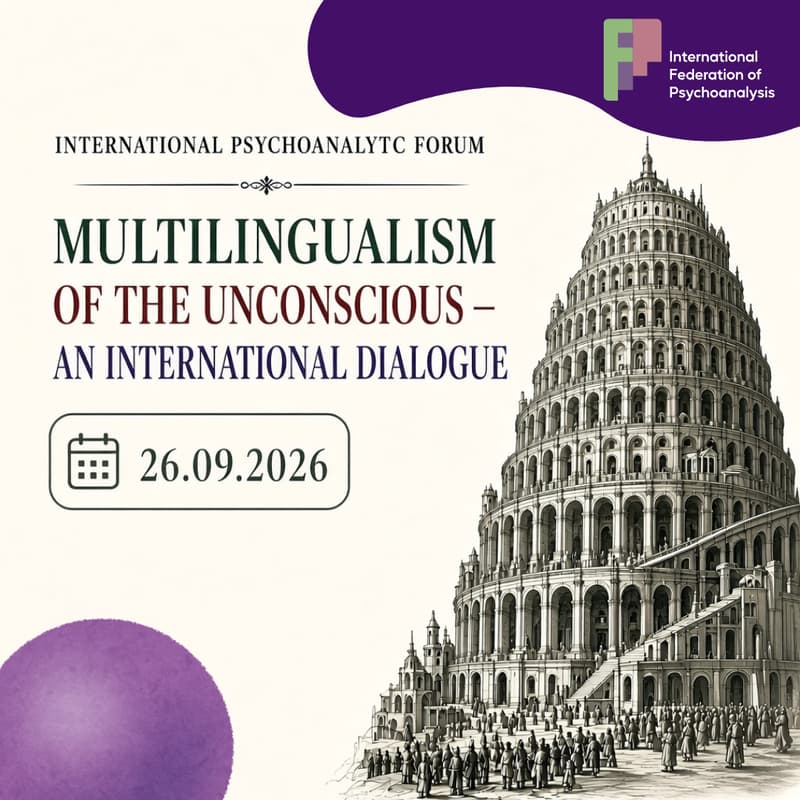

International Psychoanalytic Conference marking the UN Language Day: “Multilingualism of the Unconscious — An International Dialogue”
This event is dedicated to exploring multilingualism not merely as a linguistic phenomenon, but as a fundamental framework of the clinical and cultural space, where each distinct linguistic dimension complicates and enriches the field of psychoanalytic experience.
We invite you to an encounter with the ever-recurring diversity of languages, where the impossibility of a coincidence of meanings allows Speech—written, spoken, the living word, and the materiality of the voice—to connect, complicate, and sustain the dynamics of the subject’s existence.
Psychoanalysis is a polyphonic movement, historically shaped by the contributions of various cultures and linguistic traditions. It has never been a space of absolute linguistic transparency or idyllic understanding. Recognizing the polyphony of the unconscious and the diversity of languages means being prepared to deal with the rupture, with the subject’s unyielding uniqueness and “inappropriateness,” with the difficulties of translation, and with the encounter with the untranslatable residue.
As part of the presentations, we invite colleagues from France, Greece, Portugal, and Ukraine to present the historical trajectory, theoretical developments, and current state of the psychoanalytic movement in their own languages.
Format and main themes:
Presentations by communities from different countries united by the International Psychoanalytic Federation: the history of their origins, development, key shifts in concepts, and the current state of psychoanalysis in \(our) (native?) languages.
The function of language and the realm of the untranslatable: the difficulties of translation as a condition for the development of psychoanalysis. The language of the unconscious—symptom, metaphor, metonymy. How the unconscious manifests itself in the paradoxes of language, linguistic shifts, symptoms, and the specifics of everyday clinical experience and theoretical research within each linguistic tradition. We offer an opportunity to discuss the “productive” distortions of the primary languages of psychoanalysis.
Features of the Clinical-Theoretical Landscape: We invite participants to outline the unique coordinates within which psychoanalytic thought and clinical practice in your linguistic space have emerged and continue to develop. These coordinates—both linguistic and conceptual—shape how you perceive language in your country.
Presentations
Svetlana Uvarova (Ukraine) Welcome Address
Frédéric Vinot (France)«Accent and Charm»
Theodoros Tsirigotis (Greece) «Who Remains Unrecognizable? Psychoanalytic and Political Recognition Through the Lens of Intersectionality»
Viktoria Milotvorska (Ukraine) «Babylon as a Comedy of Coincidence: The Mother Tongue at the Digital Crossroads of the Screen»
Maxim Piskunov (Ukraine) «I Have No Native Language: Confessions of a Large Language Model Without an Unconscious»
Oksana Kulchynska (Ukraine) «The Multilingualism of the Psychoanalyst»
Adolfo Bejamin (Argentina) «Migration, Language, Multilingualism»
Lesia Kutsenko (Ukraine) «The Ukrainian that was (not) there»
The presentation program will conclude with a general roundtable discussion featuring speakers representing all the linguistic traditions presented.
Please register via the link: link.ifp-world.com/multilang-unconscious-form