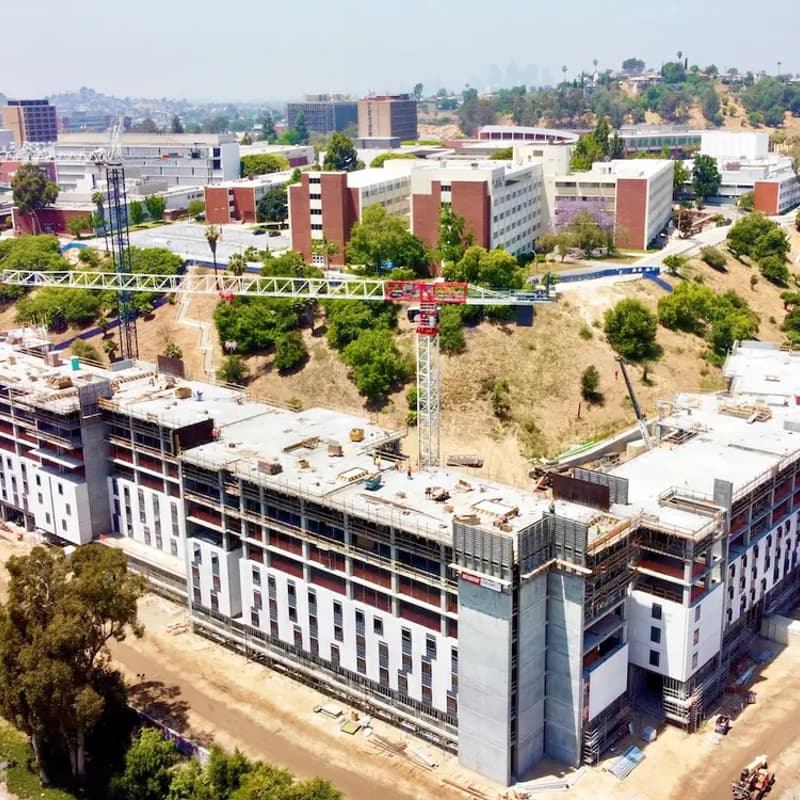

Building & Funding Student Housing
About this event
A two-hour interactive workshop designed for real estate investors, developers, and capital allocators who want to understand—and invest in—the purpose-built student housing (PBSH) asset class.
Led by Jared Hutter, Co-Founder at Aptitude Development, one of the country's leading Tier-1 student housing developers and operators. Jared and his team develop and operate purpose-built student housing through their in-house brand, The Marshall, delivering high-performance residential assets at flagship public universities across the U.S.
Tuesday, May 12: 12:00pm–2:00pm ET
The session will be recorded and shared with all participants via Circle.
Over two hours, you'll learn how the PBSH market works, why its economics consistently outperform traditional multifamily, how to source and analyze university-level demand data, and how to evaluate, underwrite, and structure student housing investments. The session includes live case studies from Aptitude's current portfolio.
Participants will receive post-course access to Circle, where we'll share recordings, underwriting models, and deal examples.
You'll learn how to:
Understand the PBSH market: what it is, what's driving demand at Tier-1 universities, and why it outperforms conventional multifamily
Quantify demand using university data: how to access and interpret enrollment figures, bed deficits, and pipeline data to model demand down to the bed
Evaluate the math—PBSH vs. multifamily: why the same square footage generates 2x the revenue under a student housing program, and how collections, pre-leasing, and guarantor profiles de-risk the income stream
Assess sites and markets: what makes a location investable—walkability, proximity to campus nodes, zoning constraints, and structural supply barriers
Underwrite student housing investments: ground-up development and acquisition opportunities using real models from Aptitude's portfolio
Structure capital stacks and exit strategies: how developers and institutional investors partner on PBSH deals, and why stabilized assets trade at meaningful spread compression
You'll leave with actionable insight into how to invest in purpose-built student housing—how the economics work, where the demand data lives, and what separates winning projects from the rest.
The Workshop Will Cover
Part One: The Market Playbook & Why PBSH Outperforms (approx. 60 min)
The First Residential Product Designed Around a Measurable Renter Base: How purpose-built student housing differs from traditional multifamily—and why precise demand data, parent-backed leases, and academic-calendar visibility make it one of the most analytically defensible opportunities in institutional real estate
What's Driving Demand: Enrollment growth at flagship publics, international student demand, rising household incomes among guarantor families, and a widening quality gap between aging off-campus stock and modern purpose-built product. Understand where demand is concentrating—and which markets are next
The Math—PBSH vs. Multifamily: How per-bed leasing transforms unit economics. A 4-bed/4-bath unit at $1,250–$1,500 per bed generates $5,000–$6,000/month on the same 1,200 SF that rents for $2,500–$3,000 as conventional multifamily. Plus: why delinquency runs 1–2% vs. 4–7% in traditional apartments, and how 9–12 month pre-leasing creates revenue visibility that no other residential format can match
Accessing & Analyzing University Demand Data: How to use publicly available enrollment data—by class year, residency, full-time status, and program—to calculate true bed deficits. How developers like Aptitude layer in shadow-market assumptions, pipeline reviews, and planning board analysis to arrive at precise demand estimates
Designing for Two Customers—Students and Parents: Why PBSH is a dual-consumer product: students choose based on proximity, lifestyle, and social positioning; parents evaluate safety, management quality, and operational standards. How this dynamic shapes architecture, amenity programming, and management platforms
The OpCo-PropCo Advantage: How Aptitude's in-house operating brand, The Marshall, integrates development and management into a single product—and why controlling both the building and the brand drives 100–200 bps of enhanced yield. Leasing cadences, staffing models, parent communication standards, and amenity programming built for the unique rhythms of student life
Trends & Evolving Dynamics: The rise of user-driven residential, institutional capital flowing into branded operating platforms, and how PBSH is functioning as a leading indicator for what the next generation of multifamily renters will demand
Part Two: The Deal Level—How to Evaluate & Underwrite PBSH Investments (approx. 60 min)
Aptitude's Buy Box & Market Selection Framework: Tier-1 enrollment resilience, significant bed deficits, structural constraints on walkable housing, and operational fit. How to evaluate markets with both a development lens and an operating lens
Case Study 1—The Marshall Tempe (ASU): 485 beds, 188 units, 900 feet from campus. Step-by-step underwriting of a ground-up Tier-1 development—from site selection and demand quantification to cost modeling, rent assumptions, yield-on-cost targeting, and institutional exit pricing. Why ASU's 25,000-bed deficit and 20% YOY rent growth in top assets create a locked-in demand thesis
Case Study 2—The Marshall Binghamton (SUNY Binghamton): 516 beds, 195 units, 500 feet from campus. How a mid-sized Tier-1 public with severe walkable supply constraints, aging off-campus stock, and strong enrollment growth supports the same underwriting framework—and why institutional buyers are increasingly targeting these markets for diversification and yield
Underwriting Yield-on-Cost & Exit Cap Rates: Building to high-6% / low-7% unlevered yields with projected exits in the low- to mid-5% cap range. How rent-per-SF arbitrage, pre-leasing visibility, and guarantor-backed collections support institutional pricing from buyers like Blackstone, GIC, Harrison Street, and DWS
Capital Stack Design & Investor Alignment: How institutional investors, private equity firms, and developers structure PBSH deals: co-GP arrangements, promotes, platform-level partnerships, and how favorable financing reflects the category's collection reliability and outsized demand-to-supply ratios
Risk & Return Frameworks: How market selection, enrollment trends, walkability constraints, construction costs, and operational execution impact underwriting and deal outcomes
Who's Teaching
Jared Hutter — Co-Founder, Aptitude Development
Jared is one of the leading purpose-built student housing developers and operators in the U.S. At Aptitude, he leads the development and operation of high-performance residential assets at Tier-1 universities through The Marshall, Aptitude's in-house property management brand. Aptitude's model integrates development and management into a single platform, delivering purpose-built product designed around students' academic and social lives—and operated to outperform. Current projects include developments at Arizona State University and SUNY Binghamton.
Thesis Driven
A media-led real estate & capital-markets platform teaching investors and sponsors the strategies shaping the built world.
Format & Access
One live session: Two hours on Tuesday, May 12 from 12:00pm–2:00pm ET
Post-workshop access via Circle: All participants will receive an invitation to join our private Circle community after the workshop concludes.
Within one week of the workshop ending, participants will receive access to:
Full session recording
Slides and presentation deck
Underwriting models, demand analysis templates, and implementation resources
Circle is where we host all workshop materials and continue the conversation. Members also gain access to a live, active community of real estate investors, developers, operators, and capital allocators to connect, ask questions, and continue the discussion beyond the session.
Frequently Asked Questions
Will participants receive a copy of the materials? Yes. All registered participants will receive an invitation to join our private Circle community. Recordings, slides, models, and case studies will be uploaded within one week of the workshop ending.
I can't make this time—will a recording be available? Yes. All registered participants receive access to the recording and materials via Circle, even if they cannot attend live.