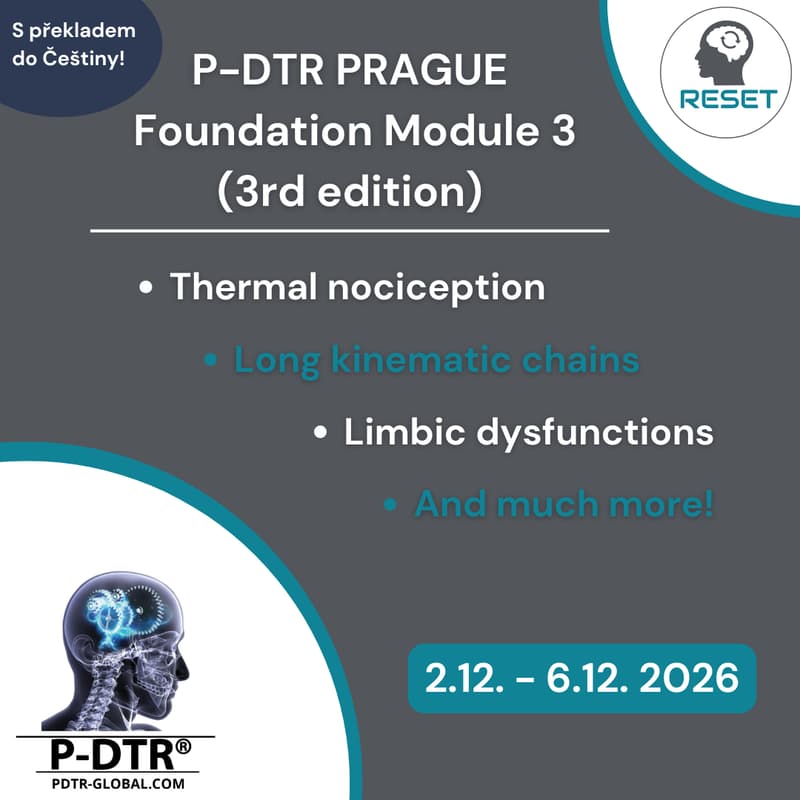
P-DTR PRAGUE Foundation – Module 3 (2026 edition) – S překladem do Češtiny!
P-DTR Foundation Series | Module 3
Course Date:
Module 3: 2.12. – 6.12. 2026
Scheldule: 8:00 – 16:00 (with hour lunch break)
Refresment during course will be availible.
Lunch and acommodation are not included.
12 | LONG KINEMATIC CHAINS
The Science of Mechanics
Statics
Dynamics
Kinematics
Kinetics
Mechanisms vs. Structures
Long Kinematic Chains
Open Kinematic Chain
Closed Kinematic Chain
Dynamic Kinematic Chain Testing
Rules of Long Kinematic Chains
Common Locations
13 | THERMAL NOCIOCEPTION
Three Types of Thermal Receptors
Cold Receptors
Warm Receptors
Nocioceptive Stimuli
Cold Receptors
Fiber Type
Pathway
Stimulation
Symptoms
Inhibition Pattern
Treatment
Warm Receptors
Fiber Type
Pathway
Stimulation
Symptoms
Inhibition Pattern
Treatment
14 | TICKLE AND ITCH
Tickle
Fiber Type
Pathway
Stimulation
Symptoms
Inhibition Pattern
Treatment
Itch
Fiber Type
Pathway
Stimulation
Symptoms
Inhibition Pattern
Treatment
15 | FINE AND CRUDE TOUCH
Fine Touch
Meissner’s Corpuscles
Merkel’s Discs
Iggo Dome Receptors
Fiber Type
Pathway
Stimulation
Symptoms
Inhibition Pattern
Treatment
Crude Touch
Fiber Type
Pathway
Stimulation
Symptoms
Inhibition Pattern
Treatment
16 | CLOACAL SYNCHRONIZATION
Equilibrium Reflex Synchronization
Labrynthine Reflex
Symptoms
Location
Head-on-Neck Reflex
Symptoms
Location
Visual Righting Reflex
Symptoms
Location
Anterior Pelvic Reflexes
Symptoms
Location
Posterior Pelvic Reflexes
Symptoms
Location
Appositional Testing
Flexion Tests for Anterior Reflexes
Extension Tests for Posterior Reflexes
Treatment
17 | VERTEBRAL FIXATION AND LIMBIC FIXATION
What is a Spinal Fixation?
Occipital Fixation
Use of Therapy Localization
Testing
Treatment
Sacral Fixation
Use of Therapy Localization
Testing
Treatment
Vertebral Fixation
Use of Therapy Localization
Testing
Treatment
Limbic Fixation
Location
Use of Therapy Localization
Testing
Treatment
18 | JOINT POSITION PROPRIOCEPTORS
Joint Position Sense
Conscious Joint Position
Pathway
Symptoms
Treatment
Unconscious Joint Position
Pathway
Symptoms
Treatment
19 | SPINOTHALAMIC DYSFUNCTIONS
Ascending Sensory Systems
Anterolateral System
Spinotectal
Spinomesencephalic
Spinohypothalamic
Spinoreticular (Paleo)
Spinothalamic (Neo)
Dorsal Column Medial Lemniscal Pathway
Fasiculus Gracilis
Fasiculus Cuneatus
Medial Lemniscus
Somatosensory Pathways to the Cerebellum
Spinocerebellar Tracts
Cuneocerebellar Tracts
1st, 2nd, and 3rd Order Neurons
Spinothalamic Dysfunctions
Spinotectal
Course
Function
Stimulus
Spinomesencephalic
Course
Function
Stimulus
Spinohypothalamic
Course
Function
Stimulus
Spinoreticular (Paleo)
Course
Function
Stimulus
Spinothalamic (Neo)
Course
Function
Stimulus
20 | ADRENALS
Histology
Location
Structure
Medulla
Chromaffin Cells
Catecholamines (Adrenaline and Noradrenaline)
Cortex
Glomerulose Zone
Mineralcorticoids (Aldosterone)
Fasiculata Zone
Glucocorticoids (Cortisol)
Reticularis Zone
Androgens (DHEA and DHEA-S)
Estrogens
Blood Supply
Function
Maintaining Metabolic Processes
Regulate Balance of Salt and Water
Control “Flight or Fight” Response to Stress
Maintaining Pregnancy
Initiating and Controlling Sexual Maturation during Childhood and Puberty
Synthesis of Corticosteroid Hormones in Cortex
Cortisol
Corticosterone
Androgens
Aldosterone
Metabolism
Role of Cholesterol
Hormones of the Adrenal Cortex
Glucocorticoids
Mineralcorticoids
Androgens
Adrenal Pathology
Cushing’s Syndrome
Addison’s Disease
General Adaptation Syndrome
Categories of Stress
Physical Stress
Chemical Stress
Emotional Stress
Thermal Stress
Stages of GAS Model
Alarm Reaction
Resistance Stage
Exhaustion Stage
Triad of Chronic Stress
Adrenal Cortex Enlargement
Atrophy of Thymus Gland and Lymphatic Tissues
Stomach and Duodenal Ulcers
Symptoms of Adrenal Stress
Signs of Adrenal Stress
Relationship of DHEA to Cortisol
Pregnenolone Steal/Cortisol Escape
Treatment