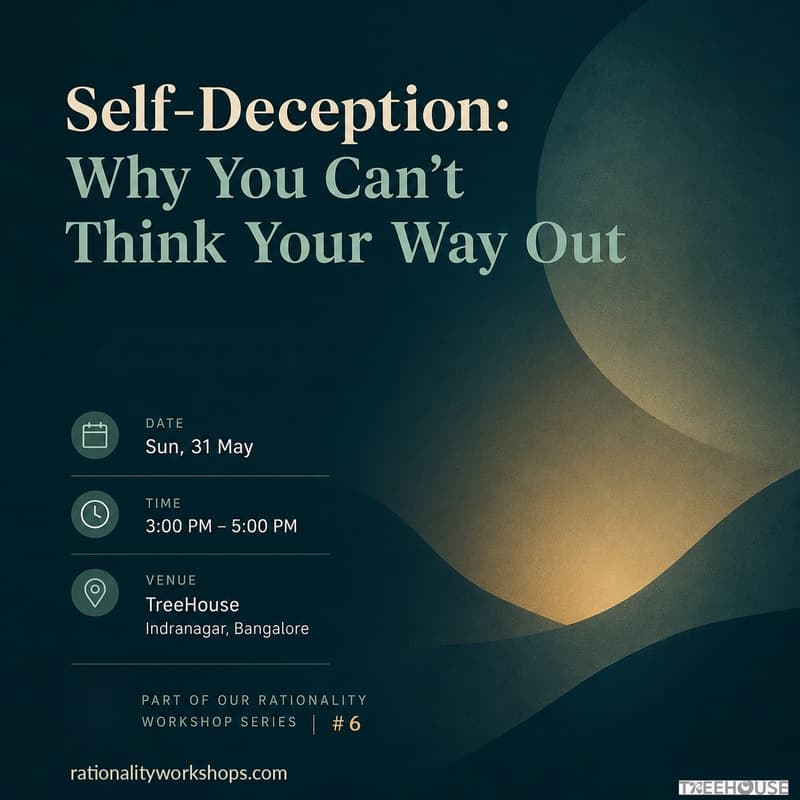
Self-Deception: Why You Can't Think Your Way Out
A person finds a strange mole on her leg. She Googles it. 95% of moles are benign. But she keeps checking, sharing zoomed-in pictures with ChatGPT. Her doctor says it's fine, but doctors of course miss things. She doesn't want to have cancer. Even with all the evidence against it, why can't she stop worrying?
The standard explanation for self-deception that "we believe what we want or like to be true" can't account for this. Something subtler is going on.
In this workshop, we will see that the mind doesn't just protect comforting beliefs that are potentially harmful. It also sometimes clings to frightening ones. The scarier the possibility, the harder it is to accept evidence against it. You will apply a framework to your own beliefs and see where this might be happening to you right now.
Then we will look at why seeing the problem isn't the same as fixing it. Three evolutionary accounts converge on the same uncomfortable conclusion: this isn't a bug in your reasoning. It's a design feature.
In the second half, you will identify beliefs that are load-bearing for your identity or community, and confront whether you have ever actually sought out the evidence that would change your mind on those beliefs.
We will close with a question: if you can't catch self-deception from the inside, what would you need to build around yourself that could?
This is 6th in the series of workshops we are doing on rationality. Each workshop is standalone, no prior attendance needed.
Tea, coffee, and light snacks will be provided.