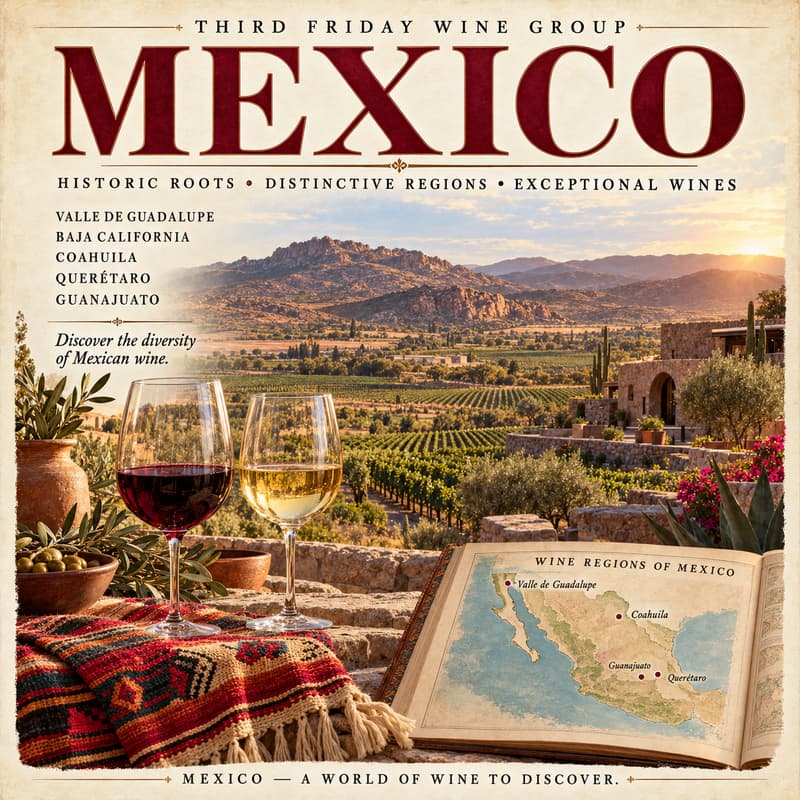
Third Friday Wine Group: Mexico
Congratulations to Sylvia, Helen, and Gonzalo, whose wines took the top three places in our Argentina tasting. Cabernet Franc won the evening, followed by two distinctive Malbecs.
First place: Sylvia
Staphyle Partida Limitada Cabernet Franc 2021
Second place: Helen
Catena Zapata Malbec Argentino 2022
Third place: Gonzalo
Mascota Vineyards Unánime Malbec 2023
First Place Sylvia
Staphyle Partida Limitada Cabernet Franc 2021
Cabernet Franc • Agrelo, Mendoza, Argentina
An expressive, savory red with cherry and dark-fruit flavors, wildflowers, herbs, and pepper. The style balances generous fruit with freshness and a lingering finish.
Partida Limitada means “limited batch.” These wines are made in small microvinification lots, and 2354 on Sylvia’s label is the individual bottle number.
Ratings context: The 2020 vintage received 93 points from Tim Atkin and 92 from James Suckling. Those scores apply to 2020, not the 2021 tasted here.
Wine details • Staphyle Cabernet Franc
Second Place Helen
Catena Zapata Malbec Argentino 2022
100% Malbec • Mendoza, Argentina
Undeniably the Winner for most expressive label. A fragrant, layered Malbec with violets, blackberry, blueberry, and spice, accented by chocolate and tobacco. Fruit from the historic Angélica and Nicasia vineyards gives this wine a strong connection to the Catena family’s history.
The illustrated label tells Malbec’s journey through four symbolic female figures: its French origins, migration to the Americas, devastation by phylloxera, and rebirth in Argentina.
2022 ratings: James Suckling 98 points • Tim Atkin 94 points
Wine and label story • Catena Zapata
Vintage ratings • Malbec Argentino
Third Place Gonzalo
Mascota Vineyards Unánime Malbec 2023
100% Malbec • Mendoza, Argentina
Once again, a value champion from Gonzalo. A rich, approachable Malbec with ripe plum and cherry, vanilla, cedar, and a silky texture. Fifteen months in French oak adds spice and roundness, with supple tannins and a generous finish. It’s available at Total Wine.
Winemaker Rodolfo “Opi” Sadler grew up in a winemaking family. Unánime means “unanimous,” reflecting a shared pursuit of harmony—a fitting name for a wine brought to a group tasting.
2023 rating: The Tasting Panel 93 points, as reported by Total Wine.
2023 review and rating • Total Wine
Wine and winemaker story • Cienfuegos
Wine descriptions summarize published tasting notes.
So last month’s winner, Sylvia Cavazos, has given us a new challenge. We actually did have Mexican wines 20 years ago at one of our tastings, but not explicitly as a theme. And be prepared: This will take some hunting around. Mexico ranks around 31st in global wine production, and remains a small exporter—helping explain why its wines take a little hunting to find abroad.
Any wine from Mexico counts: red, white, rosé or sparkling. Most Mexican wineries are small, and most of what they make is drunk at home, so only a slice of it reaches the U.S. Expect to pay anywhere from about $12 for an everyday L.A. Cetto to $40–60 for a top Valle de Guadalupe bottling.
L.A. Cetto, Bodegas de Santo Tomás, Casa Madero and Monte Xanic are the easiest names to find. If you want to impress the group, hunt down one of the boutique Valle de Guadalupe producers, such as Casa de Piedra, Adobe Guadalupe, Vena Cava, Bruma or Henri Lurton.
Incidentally, for Bunni’s offering, we bought the last bottle of 2019 Bodegas Henri Lurton Valle de Guadalupe Cabernet Sauvignon that AOC had on hand.
Baja California: The Heart of Mexican Wine
Most Mexican wine (estimates run from about 70% to 90%) comes from a cluster of valleys near the port of Ensenada, roughly 90 miles south of San Diego. Valle de Guadalupe is the star, with more than 150 wineries, and the Santo Tomás, San Vicente, San Antonio de las Minas and Ojos Negros valleys fill out the map. People like to call it the Napa Valley of Mexico.
The climate is Mediterranean: hot, dry summers cooled by Pacific breezes and morning fog, and so little rain that almost every vineyard is irrigated. The wines tend to be ripe and full-bodied, and many have a salty, mineral edge that locals credit to the sandy, granite-based soils.
Cabernet Sauvignon and the Big Red Blends
Bordeaux grapes are the backbone of Baja, with Cabernet Sauvignon and Merlot leading the way. The most exciting wines, though, are blends. Mexico has no appellation rules telling winemakers what they can plant or combine, so you’ll see Cabernet with Tempranillo, Syrah with Nebbiolo, or Grenache with Zinfandel in the same bottle. Monte Xanic, founded in 1987, kicked off the premium movement, and its Calixa blends are a good, widely available starting point.
Nebbiolo: Baja’s Mystery Grape
Almost every winery in Valle de Guadalupe makes a Nebbiolo, and it tastes nothing like Barolo. Instead of pale, rose-scented and tannic, Baja Nebbiolo is deep purple, ripe and dark-fruited. The vines are said to have arrived from Piedmont in the mid-1900s with their labels lost, and DNA tests on some old plantings have pointed to other Piedmontese grapes. Newer plantings of certified Nebbiolo exist too, so what’s in your glass depends on the vineyard. L.A. Cetto’s Reserva Privada Nebbiolo is the classic, affordable example, and it should make for a lively discussion.
Tempranillo, Grenache and Petite Sirah
Heat-loving Spanish and Rhône grapes do well here. Petite Sirah is one of L.A. Cetto’s signature wines: inky, peppery and inexpensive. Valle de Guadalupe also has old Grenache vines, some planted around 60 years ago by Russian immigrants who settled in the valley, and Tempranillo turns up both on its own and in blends.
The Whites: Chenin Blanc and Sauvignon Blanc
Chenin Blanc is one of Mexico’s most planted white grapes, usually made in a crisp, lightly honeyed style. Sauvignon Blanc from the cooler, higher valleys such as Ojos Negros and San Vicente is zesty and bright. Both are made for fish tacos, ceviche and aguachile.
Beyond Baja: Coahuila, Querétaro and the High Plateau
Central Mexico is much closer to the equator than most wine regions, and it’s altitude, just like in Argentina, that makes wine possible there. Vineyards sit at roughly 5,000 to 6,500 feet, where cool nights keep the grapes fresh. Valle de Parras in Coahuila is home to Casa Madero, whose Cabernet and Shiraz blends are easy to find in the U.S. Querétaro is Mexico’s sparkling-wine country, where the Spanish cava house Freixenet has a winery, and Guanajuato and Aguascalientes are building their own reputations.
A Little Mexican Wine History
Mexico is where winemaking in the Americas began. Spanish settlers were planting vines in the 1520s, and Casa Madero in Parras, founded in 1597, is the oldest winery in the Americas. Spain soon restricted new vineyards to protect its own wine exports, so for centuries winemaking survived mostly at the missions. Missionaries carried vines up the Baja peninsula, Bodegas de Santo Tomás opened in 1888, and the modern quality boom took off in Valle de Guadalupe in the 1980s and ’90s.
A few more facts: the Mission grape the Spanish brought over is the same variety as Argentina’s Criolla Chica and Chile’s País (its original name is Listán Prieto), so October and November are connected. Because Mexico has no formal appellation system, labels can list any grapes or regions the winemaker likes. And every August, Ensenada and Valle de Guadalupe celebrate the harvest with the Fiestas de la Vendimia.
Third Friday Wine Group Etiquette
I'm bringing a friend (or spouse). Do I bring one or two bottles?
Unless you expect to drink very little, or if the single bottle you have brought is quite special, it is generally expected that each person brings a bottle. It is also convention that in the event one bottle is expected to be better, the female companion gets that wine attributed to her. At least, that's what I do to preserve marital harmony.
With that said, as we get older we are more cognizant of safety for our participants, so please use your own judgement. Or, think ahead and use Uber or Lyft. And Waymo is coming! We love Waymo.
How should I bring my wine? In a bag? Naked?
When we first started out in 2002 we asked people to bring their wine in plain brown paper bags and write their name out the outside of the bag. Over time, we found that people enjoyed seeing what they were drinking so we switched over to affixing labels with the contributor’s name onto the outside of the bottle. So bring your wine naked.
When bringing a wine that is expected to be chilled, please bring it pre-chilled! We have limited facilities for chilling bottles here, and we have had bottles end up being forgotten in the freezer until late in the evening, by which time they’ve become winesicles. Don't let this happen to your contribution!
Where should I buy my wine?
The objective of the tasting is to try something different, so it pays to go a little further afield to specialist wine shops. Also, Central Market has surprising depth and breadth of selection, and many of you know Charles the Wine Tasting Guythere. We always let Charles know in advance what our theme is so he might be able to guide you. Also, we highly recommend the AOC Selections retail shop, which is a sister company to the Texas Wine School.
Is this a contest?
In the friendliest of ways, yes. Typically we will hand out little round sticky labels (three per guest) which you affix to your favorite bottles-- the People's Choice Awards. You can vote for any wine you wish with any or all of your three votes (including your own, though that is not totally “cricket”). We do not expect guests to be wine connoisseurs or experts. There are some experts in the group but they are pretty low-key about it. This is simply about which wine you like the most.
How much should I spend?
My general suggestion is in the $20-$30 range per bottle, unless the theme dictates otherwise. Sometimes that theme is “Best Wine Under $X”. Sometimes the theme requires raising the suggestion somewhat, as with Bordeaux , Champagne, or Amarone tastings. That said, the limit is not absolute. We have had a few crowd-pleasing wines under $15, and if you know of one that is particularly good, then go for it as we would like to learn about it. Likewise, if you are feeling particularly generous, we'll thank you for your contribution if you go over budget. But, it's not about keeping up with the Jones's. Or the Woods. Or the Ridlehubers.
Why do you ask for us to RSVP?
Before each tasting we need to provide security downstairs with a list of people coming into the building. While not absolutely required, this makes it easier for them to check people in and means they don't have to call up to our apartment to allow people in. Also, it is helpful for us to prepare the name labels in advance and judge how many snacks we need to prepare and what assistance we may need from wait staff.
Can I bring friends?
Please do! The group is all about people meeting other nice people in a comfortable surrounding. And as the evening progresses everyone gets very talkative. We have had some members in the group since its inception, and we also have new people every month. For us, it is a compliment to have so many people join the group each month. Just please let us know the names of your guests in advance so we can make necessary arrangements.
Should I bring food?
Please do! While we cannot provide a full meal, we do provide snacks to go along with the wine. Many of our friends also bring dips, fruits, chocolates, cheese, etc. Many people come to the tasting before proceeding out for dinner, or come pre-fed.
We’ve been doing this since 2002.