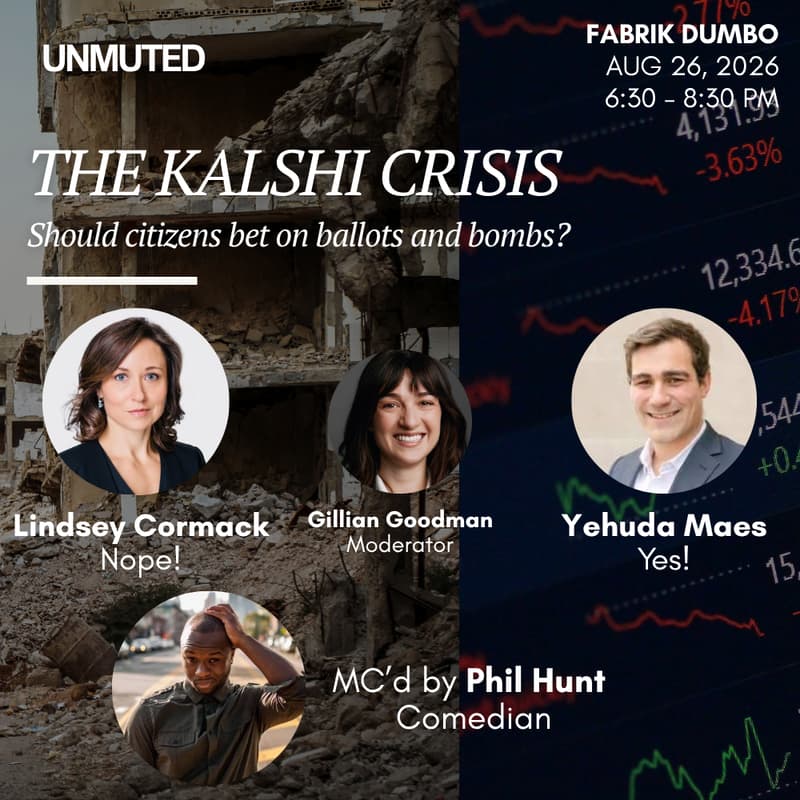


An UNMUTED Debate: Bets Over Baghdad, or Our Kalshi Crisis
DOORS OPEN AT 6:30, SHOW STARTS AT 7. Drinks included in ticket.
Polymarket processed $3.6 billion on a single presidential race. Kalshi just signed deals to pipe its odds into CNN and CNBC broadcasts. Bloomberg Terminal now carries prediction-market prices on the same screens as oil futures. The contracts run 24/7 the way commodities do: presidential races, congressional control, ceasefire dates, war casualty counts. A few clicks gets you long a candidate, short a hostage release, or a position on whether a sitting senator survives the year. Kalshi's CEO says the goal is to "financialize everything." He's most of the way there.
So: are prediction markets the most honest reading of civic life we've ever built, or the corruption of every outcome they touch?
For the prosecution, the answer is obvious. Some things shouldn't be priced. The moment you can profit from a war dragging on or an election going a particular way, you've created an incentive to make it so...and handed the deepest pockets in finance the keys to a democracy they were already overrepresented in. Markets that pay you for predicting an assassination attempt aren't predicting anything. They're paying people to think about it. A republic that lets citizens hedge against its own outcomes isn't a republic with better data. It's one that has quietly outsourced its civic life to traders.
For the defense, that's squeamishness dressed as principle. These markets aggregate information better than polls, better than pundits, better than the press. They put skin in the game on claims that have lived consequence-free for decades. Banning them doesn't make wars or elections less consequential, it just hands price discovery to offshore platforms, foreign capital, and worse actors. Polymarket and Kalshi aren't corrupting civic life. They're the first honest reading of it we've ever had.
One side says the market is the truth. The other says some truths shouldn't have a market.
Lindsey Cormack, PhD, is an Associate Professor of Political Science at Stevens Institute of Technology and the author of How to Raise a Citizen (And Why It's Up to You to Do It). She runs DCinbox, which has archived every email Congress sends its constituents for over a decade, and contributes to the New York Times, Washington Post, Bloomberg, FiveThirtyEight, and Fox News. Her entire career argues that being a citizen is something you practice, not something you trade: that civic life has to be built deliberately, in households and classrooms, not aggregated through the same mechanisms that price pork bellies.
Yehuda Maes is a Harvard Law grad ('23), former Bain consultant, former Citadel Securities trader, and has run client engagement at Norm AI, anthe AI company building legal and compliance infrastructure for institutional finance. Before all of that he was a Sergeant in the IDF and a BlackRock analyst. He's spent his entire adult life inside the machinery that puts a price on sovereign debt, legal risk, and roughly everything else. He thinks that's a feature, not a bug. He's the perfect defendant.
Two perspectives. One night. And probably a few people in the room with open positions they shouldn't admit they have.
Moderated by Gillian Goodman, a Columbia Journalism School grad whose work has appeared in The Intercept, Truthout, Prism, and Democracy Now!, with features in Vanity Fair and New York Magazine. She covered the Columbia encampments from the first days and elections in coastal Georgia from inside the precincts. She knows the difference between calling a race and calling a price. Let's get it on. Drinks provided.
Accessible. Engaging. Social. UNMUTED is the place where talking points go to die. Talk politics. Keep your friends. Make new ones.