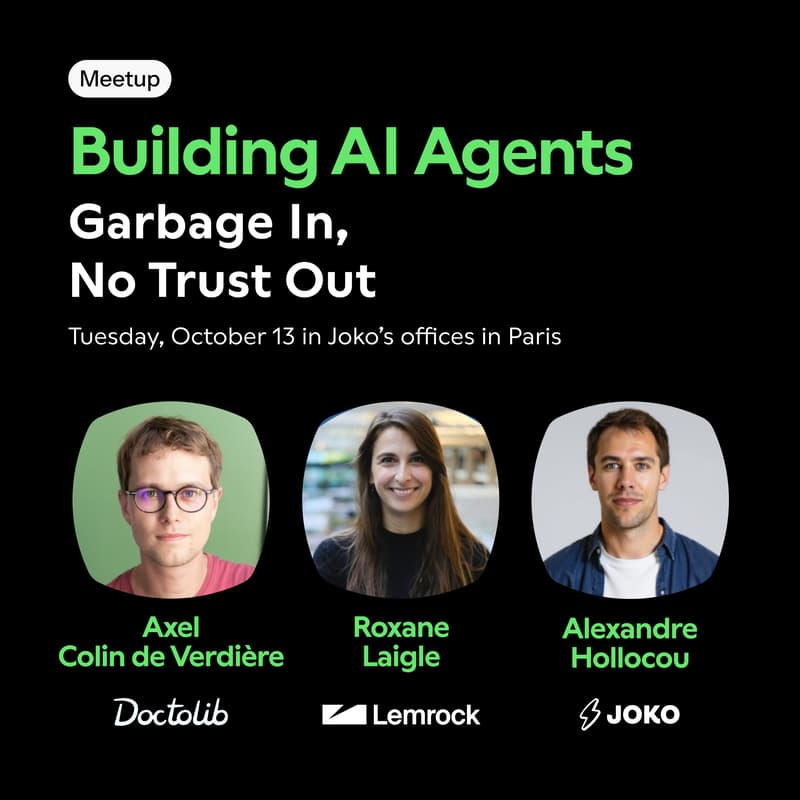
Building AI Agents: Garbage In, No Trust Out
An AI agent is only as good as the data it's built on.
A lot of focus is placed on AI models and agent harnesses. Talk to anyone actually running an AI agent in production, though, and they'll tell you that the real bottleneck, and the real moat, is the data underneath it.
For an AI shopping agent, get the price wrong, recommend a product that's out of stock, or miss a product entirely, and trust disappears instantly. For an AI health agent, cite an unreliable source or give a non-expert guidance, and the stakes are even higher.
The data problem is a major bottleneck behind many AI agents currently in production. And it doesn't stop at sourcing clean data: a major problem is closing the loop: evaluating where an agent gets it wrong, and feeding that back to continuously improve the data and/or the agent harness itself. AI increasingly plays a role on both sides of that loop: cleaning and standardizing data at scale, and evaluating the agent's own outputs.
Three companies, three very different stakes, one shared problem:
Joko is building Juno, an AI shopping assistant over a universal catalog of hundreds of millions of products — where the right price, the right stock, and the right coverage are the whole game.
Doctolib is building an AI health assistant for millions of users, where every answer must be grounded in verified sources and user data must be handled with the highest privacy.
Lemrock is building the infrastructure for agentic commerce, connecting hundreds of brands to the entire conversational market through a single integration and solving the trust problem from the supply side.
Program
18:45 — Doors open
19:00 — Panel with:
Axel Colin de Verdière — Engineering Director at Doctolib, working on the AI health assistant.
Roxane Laigle — Co-founder & CEO at Lemrock.
Alexandre Hollocou — Co-founder & CTO at Joko.
19:45 — Q&A
~20:00 — Drinks, snacks & networking 🍻