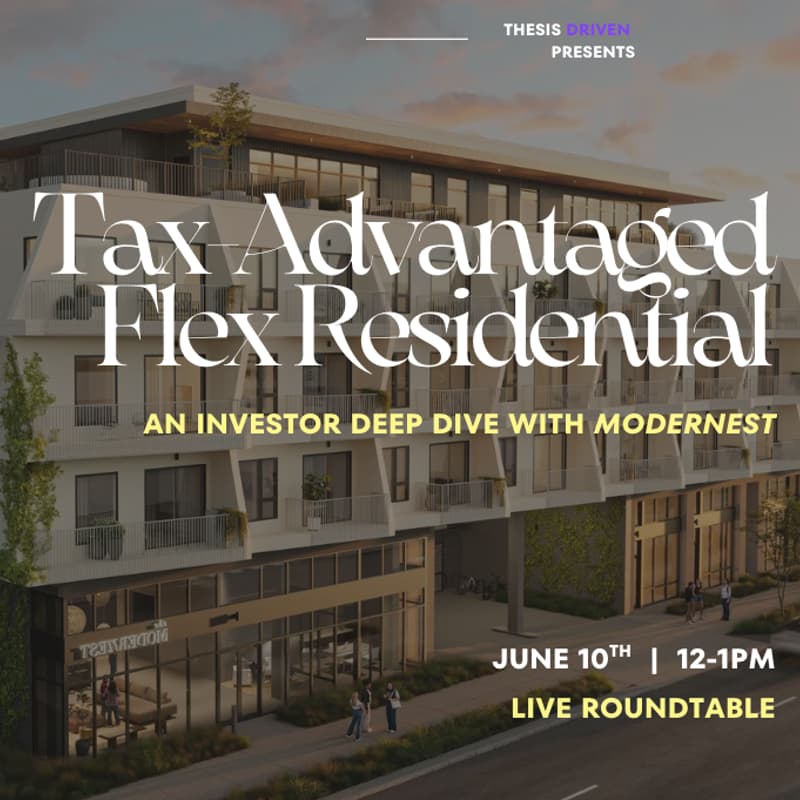

Tax-Advantaged Flex Residential: A Deep Dive on ModerNest
Date & Time: Wednesday, June 10th | 12PM - 1PM EST
Hosted by: Thesis Driven
Most tax-advantaged real estate products that cross the desks of high-net-worth investors look the same: LP stakes in multifamily syndications, passive interests in opportunity funds, cost-segregation studies stapled to industrial deals. The structures work — but the products are institutional, faceless, and built for allocators, not for private wealth investors who want to deploy capital into something they can actually use.
ModerNest was built for a different kind of buyer: one who wants the tax mechanics of an institutional vehicle wrapped around a real asset in a real place — something they can walk through and generate income from when they're not there.
The Investment Structure
ModerNest is not a lifestyle product with tax benefits bolted on. It is a triple-stacked tax-advantaged investment vehicle — and a hospitality-grade residence is the delivery mechanism.
Opportunity Zone Designation Both ModerNest properties sit in federally designated Opportunity Zones. Investors who deploy eligible capital gains can defer recognition of those gains and, if held for ten years, eliminate taxes on any appreciation in the property itself. For a buyer sitting on a seven-figure gain from a business sale, stock liquidation, or cryptocurrency exit, the OZ designation converts a taxable event into a tax-advantaged entry point for real estate ownership.
Bonus Depreciation & Cost Segregation A cost segregation study reclassifies components of the residence into shorter depreciation schedules, allowing the owner to accelerate paper losses that offset taxable income in year one — the same mechanic institutional investors use in multifamily and industrial deals, applied to an asset the buyer can actually walk through.
1031 Exchange Eligibility ModerNest residences qualify for like-kind exchange treatment. An investor rotating out of a rental property, a small commercial building, or a passive NNN lease can roll proceeds into a ModerNest unit without triggering a tax event — opening the buyer pool to the much larger universe of real estate investors actively managing portfolios.
Stack all three and the return profile diverges sharply from a conventional condo purchase: accelerated depreciation on operations, rental income, and long-term appreciation — with OZ benefits providing additional upside for eligible investors in one of the fastest-growing metros in the country.
The Delivery Mechanism
What makes the tax structure produce real after-tax returns is the asset itself. Each ModerNest residence operates in three modes: a primary or secondary home, a part-time retreat that generates rental income when the owner is elsewhere, or a full-time short-term rental operated as a pure investment. Owners toggle between modes as their needs change.
The operational layer is Victory Living Group, a hospitality-driven property manager handling dynamic pricing, booking platform marketing, and guest services at 12% of STR revenue — meaningfully below what full-service hotel operators charge. ModerNest units also carry an exclusive Airbnb licensing agreement, a structural advantage as Nashville tightens its STR permitting framework.
Two properties are under construction now: 129 residences in Wedgewood-Houston and 131 in Gulch View, with deliveries beginning in early 2027. Both sit in federally designated Opportunity Zones.
Join us for a 60-minute live conversation with the ModerNest team as we examine how hospitality-driven flexible ownership works in practice, what the tax and return profile looks like for real investors, and whether the model is replicable across other high-growth, tourism-driven metros.
In this session, we'll cover:
The OZ, bonus depreciation, and 1031 stack — and what the after-tax return profile looks like compared to a conventional condo
Why flexible ownership is the delivery mechanism that makes the tax vehicle work for private wealth buyers
Inside ModerNest: hospitality-grade design, Victory Living Group operations, and the Airbnb licensing advantage in a tightening STR permit environment
Nashville's population growth, tourism economics, and events pipeline — and why it's the ideal market for this model
How ModerNest plans to scale the model beyond Nashville
Speakers Include:
The Team
Heather Gustafson — ModerNest
The Interviewers
Paul Stanton, Thesis Driven
Brad Hargreaves, Thesis Driven
Register now to hear how ModerNest is building the tax-advantaged residential product that private wealth investors have been missing — and why the residence is just the beginning.