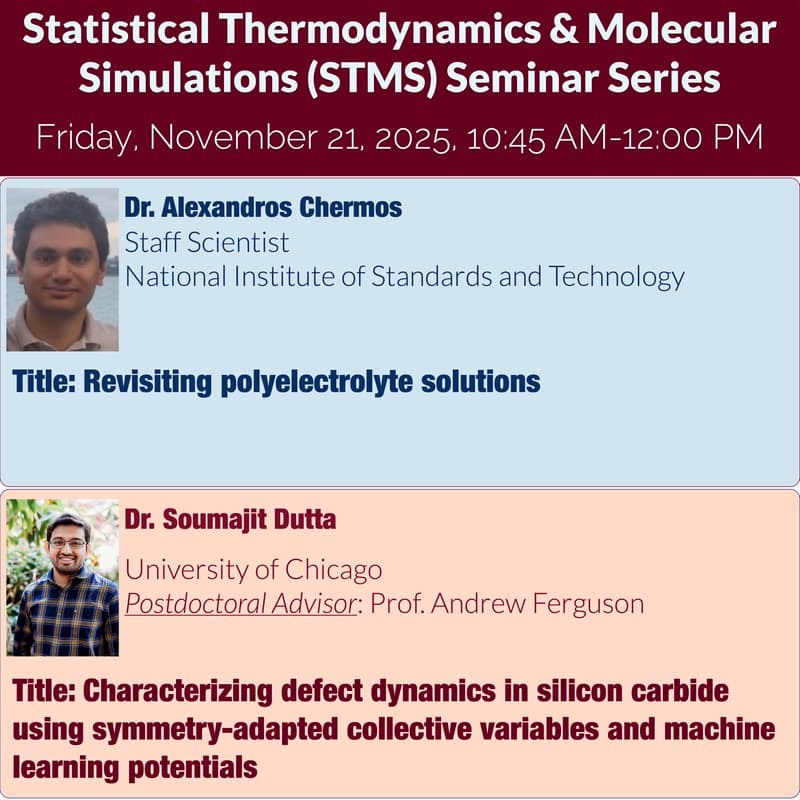
Statistical Thermodynamics & Molecular Simulations (STMS) Seminar Series: Prof. Alexandrox Chremos (NIST), Dr. Soumajit Dutta (Chicago)
These seminar series are aimed at providing a virtual platform for sharing scientific research in the area of statistical mechanics, molecular simulations, and computational materials science. Since early 2020, the coronavirus pandemic has disrupted many large in-person scientific gatherings, including conferences and department seminars. STMS is aimed at filling this gap, and provide a venue for dissemination of research findings and exchange of ideas in the age of COVID. This model is being currently used by several other scientific communities, and can potentially continue even beyond the pandemic if successful.
Each seminar will be a 60-minute event and will comprise of a long-form (30-minute) talk by a principal investigator or a senior research scientists from academia or industry and a short-form (15-minute) presentation by a graduate student or a postdoc. The remainder of the event will be dedicated to Q&A (10 minutes for the PI, 5 minutes for the student/postdoc). Long-form speakers will be chosen by the STMS Organizing Committee, while we encourage suggestions from the community at large. Student and postdoctoral speakers can either be nominated by their advisors or can self-nominate themselves by sending a CV to the organizers. During 2022 we expect to hold two seminar per month, and the events will take place in the last two Fridays of each month, from 10:45 AM-12:00 PM Eastern Standard Time (EST):
This event's talks:
Revisiting polyelectrolyte solutions
Prof. Alexandros Chremos (National Institute of Standards and Technology)
Abstract: We examine the nature of structure formation in polyelectrolyte solutions in light of findings from the past decade that challenge the theoretical foundations traditionally used to understand these systems. Using molecular dynamics simulations with a minimal model that includes explicit solvent molecules and counterions, we compare our results with experimental Small-Angle Neutron Scattering data and find excellent agreement. In contrast to conventional theories, which assume the solvent plays only a minor role and predict largely homogeneous structures, we show that solvent-mediated solvation asymmetry of charged species is the key driver behind a diverse range of heteronuclear structures and the mechanisms that generate them. We further applied our findings to other systems, including charged nanoparticles and colloids as well as electrolyte solutions, where they allowed us to clarify long-standing puzzles such as void formation in colloidal suspensions and the origins of the Hofmeister series.
Speaker Bio:
2000-2004: BSc Mathematical Physics at the University of Edinburgh
2005-2009: PhD under Prof. Philip Camp in Chemistry [Polymer Physics] at the University of Edinburgh [topics: polymer architecture and polymer adsorption]
2009-2012 postdoc at the Chemical Engineering at Princeton University under Prof Thanos Panagiotopoulos [topics: thin films of block copolymers under shear and structure and dynamics of polymer-grafted nanoparticles in the absence of solvent]
2012-2014 postdoc at the Chemical Engineering at Imperial College with George Jackson [topics: SAFT equation of state in carbon capture applications]
2015-2019 Fellowship postdoc with Jack Douglas at the National Institute of Standards and Technology (NIST) [topics: (poly)electrolyte solutions, glass transition, hyperuniformity]
2019-2023 NIH collaborating with Ferenc Horkay and Peter Basser [topics: polyelectrolyte gels]
2023-present back at NIST [topics: a little bit of everything, but mostly on bridging equation of states with molecular simulations]
Characterizing Defect Dynamics in Silicon Carbide Using Symmetry-Adapted Collective Variables and Machine Learning Potentials
Dr. Soumajit Dutta (University of Chicago)
Abstract: Solid-state spin defect of SiC crystal present attractive target as a qubit with long coherence time for quantum information science. However, high activation barriers of SiC defect dynamics create a formidable task to study these processes with first principle molecular dynamics. We train and deploy machine learning interaction potentials to accelerate defect dynamics simulations while maintaining ab initio accuracy. The performance of these potentials hinges on capturing the distribution of atomic local environments in the training data.
We adopt an active learning approach to systematically explore these environments, focusing on defects. Importantly, the indistinguishability of C and Si atoms around defects necessitates collective variables (CVs) that respect the translational, rotational, and permutational symmetries of the crystal. To achieve this, we employ the Permutationally Invariant Networks for Enhanced Sampling (PINES) approach, which integrates Permutation Invariant Vector (PIV) features with regularized autoencoders to discover symmetry-adapted CVs.
Using our trained force field, we achieve density functional theory (DFT)-level accuracy in predicting defect transition free energies and charge effects in defect dynamics. Furthermore, by employing Markov state modeling, we analyze the thermodynamics and kinetics of defect transitions across various temperatures, providing insights into the selective formation of divacancies. Our results contribute to the fundamental understanding of SiC defect behavior and offer a computational framework to guide the controlled synthesis of spin defects for quantum technology applications.
Speaker Bio: Soumajit Dutta is a Postdoctoral Researcher in Prof. Andrew Ferguson’s lab at the Pritzker School of Molecular Engineering, University of Chicago. His research develops data-driven methods to improve the accuracy and efficiency of molecular simulations, with applications in computational chemistry and biophysics. He earned his Ph.D. in Chemical and Biomolecular Engineering from the University of Illinois at Urbana-Champaign, where he studied the molecular mechanisms of cannabinoid receptor regulation under Prof. Diwakar Shukla. His doctoral research and teaching contributions have been recognized with several honors, including the Chemical Computing Group Excellence Award at the ACS National Meeting and the Mavis Future Faculty Fellowship.