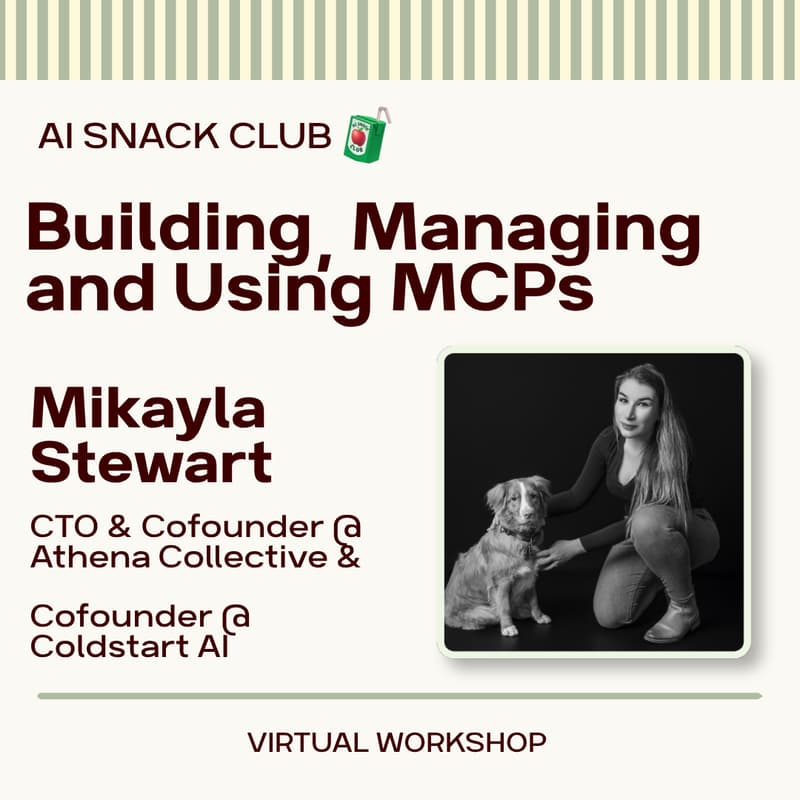

Building, Managing and Using MCPs
Every product you use is shipping an MCP server right now. There's a reason for that, and it isn't only that the technology is good.
Hear from Mikayla Stewart as she talks through the actual business logic behind the land-grab, because it explains why some of these servers are excellent and a lot of them are thin wrappers nobody maintains. That context is what lets you tell the difference before you wire one into your workflow. Then the practical half. I built and shipped the MCP server that runs Athena Collective's internal operations: seventeen tool modules across accounts, pipeline, invoices, deliverables, tasks, events and members, running in Docker behind hashed, revocable API keys, with role-based tool permissions and an audit record on every call. Our team uses it daily through Claude Desktop.
What we will cover:
How its built
The actual costs
Forty minutes of content, then 20 minutes of open Q&A. Bring your half-built server or your "should I even bother" question.
You'll leave with:
An honest read on why vendors are pushing MCP servers, and how to spot a maintained one from a launch-week one
The build path: the three primitives, tool design, and why tool descriptions are the only documentation a model ever reads
A decision framework for build versus adopt, with the specific conditions that push it either way What ongoing management really involves: auth, permission gating, audit trails, and what breaks when the upstream API changes. The trust checklist for running a third-party server against your own credentials
Prerequisites this is aimed at people who write code, or who make build-versus-buy calls for people who do.
You don't need to have built an MCP server.
You should be comfortable with a REST API and the general idea of a JSON schema. If you want a no-code overview of what MCP is, this will move faster than you want.
Please note this event is only open to AI Snack Club paying members. To join, sign-up here: aisnackclub.com