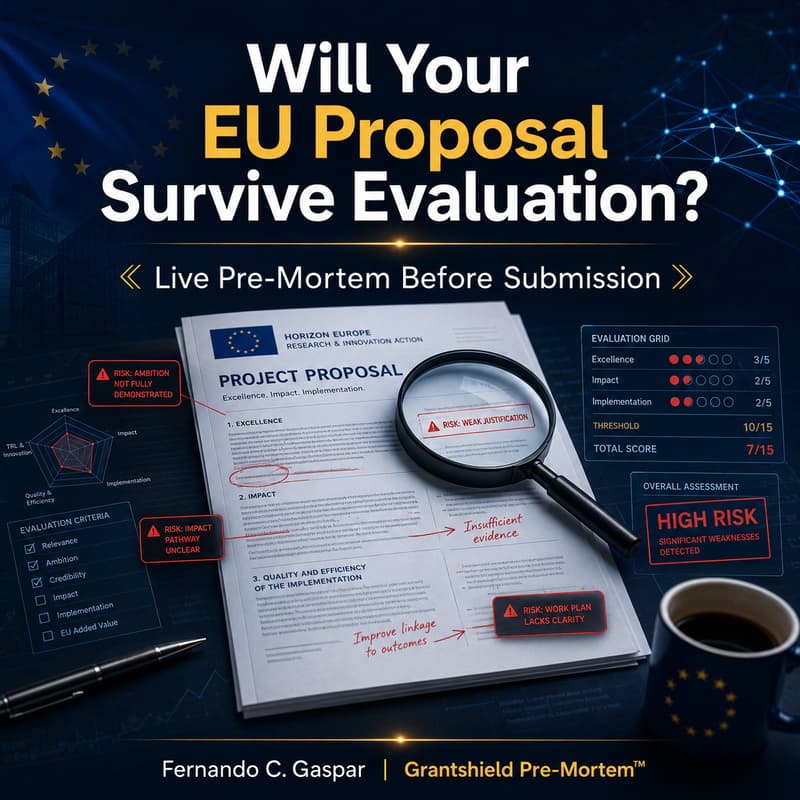
Will Your EU Proposal Survive Evaluation?
Live Pre-Mortem Before Submission
Most EU proposal teams keep polishing the text until the deadline.
But evaluators do not score polish.
They score clarity, coherence, credibility, impact logic and implementation confidence.
In this live session, I will apply a Pre-Mortem method to a fictional Horizon Europe proposal and show where it may lose points before an evaluator ever sees it.
We will stress-test the proposal across Excellence, Impact and Implementation, looking for hidden downgrade triggers such as weak impact logic, unclear work package alignment, decorative consortium roles, vague KPIs, overpromising and implementation gaps.
You will not need to share your own proposal.
The session uses a fictional draft, designed to feel realistic enough for proposal teams to recognise risks in their own work.
What you will learn
You will learn:
why strong-looking proposals still lose points
how to identify structural risks before submission
what evaluators may punish even when the writing looks good
how to prioritise fixes when the deadline is close
when a proposal needs an independent Pre-Mortem review
Who should attend
This session is for:
Horizon Europe coordinators
proposal writers
EU project managers
research and innovation offices
consortium leaders
consultants supporting proposal teams
teams submitting an EU proposal in the next few weeks
Agenda
Why good proposals still lose points
The fictional proposal: call, consortium, objectives, work packages and impact claims
Live Pre-Mortem across Excellence, Impact and Implementation
The 5 hidden downgrade triggers
What to fix first when the deadline is close
When to do it yourself and when to request an independent Pre-Mortem
At the end, I will also explain when it makes sense to request a 15-minute Grantshield Pre-Mortem Fit Check for an advanced draft.
This session is especially relevant for teams with EU proposal deadlines approaching soon.
Speaker bio
Fernando C. Gaspar is an economist, professor at ISCAL, author of Transition Science in the Economy, host of InnovEU - The EU Project Chronicles, and author of Polis Doxa - The Transitions Letter.
He works on economic transitions, EU innovation, proposal strategy and the structural risks that shape funding, competitiveness and resilience.