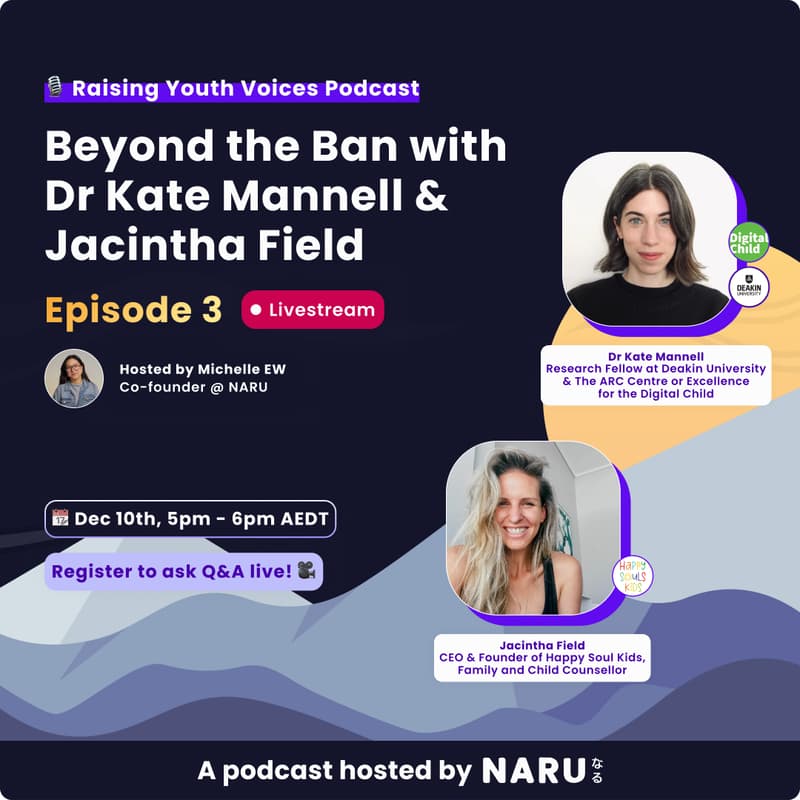

Beyond the Ban - Episode 3 with Dr Kate Mannell & Jacintha Field
Register to receive a link to the podcast recording after the session. 🎥
Join Dr Kate Mannell and Jacintha Field for a conversation about children's digital experiences, online safety, screen time and what parents, educators and youth organisations need to understand.
Beyond the Ban: Are We Preparing Children for the Digital World?
Restricting access to social media might change where children spend their time online. But does it address everything we should be concerned about?
Parents are constantly told to monitor screen time, set boundaries and protect their children from the dangers of the digital world.
But children's digital experiences go far beyond the number of hours they spend on a device.
From online friendships and entertainment to exposure to strangers, inappropriate content and the emotional challenges of growing up in a connected world, there are bigger questions about what children encounter online and how prepared they are to navigate it.
Australia's under-16 social media restrictions have reignited this conversation.
But what happens when we focus so much on restricting access that we overlook the importance of emotional development, digital literacy and the relationships that help children feel safe enough to ask for help?
Is the goal simply to keep children away from certain platforms?
Or should we be doing more to prepare them for the digital world they are growing up in?
Meet the Guests
Dr Kate Mannell is a Research Fellow in Digital Childhoods at Deakin University and the ARC Centre of Excellence for the Digital Child.
Her research examines everyday digital technology use, particularly among families and young people, and how public conversations shape our understanding of children's relationships with technology.
She is the author of Screen Time and the Impossibility of Modern Parenting (Routledge, 2026), which examines how popular conversations about children and screens are shaped by often unrealistic expectations of modern parenting.
Her current research spans parenting culture, social media, child health communication and youth media practices. She has published in journals including New Media & Society, Journal of Children and Media and Social Media + Society.
Her work has also been featured in The Atlantic, BBC, The Guardian and ABC Radio National.
Jacintha Field is a Family and Child Counsellor and the founder and CEO of Happy Souls Kids.
Through her private counselling practice and Happy Souls Kids, Jacintha works with children and families to strengthen parent-child relationships and develop emotional skills from an early age.
Happy Souls Kids is a digital platform that uses the influence of children's heroes, including elite athletes, to make emotional wellbeing education engaging and accessible.
Her work focuses on helping children understand their emotions, develop self-regulation, build resilience and navigate relationships and conflict.
Jacintha believes protecting children in a digital world requires more than restricting access to platforms. It also means equipping them with the emotional skills to recognise risks, communicate when something feels wrong and seek support from trusted adults.
Together, Kate and Jacintha bring research and practical experience to an important question: How do we move beyond restricting children's digital access towards creating environments where they can feel safe, connected and supported?
What we'll explore
Are we asking the right questions about screen time?
We often measure children's digital experiences by how many hours they spend on screens. But does screen time tell us enough about what children are actually doing online?
What should parents and policymakers be paying attention to instead?
What are children really being exposed to online?
The conversation about online safety often focuses on social media platforms. But children encounter digital risks in other online environments too.
What should parents understand about the spaces children use, including gaming platforms, and where does greater platform accountability become necessary?
Are we expecting too much from parents?
Parents are expected to monitor devices, supervise online activities and protect children from digital harm, often while navigating conflicting advice.
Are we placing too much responsibility on families for problems that are also shaped by technology companies and wider society?
Is restricting access enough to protect children?
Australia's under-16 restrictions are designed to address concerns about young people's social media use.
But what happens beyond the restrictions? How do we ensure children are developing the skills and support systems they need to navigate digital environments as they grow?
What role does emotional development play in online safety?
Helping children understand their emotions, regulate their responses and communicate when something feels wrong can be an important part of keeping them safe.
How can parents and educators build these skills early, and why does the parent-child relationship matter?
What should we be building instead?
If we want children to grow up in a safer digital world, what needs to change?
From better-designed platforms and greater accountability to stronger family connections and emotional wellbeing education, what should organisations, parents and policymakers prioritise?
Who should attend?
This conversation is for people who work with, care about or design for young people:
Parents and carers
Educators and school leaders
Youth organisations and youth workers
Community builders
Researchers and policymakers
People working in youth wellbeing and digital safety
Anyone trying to understand how young people will build connection in a changing digital world
You don't need to work in technology to join the conversation.
If young people are part of your work, this conversation is for you.
About NARU
NARU is exploring what safe digital community can look like for young people in a world where the way they connect online is changing.
We believe young people still need places to build friendships, find belonging, learn from their peers and participate in communities.
The question is what those spaces should look like.
That means listening to the people closest to the issue, young people, parents, educators, youth organisations, researchers and community leaders.
This conversation is part of that work.