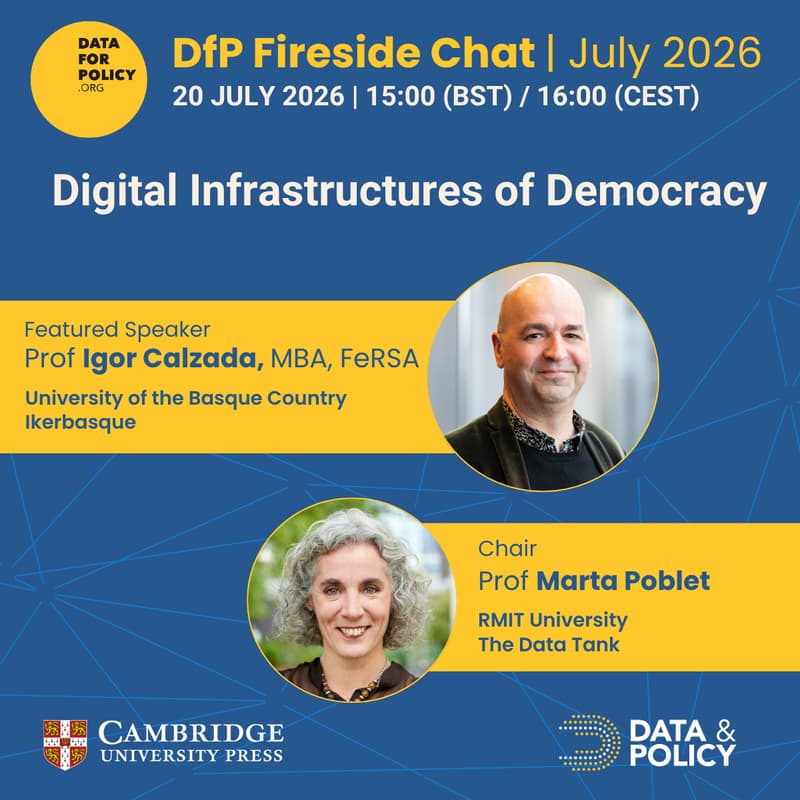
Data for Policy July Fireside Chat: Digital Infrastructures of Democracy
Digital Infrastructures of Democracy
Featured Speaker: Prof. Igor Calzada, MBA, FeRSA
Session Chair: Prof Marta Poblet
Digital infrastructures—including AI systems, digital platforms, data governance, and algorithmic decision-making—are increasingly shaping democratic participation, public institutions, and accountability. Far from being neutral technologies, they reflect political, economic, and societal choices about ownership, control, and public value.
The upcoming Data for Policy fireside chat will explore the ideas presented in the recently published Oxford Research Encyclopedia of Science, Technology, and Society article Digital Infrastructures of Democracy. The discussion will examine how AI, datafication, and computational infrastructures are transforming democratic governance, with particular attention to digital sovereignty, data governance, trustworthy AI, data cooperatives, and the role of public value in building democratic resilience.
Drawing on Prof Calzada's broader research, including Datafied Democracies & AI Economics Unplugged: Technopolitics in Smart Cities and Datafied Network States, and the Data & Policy paper The Illusion of the Web3 Decentralization, the conversation will also consider emerging approaches to democratic AI governance, including the Digital Metropolis paradigm, EcoTechnoPolitics, and Anticipatory AI Governance. These themes are illustrated through comparative international research and the evolving Basque model of anticipatory regional governance, recently accepted by the Cambridge Journal of Regions, Economy and Society, highlighting how city-regions can act as laboratories for democratic innovation under conditions of AI-driven transformation.
The session will conclude by addressing a central question for the Data & Policy community: How can democratic institutions design and govern digital infrastructures that strengthen public value, democratic legitimacy, and resilience in the age of AI?
Please note that this session will be recorded and shared on the Data for Policy YouTube channel. Cameras off are welcome; active participation is warmly encouraged.
Prof. Dr. Igor Calzada, MBA, FeRSA, is a Full Professor in Social Sciences and Humanities and Established Researcher (R3) (www.igorcalzada.com/publications). He works as Principal Investigator in Ikerbasque (Basque Foundation for Science) at the University of the Basque Country, Public Policy & Economic History Department (Spain) as well as at Cardiff University/WISERD (UK), being since 2022 Fulbright Scholar in California (USA) collaborating as Fellow with Decentralization Research Centre (Canada). He is currently an Invited Professor at Warsaw School of Economics SGH (Poland), Indian Institute of Technology ITT Delhi (India), and Budapest University of Technology and Economics BME (Hungary). For a decade (2012–2022), he has been Senior Scientist at the University of Oxford, European Commission DG Joint Research Centre, UN-Habitat, and has held academic positions in 14 universities worldwide (particularly, UK, USA, Belgium, Italy, and Spain). From 2002–2011, he worked at Mondragon Cooperatives and held a Director of Innovation & Technology position in the Basque Government (Spain). His research currently revolves around how decentralization as a paradigm shift can change the course of data-opolies and AI through emerging Web3 Decentralized Technologies including case studies in different fields around Blockchain, DAOs, and Data Co-operatives. Google Scholar: 4808 citations, h-index 32, and i10-index 66. He has been nominated as Apolitical’s 100 Most Influential Academic in Government.
Session Chair:
Marta Poblet is Senior Research Lead at the Data Tank and Adjunct Professor at RMIT University. Prior to that, she was a Professor at RMIT University’s Graduate School of Business and Law. She is one of the co-founders of the Institute of Law and Technology at the Autonomous University of Barcelona and past researcher at ICREA (Catalonia). She holds a JSD in law (Stanford University 2002) and a Master in International Legal Studies (Stanford University 2000). Her research interests cover different areas at the intersection of law, political sciences, and technology, with a focus on data, AI, distributed technologies, human-computer interaction, and the different theories of democracy and citizenship. She has been the PI of a number of national and international research projects and has published over 80 scientific articles and book chapters on these topics.