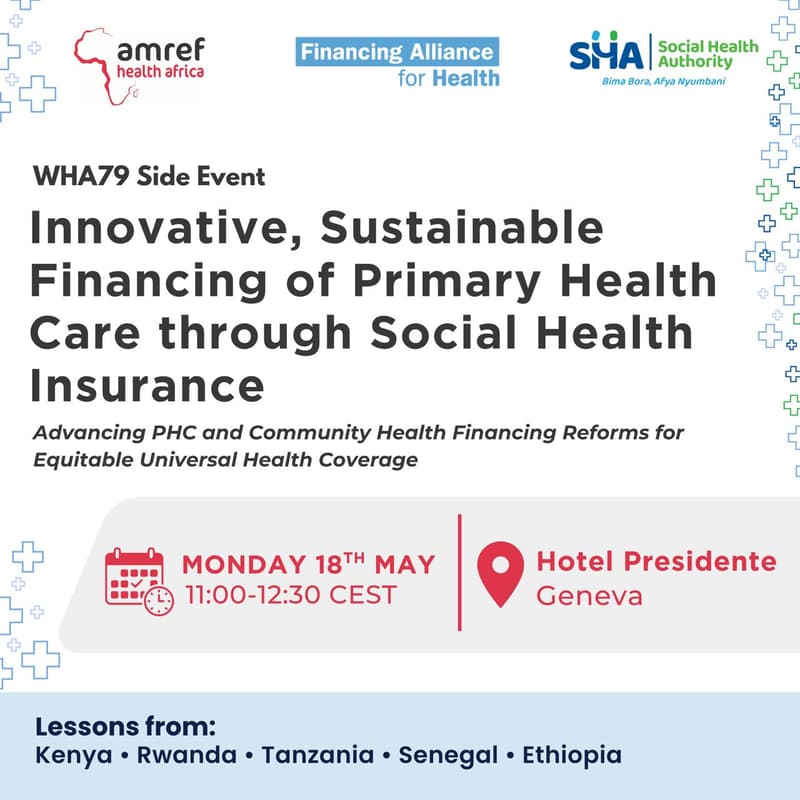

Innovative, Sustainable Financing of Primary Health Care through Social Health Insurance
Robust, sustainable financing for Primary Healthcare (PHC), including Community Health Services (CHS) remains one of the most urgent and consequential priorities on the path to Universal Health Coverage. Social Health Insurance (SHI) has emerged as a promising mechanism to mobilize domestic resources, strengthen pooling arrangements, and strategically purchase services. Yet its potential to transform PHC delivery will only be realized if community health is deliberately embedded within SHI design, not left as an afterthought.
This session explores how Kenya, Rwanda, Ethiopia, Tanzania, and Senegal are leveraging SHI to strengthen PHC, with a particular focus on community health systems. It proposes a practical, scalable approach for integrating PHC and community health into SHI reforms as an explicit, contracted, and strategically purchased service platform — anchored in three design principles: (i) coherent pooling arrangements that reduce fragmentation; (ii) an explicit PHC and community benefit package at zero or minimal point-of-service payment; and (iii) blended provider payment that creates predictable funding for frontline teams while rewarding performance and assuring commodity availability.
The rationale for this integration is fourfold. First, PHC and community health are public goods: essential services like prevention, health promotion, and outbreak detection risk chronic under-provision if financing depends on out-of-pocket payments, making it essential that SHI covers CHW remuneration, training, supervision, and supplies as core programme elements. Second, hospital-focused SHI designs widen inequality — concentrating benefits on facility care drives late presentation and higher costs, while a PHC-first model aligns incentives with equity and efficiency. Third, financial protection gaps remain stark: out-of-pocket expenditure accounts for 46.3% of total health spending in Ethiopia, 27.9% in Tanzania, and 24.0% in Kenya, underscoring the urgency of SHI-financed community services to reduce catastrophic spending on medicines and basic care. Fourth, country reforms are already creating integration pathways — Kenya’s PHC Act, Rwanda’s PBF framework, Tanzania’s pooling reforms, and Senegal’s CMU initiative all illustrate the legal and institutional openings available to embed PHC within SHI systems.