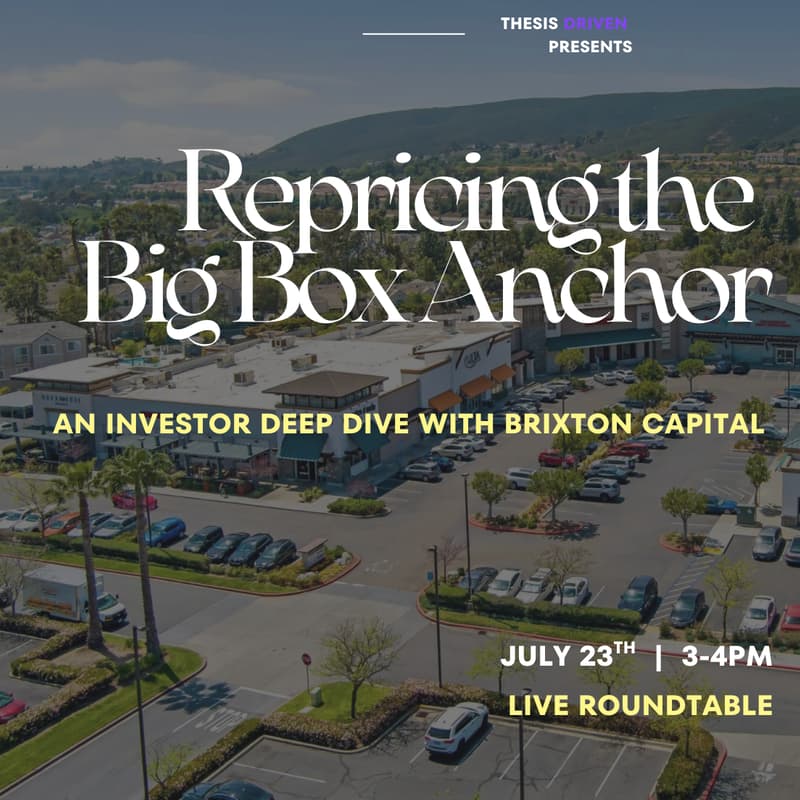

Repricing the Big Box Anchor: A Deep Dive on Brixton Capital
Date & Time: Thursday, July 23rd | 3PM - 4PM EDT
Hosted by: Thesis Driven
Over the past decade, most investors chasing retail real estate focused on small-box strip centers tenanted with concepts e-commerce couldn't replicate, like restaurants, salons, medical clinics and pet groomers. They avoided anchor tenants and big boxes altogether.
Brixton Capital have taken a contrarian view — believing there is serious alpha in big box investing, if approached properly — and it's paid off.
Based in San Diego, Brixton has focused on grocery-anchored and nationally tenanted big-box retail — the segment most of the industry spent a decade walking away from.
Institutional capital avoided the category so long that cap rates on high-quality anchored product widened to levels that no longer reflect the underlying fundamentals, even as small-box compressed toward 5-6 percent.
The market case against anchors rested on a version of these tenants that no longer exists. The weakest national retailers — Bed Bath & Beyond, Pier 1, Toys "R" Us, Circuit City — are gone.
The survivors have healthier balance sheets and clearer competitive advantages than at any point in modern retail history. A Best Buy runs Geek Squad installations and a healthcare division out of the same box. A Kroger ships 70 percent of its online orders from the physical store. The relocation friction on tenants like these is categorically different from a traditional retail lease.
Join us for a conversation with the Brixton Capital team on why anchor-tenant retail is being repriced, what Blackstone's $4 billion bet on grocery-anchored centers signals for the category, and why the pricing window may not stay open much longer.
In this session, we'll cover:
Why institutional capital spent a decade avoiding anchor tenants and big-box retail — and why that fear no longer matches the fundamentals
How surviving national retailers (Best Buy, Petco, Kroger, Publix, Dick's Sporting Goods) transformed into multi-revenue platforms with services, healthcare, and fulfillment built into the same box
Why store-based fulfillment (Target at 97%, Dick's at 90%) makes anchor tenants structurally dependent on their physical locations
How historically low new supply and near-record-low vacancy are creating a structurally supply-constrained market for existing centers
What Blackstone's $4 billion take-private of ROIC signals about institutional capital following Brixton's thesis
How Brixton underwrites and re-tenants anchor boxes, from Bed Bath & Beyond backfills to a former Walmart converted into Ace Pickleball
Speakers Include:
The Team
Grant Brutten – Brixton Capital
Rob Taylor – Brixton Capital
The Interviewers
Brad Hargreaves – Thesis Driven
Paul Stanton – Thesis Driven
Register now to hear how Brixton Capital is underwriting the repricing of anchor-tenant retail — and why the survivors of the last decade's shakeout are becoming the most attractive trade in commercial real estate.