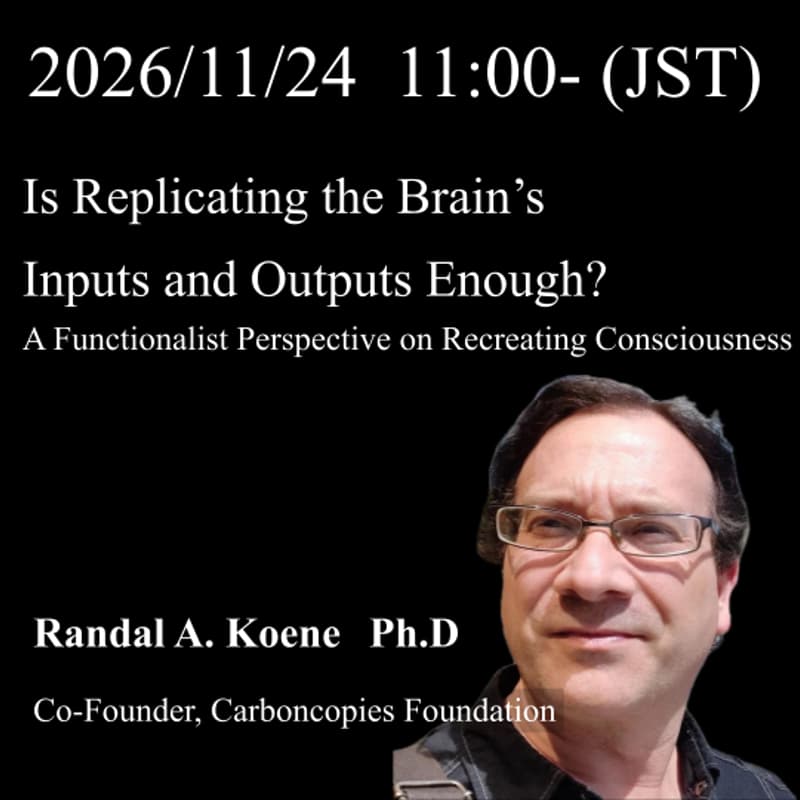
Is Replicating the Brain’s Inputs and Outputs Enough? A Functionalist Perspective on Recreating Consciousness
Talk Abstract
If a system receives the same inputs and produces the same outputs as a brain, have the mind and consciousness been recreated? Functionalism holds that mental states are defined by what they do, rather than what they are made of. Taken at face value, this suggests that input-output equivalence is sufficient. The answer depends on where the boundaries are drawn.
At the outermost boundary—senses and muscles—equivalent behavior can in principle be produced by a mechanism devoid of anything like a mind, as illustrated by Ned Block’s "Blockhead" lookup table. At finer boundaries—the input-output behavior of brain regions, circuits, and individual neurons—there is increasing preservation of the functional organization that functionalists prioritize over physical matter. David Chalmers’ gradual replacement argument suggests that consciousness is also preserved when this fine-grained organization is present.
In this talk, I argue that the criterion of "replicating inputs and outputs" lacks a crucial parameter: the granularity at which it is applied. I connect this to whole brain emulation, which poses the practical question of what level of input-output equivalence a successful emulation must satisfy. Finally, I outline the success criteria that the Carboncopies Foundation is developing to address this question, and examine whether they reach a consensus on consciousness.
Program
2026/11/24 11:00~12:30 (Seminar)
Speaker
Randal A. Koene, Ph.D
Co-Founder, Carboncopies Foundation (https://carboncopies.org/)
Randal A. Koene is a Dutch neuroscientist and neuroengineer, and a pioneer in Whole Brain Emulation (WBE)—the computational reconstruction and simulation of the brain's structure and activity. He holds a Ph.D. in Computational Neuroscience from McGill University and is a former professor at Boston University.
As co-founder of Carboncopies, he advances research on Substrate-Independent Minds (SIM), exploring the possibility of realizing human minds beyond their biological substrates. His work bridges neuroscience, computational modeling, and neuroengineering to explore the future of minds and consciousness.
Carboncopies Foundation
Carboncopies Foundation is a non-profit organization co-founded by Randal A. Koene, dedicated to advancing Whole Brain Emulation (WBE) through interdisciplinary research, education, and outreach. Bringing together neuroscience, AI, and neuroengineering, it aims to recreate brain functions on non-biological substrates and explore the future of human minds and consciousness.
Consciousness Club Tokyo
Consciousness Club is a Tokyo-based study group led by Ryota Kanai (Araya), fostering transdisciplinary discussions and creative approaches to understanding consciousness across philosophy, neuroscience, AI, and related fields.