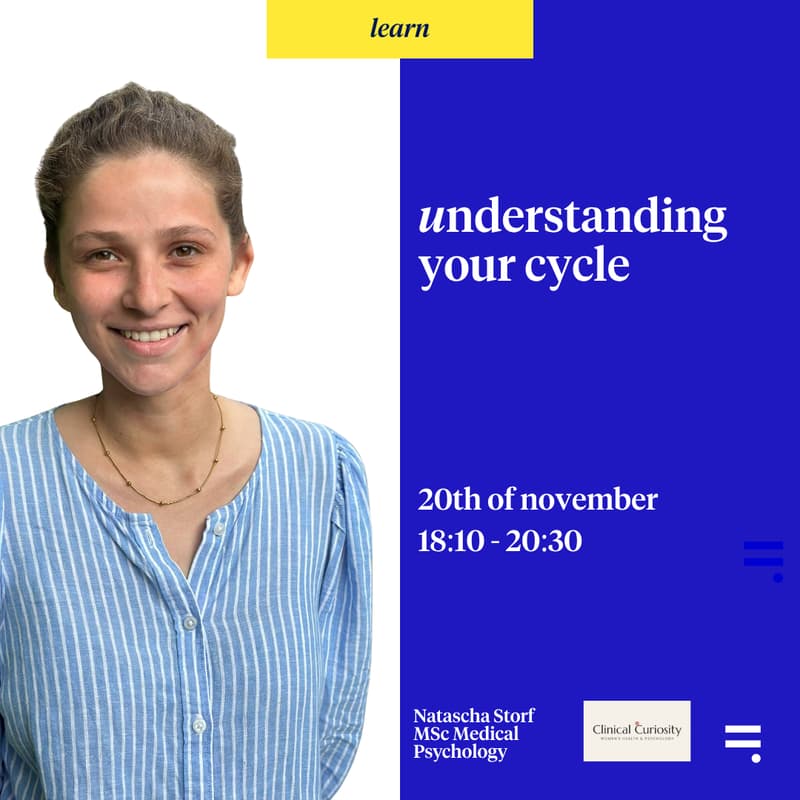

Understanding your Cycle
Event Description
Most of what we're taught about the menstrual cycle stops at middle school biology, and most of what we hear after that is anecdotal: girls' evening talk, online trends, "just how it is." Neither actually explains what's happening in your body, and how to best live with your cycle.
This workshop goes further. As a psychologist, I weave psychology and scientific literature into the content, showing you not just how your cycle works, but how it shapes the way you feel, function, and relate to your own body.
We'll get into:
• The biology of your cycle and hormones
• Why the luteal phase often feels harder
• Whether your performance genuinely changes across your cycle, or just feels like it does
• What the science actually says about trends like cycle syncing, and whether adapting your lifestyle to your cycle phase is worth it
This is an interactive session. Questions, differing experiences, and open discussion are part of the format, not an afterthought.
3 reasons that make your event unique / Why should people attend this program.
1. It’s based on scientific literature, so participants leave with an actual understanding of their cycle, not another myth to unlearn later.
2. Its lead by a psychologist and the psychological concepts and understanding are weaved throughout.
3. It is interactive - participants are encouraged to ask questions, share their own experience, and hear from others whose cycles look completely different from their own.
Facilitator/Speaker Bio
I'm Natascha Storf, a health and medical psychologist (MSc) with a passion for women's health and science communication. My background spans research, a thesis on women's health topics, work at the endometriosis foundation, and founding Clinical Curiosity, where I write about the science behind women's health topics that don't get talked about enough.
Read more at clinicalcuriosity.com
Can you give us a quote about the event? (something inspiring, not reviews of past events)
The week before your period isn't a mood swing for no reason. It's progesterone dropping, and with it, a natural anti-anxiety buffer most people have never heard of.
The psychology of your cycle, explained.