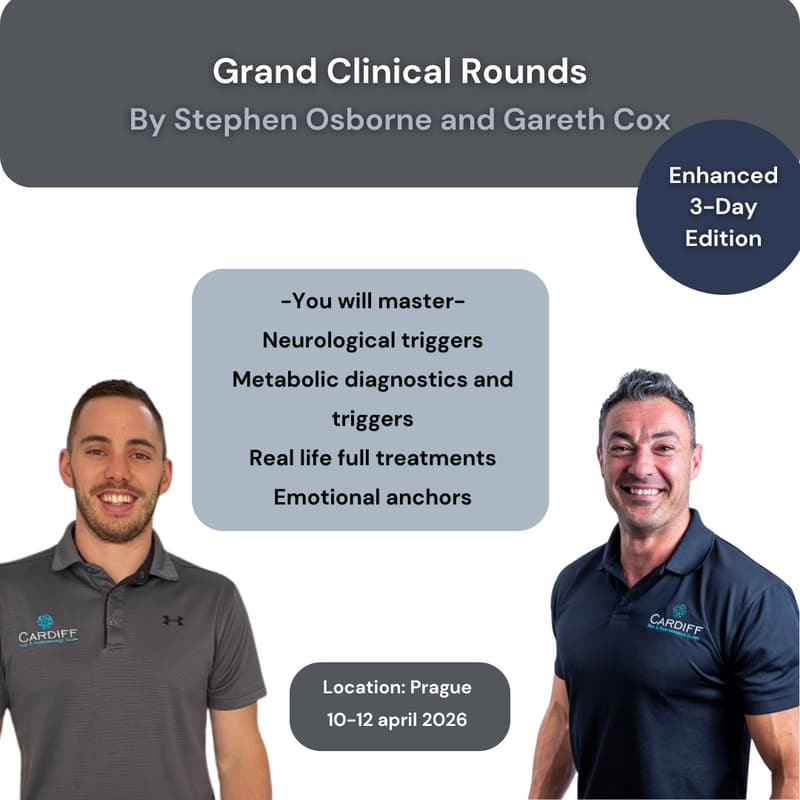
Grand Clinical Rounds – Stephen Osborne and Gareth Cox
Grand Clinical Rounds: Enhanced 3-Day Edition
with Gareth Cox & Stephen Osborne — 10–12 April 2026
Quick Summary — What You’ll Gain:
Brand-new, never-before-taught material from Cox & Osborne
Integrated Applied Kinesiology + P-DTR assessment and correction strategies
Advanced methods for metabolic pattern testing and clinical translation
Frameworks for identifying and managing microglial dysregulation and CNS-driven relapse
Clear solutions for patients who don’t improve or whose issues keep returning
High-level case reasoning applied to complex, real, unresolved presentations
Event Description
This enhanced 3-day variant of Cox and Osborne’s Grand Clinical Rounds presents their most advanced clinical content to date—featuring brand-new material never previously taught in any course. Designed for experienced practitioners, this immersion focuses on the hardest cases in clinical practice: the patients who relapse, plateau, regress, or simply don’t respond as expected.
You will learn how to combine Applied Kinesiology, P-DTR, and metabolic assessment into a cohesive reasoning model that reveals the hidden drivers behind persistent dysfunction.
Core Learning Themes
1. Deep Integration of Applied Kinesiology & P-DTR
Using layered neurological and functional testing to uncover missed drivers.
Recognizing when a problem is mechanical, reflexive, metabolic, or centrally mediated.
New correction sequences and testing priorities being taught for the first time.
2. Advanced Metabolic Testing & Clinical Interpretation
Identifying metabolic stressors that repeatedly derail progress.
Mapping metabolic signatures to recurring symptoms and treatment failures.
How to incorporate metabolic insights into your plan without overstepping scope.
3. Microglial Dysregulation & CNS-Level Challenges
How microglial activation contributes to chronic pain, hypersensitivity, instability, and relapse.
Practical strategies used in practice to help regulate an over-reactive CNS.
Distinguishing between peripheral vs. central drivers—fast and accurately.
4. What To Do When Patients Don’t Improve
This is the central purpose of the enhanced edition. You will explore:
A step-by-step framework for re-evaluating stalled or complex cases.
Why certain problems keep returning despite correct treatment—and what to do next.
High-level reasoning patterns for managing cases with shifting or contradictory findings.
When to escalate, when to redirect, and when to re-classify the case entirely.
Format & Experience
Across three immersive days, Cox and Osborne will lead:
Live case demonstrations
Structured clinical problem-solving sessions
Advanced testing progressions never taught before
Iterative case refinement and reasoning workshops
Open-floor analysis of participant-supplied challenging cases
Expect a fast-paced, clinically dense experience designed to significantly elevate your diagnostic accuracy, treatment clarity, and confidence with the most complex patients you see.