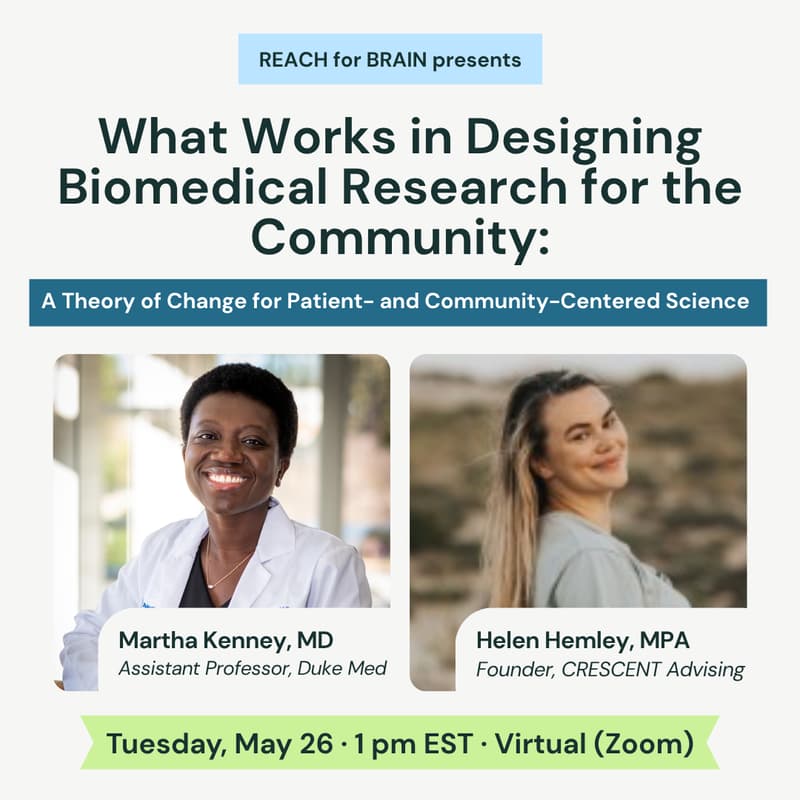
What Works in Designing Biomedical Research for the Community:A Theory of Change for Patient- and Community-Centered Science
How do we bridge the gap between biomedical research and the communities it intends to help? Using her research on pain as a critical case study, Dr. Martha Kenney (Duke Anesthesiology) will join community engagement expert Helen Hemley (CRESCENT Advising) to discuss her work in developing a Theory of Change for community-driven science. This approach shifts the focus from treating research participants as subjects to involving them as experts and stakeholders.
This event will cover:
Identifying and overcoming barriers to research participation.
Building sustainable infrastructures for community-led expertise.
Strategies to address health disparities through inclusive, evidence-based design.
This event is sponsored by Recruitment and Engagement for Advancing American Community Health (REACH) for BRAIN (NIH BRAIN Initiative, R01MH134144).
About the Speakers
Martha Kenney, MD - Assistant Professor of Anesthesiology & Pediatrics at Duke University School of Medicine and an interdisciplinary pain researcher specializing in pain processing and management in adolescents and young adults, particularly those with sickle cell disease. Her work focuses on improving pain outcomes and increasing research engagement in underrepresented communities. Funded by the NHLBI and PCORI, her research and leadership have been recognized nationally across pain advocacy, equity, and sickle cell care initiatives.
Helen Hemley, MPA - Founder and Administrative & Policy Principal of CRESCENT Advising with expertise in community-engaged clinical research and public health strategy. Previously, she led community engagement initiatives at Massachusetts General Hospital and for the NIH All of Us Research Program in New England. Her work focuses on building equitable research infrastructure and improving engagement with historically marginalized communities.