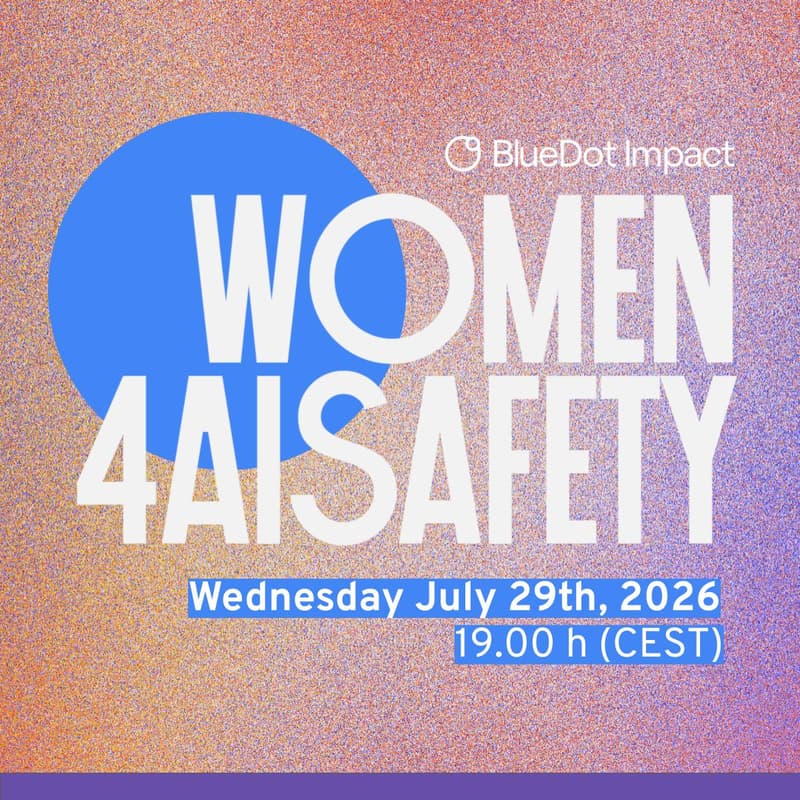
W4AIS | Women for AI Safety
W4AIS | Women for AI Safety
Date: Wednesday 29th July
Time: 19:00 to 20:00 CEST
Location: Zoom (link shared upon registration)
Organised by: BlueDot Impact
Facilitated by: Osmani Redondo and Mmachukwu Osisioma
About the Event
AI is being built by a narrow profile of people. That is not just an inclusion problem, it is a safety problem.
The benefits we have today are not guaranteed tomorrow. A system built by few, for few, can change what it protects, and most of us are not yet part of that process.
W4AIS exists to change that, now, while it can still be shaped.
Whether you work in AI safety, alignment, governance or policy, or you are simply paying attention to where this is going, this is your space.
First meeting. One hour to meet each other and start deciding, together, what W4AIS becomes.
Agenda (1 hour)
No preparation needed. Just bring curiosity and enthusiasm. If you'd like to share something, you can propose a talk for future sessions.
Small groups (50 mins): what brought you here, what you're working on, and where you'd want W4AIS to open doors.
Closing and next steps (10 mins): announcements and how to stay connected.
Session materials will be available exclusively to registered participants via W4AIS.
W4AIS aims to gather regularly, as a safe, accessible and inclusive space to connect, share ideas and learn together.
Everyone interested in AI Safety is welcome. We would love for you to join us and help build something thoughtful, curious and strong.
Follow us on LinkedIn.
Thank you, and see you soon!