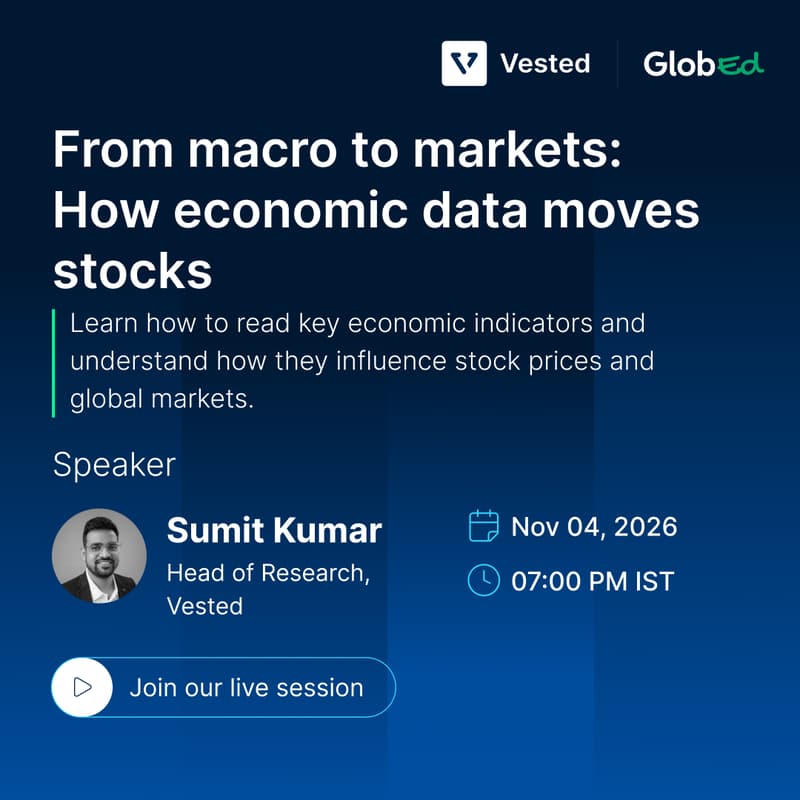

From macro to markets: How economic data moves stocks
About this Live Session
Stock markets are influenced by more than company performance. Economic indicators such as inflation, interest rates, GDP growth, and employment data can shape investor sentiment, influence market movements, and affect how stocks are valued.
In this session, we will explore how macroeconomic developments influence financial markets and how investors can interpret economic data to better understand stock market movements. We will look at the relationship between economic indicators, central bank decisions, and market performance, with practical examples from global markets.
The session is designed to help investors connect economic developments with market movements and make more informed investment decisions.
Key Agenda
Understanding macroeconomics and why it matters to stock market investors
How inflation, interest rates, and GDP growth influence stock prices
Understanding the impact of Federal Reserve decisions on US markets
How employment data, consumer spending, and economic growth affect market sentiment
Why markets sometimes react differently than expected to economic news
Understanding the relationship between bond yields, the US dollar, and equities
Practical examples of how economic announcements influence stock market movements
How investors can use macroeconomic indicators to assess market conditions and risks
Speaker
Sumit Kumar, brings close to 8 years of experience across wealth management, portfolio strategy, and equity markets, and currently leads Portfolio Research at Vested.
He was previously part of J.P. Morgan Chase’s Wealth Management team, where he managed approximately $11 billion in AUM across 5,000 client accounts, with a strong focus on tax-loss harvesting and portfolio rebalancing.
Before that, he was with Goldman Sachs in Management & Strategy, covering U.S. derivatives and equity markets. His work included sell-side analysis, market research, and tracking competitive dynamics.