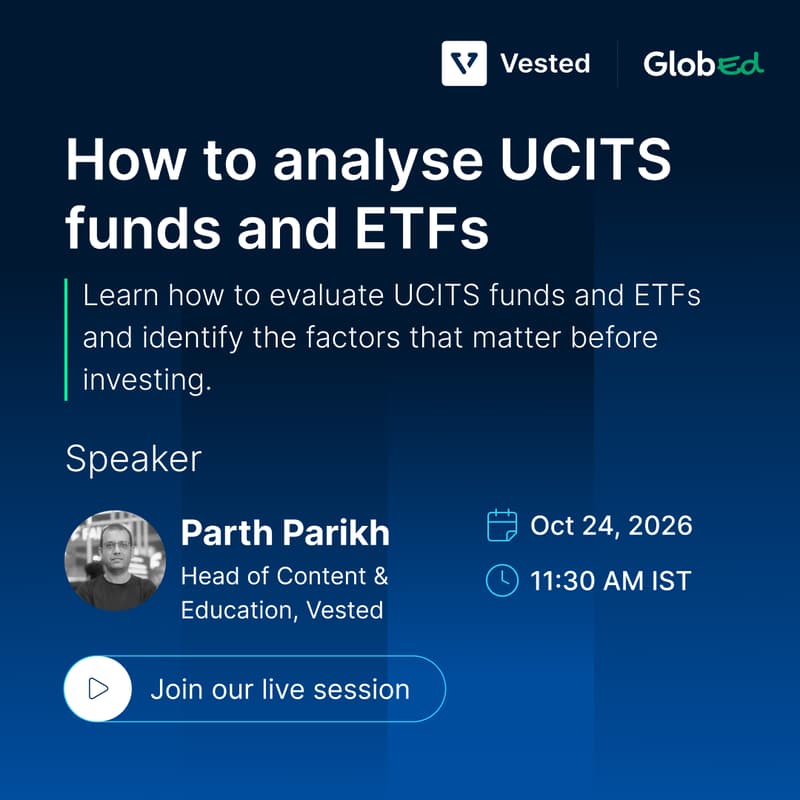

How to analyse UCITS funds and ETFs
About this Live Session
Choosing the right global fund or ETF involves more than looking at past returns. Investors need to understand what a fund invests in, how it performs, what it costs, and how it fits into their overall portfolio.
In this session, we will explore how to evaluate UCITS funds and ETFs using key metrics such as expense ratios, historical performance, fund size, tracking error, and underlying holdings. We will also look at how to compare funds, assess risk, and identify options that align with different investment goals.
By the end of the session, investors will have a practical framework to compare global funds and ETFs and make more informed investment decisions.
Key Agenda
Understanding UCITS funds and ETFs, and how they differ
Identifying a fund's investment objective, benchmark, and underlying holdings
Evaluating expense ratios and other costs that affect returns
Comparing historical performance across different market conditions
Understanding tracking error and how closely a fund follows its benchmark
Assessing fund size, liquidity, and trading considerations
Evaluating concentration, diversification, and key risks
Building a checklist to compare funds and ETFs before investing
Speaker
Parth Parikh leads content, growth, and community initiatives at Vested, where he helps Indian investors understand and access global markets. His work focuses on US equities, ETFs, global mutual funds, and private market opportunities, with an emphasis on simplifying complex financial concepts into practical insights.
Prior to Vested, he worked at Finsire in the secured-lending and financial infrastructure space, and earlier spent several years at FinShiksha teaching finance and designing structured, application-oriented learning programs. He is a regular contributor to Indian Express and Financial Express, and has conducted training sessions for institutions including Kotak Securities, Motilal Oswal, Nippon Mutual Fund, JPMC, CRISIL, and leading IIMs and IITs.