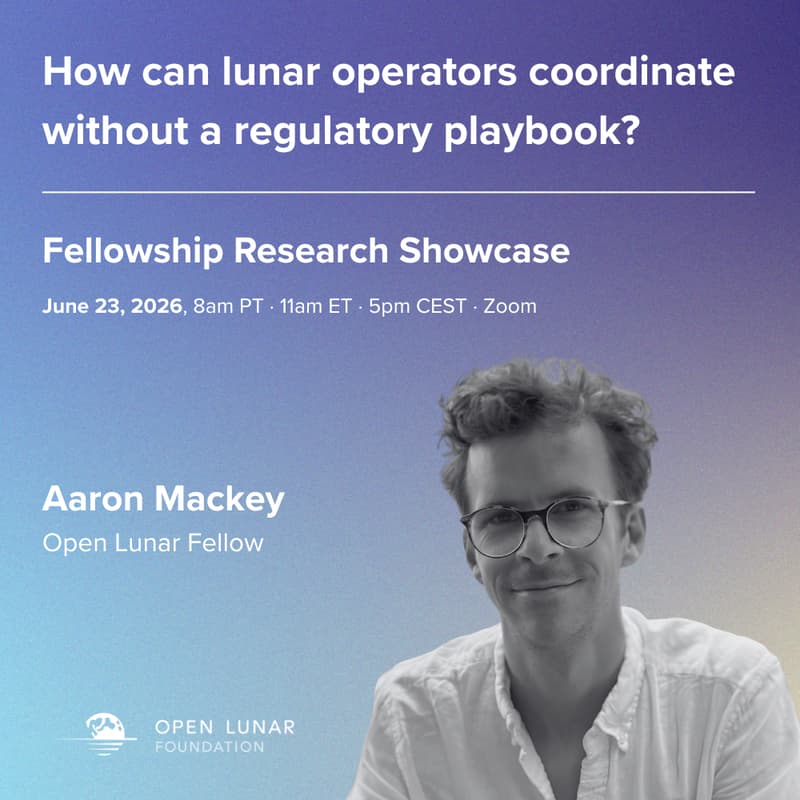

Ground Rules: Decision logic for lunar ground operations
Open Lunar Foundation's Research Fellowship commissions independent research on the questions that will define lunar governance. During this event, Fellow Aaron Mackey presents his work on Designated Lunar Areas (DLAs) and the Ground Rules Toolkit, a proposed framework for coordinating lunar surface operations before conflicts arise.
As activity on the Moon accelerates, a critical question remains unresolved: how large should an operator's area of operations be, and what makes that claim legitimate? Without a shared methodology, operators have incentives to overclaim space, while regulators and international bodies lack a technical basis for evaluating those claims.
Ground Rules addresses this challenge through a decision-support framework that derives operational area boundaries from mission characteristics, equipment specifications, environmental conditions, and hazard modelling. Built around Open Lunar's proposed Designated Lunar Area structure, the framework establishes three concentric zones: a Core Operations Zone, a Harmonisation Zone, and a Coordination Area. Each has distinct transparency, coordination, and communication obligations. Together, they provide a practical mechanism for distinguishing legitimate operational needs from de facto appropriation.
The framework is designed to help operators identify and resolve conflicts before they occur. By combining shared registries, hazard modelling, and structured decision logic, Ground Rules offers a common technical reference for mission planners, regulators, insurers, and policymakers seeking to coordinate increasingly complex lunar activities.
Aaron Mackey works on geospatial data applications and remote sensing, developing open-access tools for lunar surface coordination. His research brings empirical and spatial analysis to governance questions that have traditionally been addressed primarily through legal and political frameworks.
Join us for a discussion on how evidence-based operational area design, shared data infrastructure, and practical coordination mechanisms could help move lunar governance from geopolitical negotiation toward technical consensus.