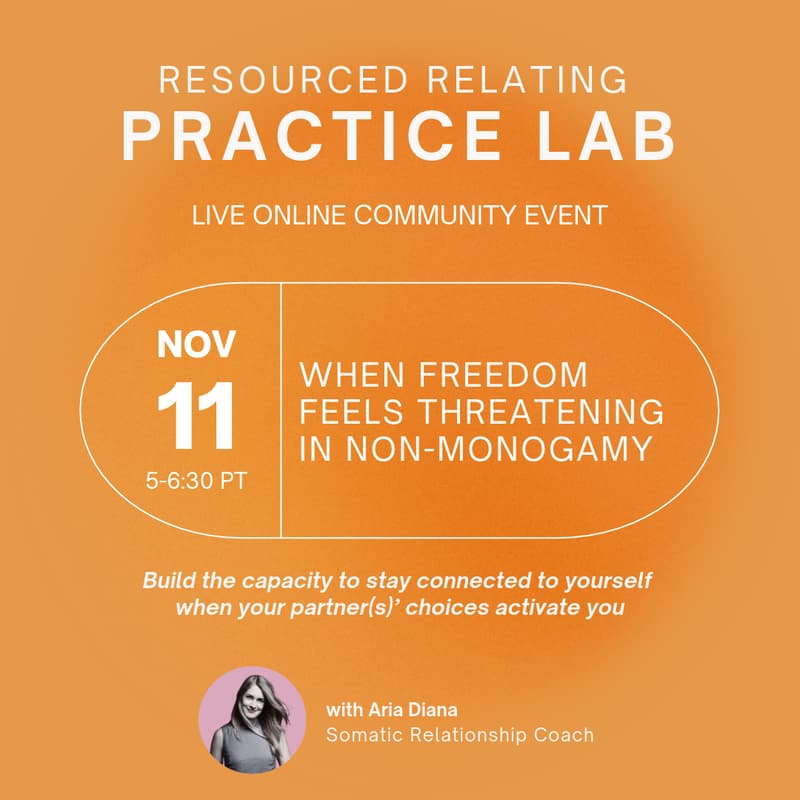
Resourced Relating Practice Lab: When Freedom Feels Threatening in Non-Monogamy
A 90-minute, live online practice lab to help you stay connected to yourself, navigate difficult feelings, and respond with greater choice when your partner(s)' autonomy activates you.
What happens when we deeply value freedom and autonomy in non-monogamy, but our partner(s)' choices bring up feelings of fear, insecurity, or disconnection?
Maybe your partner wants to spend time with someone else when you've been longing for more connection.
Maybe they express a desire, preference, or boundary that doesn't align with your own.
Or perhaps someone you care about wants a different kind of relationship than the one you've imagined together.
Even when we wholeheartedly believe in one another's autonomy, encountering these differences can activate some very tender places inside us.
We might feel rejected, afraid, jealous, or disappointed. We might notice an urge to withdraw, defend ourselves, seek reassurance, accommodate, or try to change someone's mind.
These responses are often protective strategies we've developed to navigate experiences of uncertainty, rejection, disappointment, or disconnection.
And while we may understand the principles of autonomy, differentiation, and emotional responsibility intellectually, having the capacity to practice them when our nervous systems are activated is another matter entirely.
That's what Resourced Relating is all about.
What if we could learn to recognize our protective responses, turn toward them with compassion, and create more room to choose how we respond?
From Automatic Protection to Greater Relational Choice
In this experiential Resourced Relating Practice Lab, we'll explore how to stay connected to ourselves when someone else's desires, boundaries, or autonomy activate us.
Drawing on somatic practices, Internal Family Systems (IFS)–informed parts work, and relational differentiation, we'll practice recognizing our protective responses and turning toward them with curiosity and compassion.
Rather than trying to suppress our feelings or convince ourselves that everything is okay, we'll experiment with making more room for the different parts of ourselves that emerge when relationships feel challenging.
We'll practice moving gently between moments of activation and experiences of safety, support, and belonging—a somatic process called titration.
And we'll explore what becomes possible when we turn back toward another person's reality feeling more resourced, grounded, and connected to ourselves.
What We'll Practice Together
During our 90 minutes, you'll be guided through:
Somatic resourcing: Connect with an embodied sense of support and belonging that you can return to when relational experiences feel challenging.
Recognizing protective parts: Notice the sensations, stories, and impulses that arise when someone else's desires or choices affect you.
Unblending: Practice recognizing that a part of me is having this response, but it isn't all of me, creating more space for curiosity and choice.
Gentle titration: Experiment with moving between a manageable relational trigger and a resourcing experience, building your capacity to accompany difficult feelings.
Relational witnessing: Practice sharing and receiving another person's experience without needing to fix, advise, reassure, or rescue.
You'll leave with a practical sequence you can return to when differences arise in your relationships, helping you move beyond automatic defensive reactions and respond with greater choice, compassion, and alignment with your values.
This isn't about learning to be okay with everything.
Being resourced doesn't mean you have to feel comfortable with every choice someone else makes.
You might still feel disappointed. You might need reassurance, want to make a request, or recognize that a boundary needs to be honored.
The goal isn't to eliminate your protective responses. It's to develop a more compassionate relationship with them, so they don't have to navigate difficult moments alone.
When we can stay connected to more of ourselves, we have more capacity to discern what we actually need and how we want to respond.
And that can make room for more honest, differentiated, and nourishing relationships.
What to Expect
This is a participatory, practice-centered gathering rather than a traditional webinar.
We'll combine brief teaching, guided somatic exploration, personal reflection, and optional sharing in small group breakout rooms.
You won't need to share intimate details about your relationships or revisit your most painful experiences. In fact, we'll intentionally work with ordinary, manageable moments of relational difference.
You're always welcome to slow down, modify an exercise, or opt out of a practice. Your capacity and choice matter here.
No previous experience with somatic practices or parts work is necessary. Whether you're new to non-monogamy or have been practicing for years, you're welcome here.
About Your Facilitator
Aria Diana is a relationship coach and writer with more than 13 years of lived experience practicing consensual non-monogamy. Her approach integrates somatic practices, parts work, and relational education, informed by specialized training in integrative somatic trauma therapy, somatic parts work, and trauma-informed facilitation.
Through her coaching practice, writing, and facilitated gatherings, she helps people cultivate the emotional, somatic, and relational capacities that support more nourishing, interdependent ecosystems of care.
Her publication, Nourishing Non-Monogamy, reaches readers across all 50 U.S. states and 83 countries. Recognized on Substack's Bestseller List and regularly ranked among its Rising in Culture Top 100, the publication offers somatic reflections, practical tools, and personal stories to help people navigate the complexities of non-monogamous relationships.