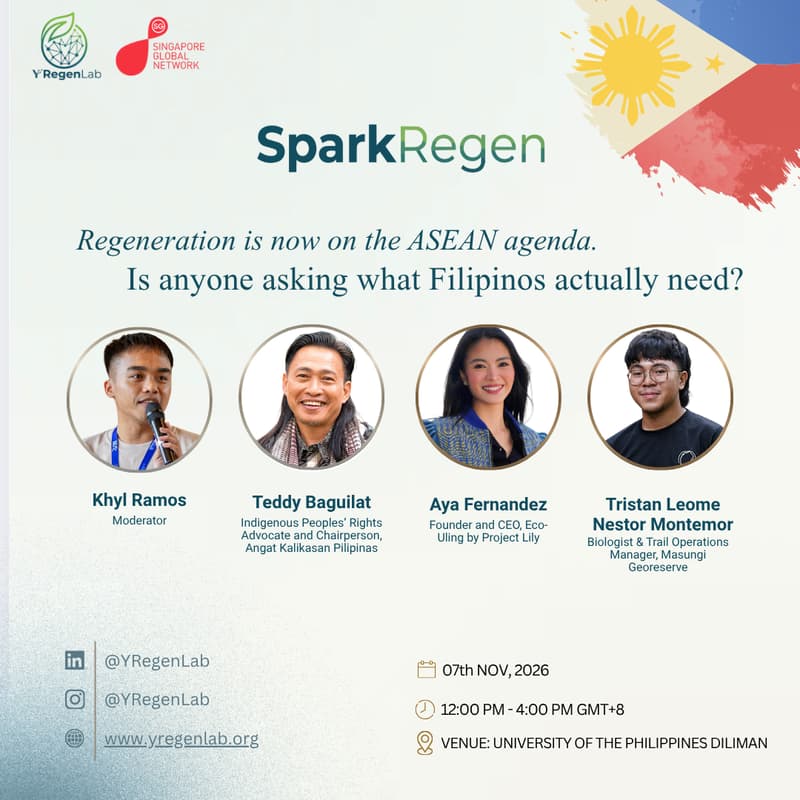
SparkRegen: The Philippines is still working towards sustainability. So what could regeneration look like?
About The Event
The Philippines is rich in forests, rivers, coastlines, agricultural landscapes, and cultural traditions. But many communities are also navigating environmental degradation alongside very immediate concerns around livelihoods, food, housing, infrastructure, and access to opportunity.
So what does regeneration mean in a country where many communities are still working towards sustainability in the first place?
Rather than treating regeneration as a formula or simply the next step after sustainability, this conversation asks what it could mean within Philippine realities: how can we restore ecosystems while supporting the people who depend on them, create livelihoods without weakening the systems that sustain them, and draw on knowledge that has long connected communities to place?
Join Teddy Baguilat, Aya Fernandez, and Tristan Montemor for a conversation on how regeneration might take root in the Philippines—from Indigenous relationships with land, to circular livelihoods, to landscape conservation and restoration.
We’ll explore:
What regeneration can mean when ecological and human wellbeing are deeply connected
What Indigenous knowledge can teach us about stewardship, reciprocity, and relationships with land
How waste, enterprise, and local livelihoods can become part of more circular systems
What landscape restoration looks like beyond simply planting trees
How conservation can work alongside communities and the livelihoods that depend on ecosystems
Whether regenerative approaches can take root within existing Philippine economic and social realities
What we already have in the Philippines that could inform a more regenerative future
Whether you work in conservation, development, entrepreneurship, culture, policy, or simply want to understand what regeneration could mean here, join us for the conversation.
🍽 Salo-salo at Kuwentuhan
Join us from 12:00–1:00 PM for lunch, Filipino snacks, and informal mingling before the programme.
About The Speakers
Teddy Baguilat - Indigenous Peoples’ Rights Advocate; Former President, Global Consortium for Indigenous and Conserved Areas.
Teddy Baguilat is an Indigenous Peoples’ rights advocate and former legislator who has worked extensively on Indigenous rights, ancestral domains, environmental protection, and community stewardship. His perspective brings the conversation back to a fundamental question: what can be learned from Indigenous communities whose relationships with land, culture, and natural resources have developed over generations?
Aya Fernandez - Founder & CEO, Eco-Uling by Project Lily Inc.
Aya Fernandez is a social entrepreneur and the founder of Eco-Uling by Project Lily, a livelihood project turned social enterprise that produces charcoal briquettes primarily from coconut waste. Project Lily began as a community livelihood initiative and has since worked to connect waste reduction with local employment and opportunities for persons with disabilities. Its current work also includes partnering with farming communities and exploring ways to bring its technology into coconut-producing areas.
Tristan Leome Nestor Montemor - Biologist & Trail Operations Manager, Masungi Georeserve.
Tristan Montemor is a biologist and Trail Operations Manager at Masungi Georeserve, where he works within a landscape that has been undergoing long-term conservation and restoration. Masungi's work extends beyond protecting its limestone formations: its conservation model includes landscape-scale restoration, watershed protection, community involvement, education, and geotourism that helps support conservation operations.
Khyl Ramos (Moderator) - Community development practitioner and climate justice activist.
Khyl Ramos is a community development practitioner working on grassroots organising, labour rights, and climate justice campaigns across the Philippines and the Asia-Pacific.
About YRegenLab
This conversation is part of YRegenLab, an initiative exploring what regeneration means across ASEAN and connecting young people with the practitioners, researchers and communities already putting these ideas into practice.
The dialogue will also feed into conversations at Regen Asia Summit 2027 in Singapore, bringing Singapore perspectives into a wider regional discussion on what regeneration could mean for ASEAN.
Proudly supported by Singapore Global Network
Supported by Singapore Global Network (SGN), a division under Singapore Economic Development Board (EDB). Join SGN to become a member of our global network of professionals and friends with Singapore at its heart. Learn more at www.singaporeglobalnetwork.gov.sg.