
Creating Seed Artefacts
How to create a product which grows itself — and your business with it.
When you run a small business, there’s an obvious limit to how much your work can grow: you only have so much time.
But what if some of the ideas, knowledge and approaches you've developed could take on a life of their own?
I'm interested in what happens when we turn something we know or do into a product.
Not simply as another source of income, but as a way for our work to travel further, reach different people, and develop in ways that aren't entirely dependent on us.
Overview
In this online talk, I'll be sharing a concept I've been developing called Seed Artefacts: an 'organic' way of thinking about what it means to design and create products, as part of growing a business.
I'm still working this idea out myself; this isn't a polished methodology or a step-by-step masterclass.
It's more of an invitation to explore the perspective with me while it's still germinating — using what I call Garden Thinking, and drawing on some of the things I've learned from creating products myself.
What we'll be exploring
I'll share some of what I've been noticing about:
— Why creating a product can be particularly interesting for small, service-based businesses.
— What makes some products more capable of travelling, spreading, and generating new possibilities.
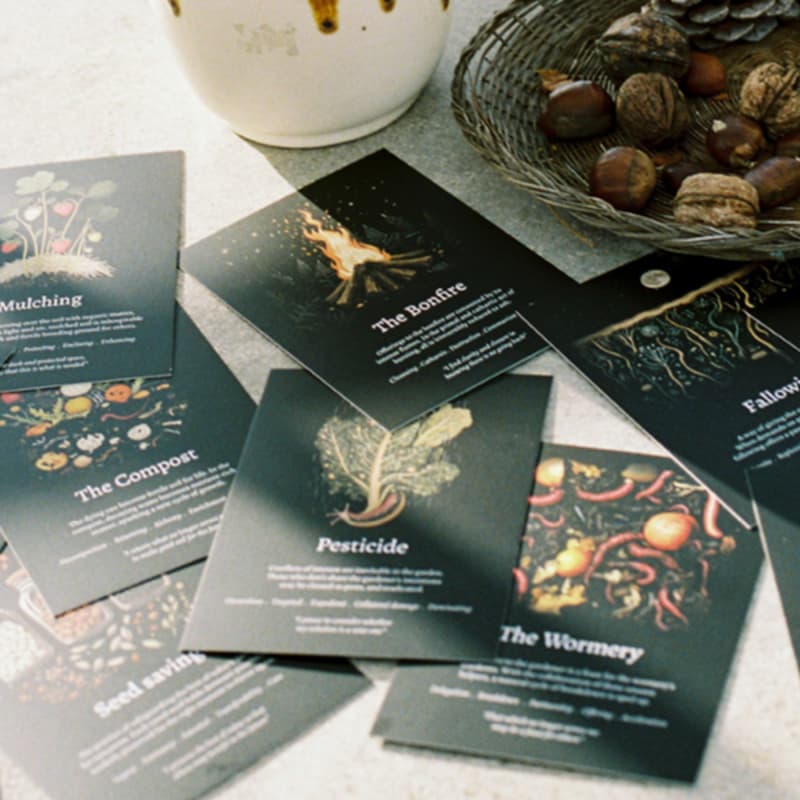
— What I've learned from co-creating Tending to Endings, a card deck that has now found its way into the hands of hundreds of people.
— The emerging idea of the Seed Artefact, and some of the questions I'm currently exploring around it.
— A few experiments I'm developing myself, including an early look at Curated Notes.
There'll also be plenty of space for questions and conversation.
I'm particularly interested in hearing what you're working on, what you're considering creating, and where your ideas are taking you.
Who is it for?
This is primarily for people who already have a body of knowledge, experience or practice — but are interested in finding new forms for it.
Perhaps you're:
A consultant, coach, facilitator or independent practitioner.
Running a small business built largely around your own time and expertise.
Thinking about turning an idea, method or body of work into something tangible.
Looking for greater creative autonomy and ownership over your work.
Interested in ways your work might reach people beyond your existing client relationships.
You don't need any prior knowledge of ecology or Garden Thinking. And you don't need to have a product idea already.
What you might take away
This is an opportunity to:
See your own expertise and ideas from a different perspective.
Understand some of the possibilities — and challenges — of turning knowledge into a product.
Encounter a new way of thinking about growth, based more on cultivation than calculation or control.
Identify something in your own work that might be ready to take a different form.
Hear from someone who has experimented with this in practice, including what worked (and what didn't!).
Most of all, I hope you'll leave with a few ideas you hadn't arrived with — and perhaps one that you'll be inspired to start seeding...
Date & Time
Wednesday, 14th October
2:30pm–4pm UK Time
Seats & Pricing
30 seats available
£25
Seed framing
This presentation is itself a kind of Seed Artefact.
I'm deliberately putting it into the world while the idea is still developing — to see what happens when you give an emerging idea a form, share it with people, and allow the response to become part of its development.
Please don't come expecting a polished framework with all the answers; come to explore an idea with me!
Presented by Will Brown
Will is a growth strategist & essayist.
Through his independent studio, Grain, he helps businesses and institutions to grow better (rather than necessarily bigger).
His work is grounded in a philosophical project and practice, Garden Thinking, which explores the historical, ecological, and cultural significance of gardens — and how the wisdom of good gardening can helps us to cultivate, rather than force, change.
His background spans English Literature (BA, Oxford), Ecological Design Thinking (MA, Schumacher College) — and writing, research, convening, facilitation, and coaching.
Most recently, he co-created Tending to Endings — a Joseph Rowntree Foundation–funded project that uses garden metaphors to open up conversations around death, endings, and transitions.