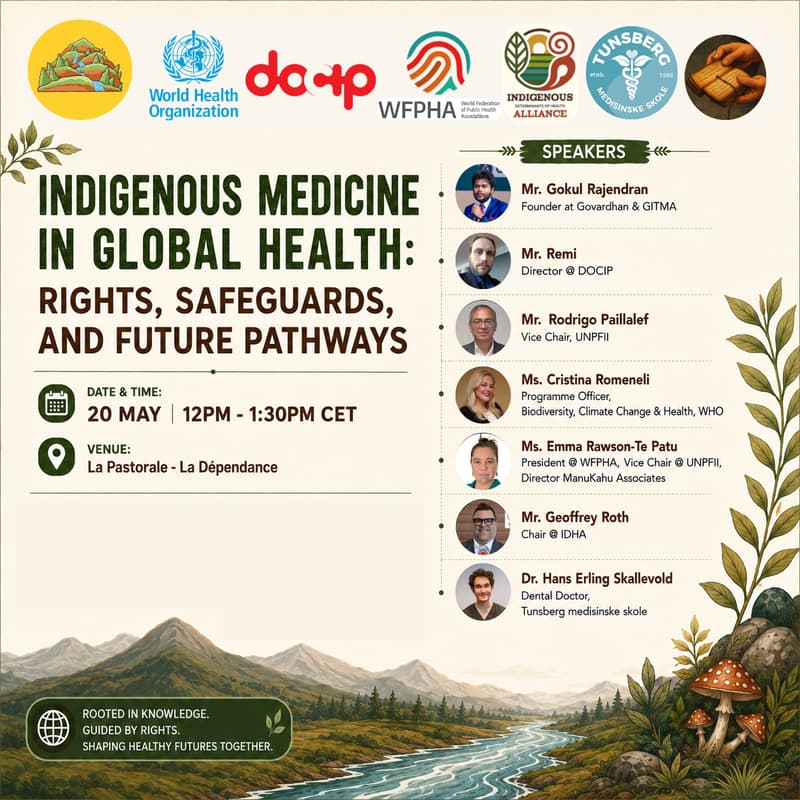

Indigenous Medicine in Global Health: Rights, Safeguards, and Future Pathways
Indigenous medicine systems have sustained communities for generations, carrying deep knowledge on health, biodiversity, healing, and the relationship between people and nature. As global health systems increasingly recognise the importance of traditional and indigenous knowledge, urgent questions emerge around ethics, safeguards, intellectual property, representation, and equitable integration.
This dialogue brings together Indigenous leaders, global health experts, youth representatives, and policy actors to explore how indigenous medicine can be meaningfully positioned within global health governance while ensuring the protection of Indigenous Peoples’ rights and knowledge systems.
The session will create space for critical discussion on ethical collaboration, biodiversity-linked knowledge preservation, communication gaps within international institutions, and future pathways for safeguarding indigenous medicine in the context of rapidly evolving global health frameworks and AI technologies.
Organised by
Govardhan App & GITMA
In Collaboration With
DOCIP
WHO
IDHA
World Federation of Public Health Associations (WFPHA)
Proposed Speakers
Mr. Gokul Rajendran — Founder, Govardhan App & GITMA | BAMS Student, India
Mr. Rémi Orsier - Director @ DOCIP
Mr. Rodrigo Paillalef — Vice Chair, UN Permanent Forum on Indigenous Issues (UNPFII)
Ms. Cristina Romanelli — Programme Officer, Biodiversity, Climate Change & Health, WHO
Ms. Emma Rawson-Te Patu — President, WFPHA | Vice Chair UNPFII | Director, ManuKahu Associates
Mr. Geoffrey Roth — Chair @ IDHA
Dr. Hans Erling Skallevold — Dental Doctor @ Tunsberg Medical School
Special Video Message
Gabor Soos — UNESCO, Hungary
Topic: Ethical AI and Indigenous Knowledge Systems
Objectives
Explore how indigenous medicine should be positioned within WHO and global health governance.
Examine existing gaps in safeguarding indigenous knowledge systems.
Critically assess intellectual property regimes and their relevance to indigenous medicine.
Facilitate direct feedback from Indigenous Peoples and youth on representation and communication.
Co-create pathways for the ethical integration and protection of indigenous medicine.
This event is part of ongoing global conversations on health equity, Indigenous rights, biodiversity protection, and the future of traditional medicine within international policy spaces.