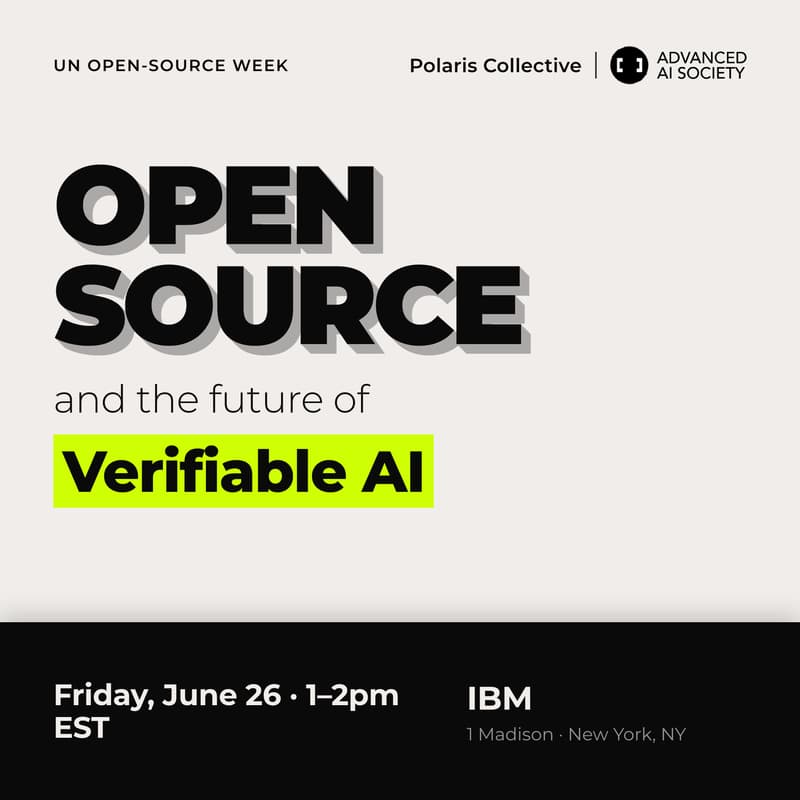

Open Source and the Future of Verifiable AI
The good news is that AI security has become a first-class problem. The most critical work to secure the stack is happening in Verifiable AI. The question is whether it gets built in the open, or built behind closed doors.
A latent market of companies is already building the most robust form of verification under different names that all share an underlying feature: cryptographic verification. In a world of autonomous agents, indistinguishable copies, and scale beyond human oversight, verification is the only way forward to resolve identity, authorization, and accountability. Open source is the only path that keeps verification itself verifiable.
On this panel we'll hear from the companies and standards bodies on the front lines of this work, with a report on the Proof-of-Control Cryptographic Verification Standard, which is being written in the open, vendor-neutral and interoperable by design.
Opening Remarks:
Tricia Wang, Advanced AI Society
Bhavya Gupta, Polaris Collective
Panel
Julie Tsai - Moderator
Stan Byers, VIA — Cryptographic trust for verifiable AI and accountable digital transactions anywhere on Earth
Dr. Hani Jamjoon, IBM Granite — Open-source language models with built-in cryptographic security
Cloud Security Alliance — Industry standards body for cloud and AI security
Evan Powell, Deep Tempo — First open-source AI-native security operations platform
Closing Remarks
Mostafa Elkordy, UNICC - OSARA, Open Sovereign Agent Reference Architecture
James Landay, Director of the Stanford Institute for Human-Centered AI
IMPORTANT - HOW TO REGISTER: To attend, register yourself for our side event here with IBM and the UN. Be sure to select “Yes” for questions 18 and 19 when asked if you are interested in attending the Community-Led Side Events to ensure you are registered with IBM.
Hosted by the Advanced AI Society and Polaris Collective.
The Polaris Collective is a Public Benefit Corporation that seeks to raise up and respond to pressing questions in security, trust, and risk in resonant, humanistic ways. High-trust security risk community event forums and connectors for practitioners, by practitioners.