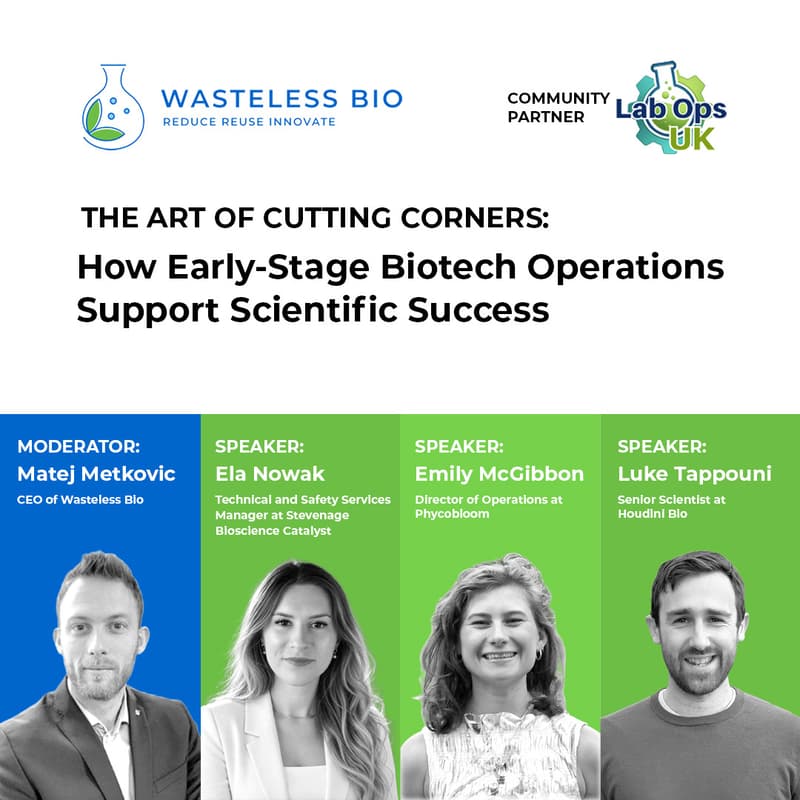
The Art of Cutting Corners: How Early-Stage Biotech Operations Support Scientific Success
Running an early-stage life sciences company usually means running its lab, too. Someone has to order the consumables, arrange equipment servicing, keep training and risk assessments up to date, and handle the hundred small tasks that keep a lab working. For a founder, that work can take 20% or more of the week, and when done badly, it delays experiments and burns funding.
The focus is on working smarter and making limited resources go further, without compromising safety, compliance or scientific quality.
Moderated by Matej Metkovic, CEO of Wasteless Bio, the panel will cover:
Where your time actually goes: the operational work that pulls you away from the bench
The tasks no one notices until something fails, how they eat into research time, and how to prevent problems before they happen
What changes as the lab grows and what to put in place before you can afford a full-time lab manager
How to prepare for new funding so a growing team can focus on research instead of figuring out how to run the lab
How to stretch a small lab budget, and where cutting costs can lead to greater expenses through downtime or lost research time.
A networking session will follow after the panel.
For
Early-stage biotech founders, scientists and scientific leaders who find themselves running the lab as well as doing the research, lab operations managers, and anyone taking on operational responsibilities as their team grows.
Speakers
Emily McGibbon is Director of Operations at Phycobloom, a London-based algae biotech startup developing genetically engineered algae for sustainable aviation fuel. As the company's sole operational leader, she owns health, safety and compliance in a working laboratory, manages equipment, suppliers and contractors, and leads two Innovate UK grants. She previously worked in life sciences sales at QIAGEN and managed a shared biotech park, and mentors lab operations managers as a volunteer with Lab Ops UK.
Ela Nowak is Technical and Safety Services Manager at Stevenage Bioscience Catalyst, supporting around 30 life science companies across shared and dedicated labs. She oversees health and safety, laboratory onboarding, risk assessment, waste management, gases and cryogenic systems, equipment servicing, contractor controls, training and incident management. She holds NEBOSH, IOSH Laboratory Safety and Biological Safety Officer qualifications and shares practical lab-operations expertise through Lab Ops UK.
Luke Tappouni is a Senior Scientist in DNA engineering at Houdini Bio, a London startup working on genetic medicines. He completed a PhD at UCL and previously worked as a Technician and then an Associate Scientist at OXGENE (Oxford Genetics), giving him a first-hand view of how lab responsibilities and support differ across industry, academia and startups.
Moderator
Matej Metkovic is CEO and founder of Wasteless Bio, with a background covering research roles at Quell Therapeutics, Cygnal Therapeutics and Neon Therapeutics, and specialist and commercial roles at Bio-Techne and Enzo Life Sciences. He holds a degree in Cell and Molecular Biology from Northeastern University and is a former member of the Croatian national rowing team.
This event is organised with Lab Ops UK, a community partner bringing UK lab ops professionals together to share knowledge, build connections and encourage collaboration through networking, mentorship and constructive discussion.
Free, with limited places.
Attendance is by approval only.
Approved guests will be asked to reconfirm nearer the date.
Please apply only if you expect to attend.
This event runs under the Chatham House Rule. Anyone who attends is free to use information from the discussion, but may not reveal the identity or affiliation of a speaker, or that of any other participant.
About Wasteless Bio
Wasteless Bio is an online marketplace that helps organisations reuse, resell, donate and redistribute surplus lab equipment, consumables and reagents, so funding goes further, projects stay on schedule and lab waste is reduced.