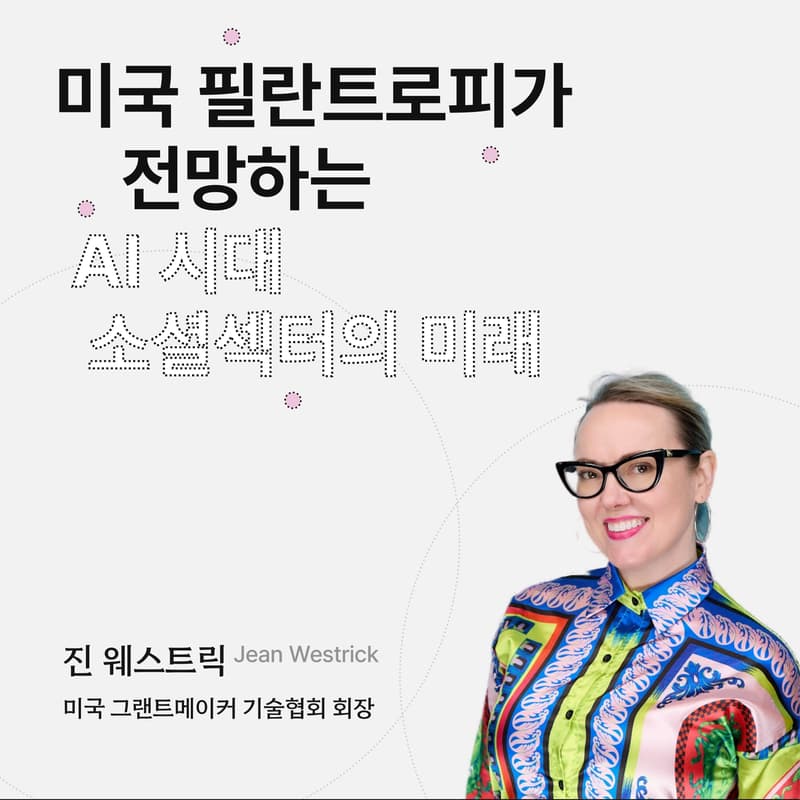
아산 프론티어 아카데미 글로벌 특강 | 미국 필란트로피가 전망하는 AI 시대 소셜섹터의 미래
※ 통역 안내 및 1회차 강의 영상 제공 안내
본 행사는 AI 도구를 활용한 실시간 번역 자막(영어 ↔ 한국어)을 제공합니다.
음성 통역은 제공되지 않으며 텍스트 자막 형태로만 제공되오니, 통역이 필요하신 분께서는 휴대폰 외에 별도의 화면(예: 태블릿, 노트북 등)으로 자막을 보실 수 있도록 사전에 준비해주시기 바랍니다.
또한, 참가 신청자 분들께는 1회차 강의「임팩트 허브 사례를 통해 본 소규모 비영리 글로벌 진출 전략」(가브리엘라 간델)의 다시보기 링크를 공유할 예정입니다.
※ Interpretation Guidance & Session 1 Replay Access
This event will offer real-time translation(English ↔ Korean) using AI tools.
The translation will be text-based only, not audio-based, so participants who require interpretation are kindly advised to prepare a separate device (such as a phone or tablet) to view the translated subtitles during the session.
We will also share a replay link of the first session,「Scaling Global Without Losing the Mission: Impact Hub’s Global Network and Distributed Governance」 (led by Gabriela Gandel) with all registered participants.
아산 프론티어 아카데미 글로벌 특강
차세대 사회혁신 리더를 양성하는 교육 프로그램 아산 프론티어 아카데미는 국내외 사회혁신가와 함께하는 글로벌 특강 시리즈를 운영합니다.
이번 특강은 외부에도 무료로 공개되며, 아산 프론티어 아카데미 수강생이 아니어도, 현장의 언어로 배움을 얻고 싶은 분이라면 누구나 참여하실 수 있습니다.
Asan Frontier Academy Global Lecture Series
Asan Frontier Academy, an educational program dedicated to cultivating the next generation of social innovation leaders, hosts a global lecture series featuring leading social innovators from around the world.
This lecture is open to the public free of charge. Anyone interested in learning from real-world, practice-based experiences whether or not they are enrolled in the program is welcome to join.
[글로벌 특강 개요]
목적
AI가 비영리의 업무 효율을 넘어 소셜섹터가 다루는 사회·경제·시민사회 문제 자체를 어떻게 바꾸고 있는지, 미국 필란트로피 현장의 최신 데이터와 사례를 통해 살펴봅니다.
매일 쏟아지는 AI 소식(노이즈) 속에서 조직의 전략을 바꿔야 할 진짜 변화(시그널)를 가려내는 관점을 배우고, 기금 신청·심사 현장에서 실제 벌어지고 있는 변화를 확인합니다.
신뢰, 책임 있는 데이터 관리, 인간 중심 혁신을 기준으로, 개인의 AI 활용을 조직의 전략과 거버넌스로 옮기기 위해 한국의 비영리·재단 리더가 고려해야 할 질문을 도출합니다.
연사
진 웨스트릭 | 미국 그랜트메이커 기술협회(TAG) 회장
일시: 10.15(목) 11:30 ~ 13:00 (KST)
대상: 비영리·사회혁신 조직의 리더와 중간관리자, 재단·모금·배분 기관 종사자, 조직의 AI 전략과 가이드라인을 고민하는 소셜섹터 실무자
장소: ZOOM
신청링크: https://luma.com/li0b10dh
Pay it Forward
받은 배움을 다음 현장에 전하는 것.
이 특강은 그 정신으로 만들어졌습니다.
[Global Lecture Overview]
Purpose
To understand how AI is transforming not only how nonprofits work, but the social, economic, and civic challenges they exist to address, drawing on the latest data and cases from U.S. philanthropy.
To learn how to distinguish lasting signals from daily noise, and to see what is actually changing in grant applications and grant review from both the funder's and the applicant's side.
To identify the questions Korean nonprofit and foundation leaders must answer first in order to move from individual AI use to organizational strategy and governance grounded in trust, responsible data stewardship, and human-centered innovation.
Speakers
Jean Westrick | President and CEO, Technology Association of Grantmakers (TAG)
Date & Time: Thursday, October 15 | 11:30 – 13:00 (KST) / 9:30 – 11:00 PM (CDT, Wednesday, October 14)
Target Audience: Leaders and mid-level managers of nonprofit and social innovation organizations, professionals at foundations and grantmaking institutions, and practitioners developing their organization's AI strategy and guidelines
Location: Online (via Zoom)
Registration Link: https://luma.com/li0b10dh
Pay it Forward
This lecture was created in the spirit of paying it forward passing on what we’ve learned to those in the next field or community.
미국 필란트로피가 전망하는 AI 시대 소셜섹터의 미래
🌱 AI가 신청서를 쓰고, AI가 그 신청서를 심사한다면, 그 사이에서 사람은 어디에 있어야 할까요?
미국의 비영리 조직에서는 AI를 활용해 지원할 기금을 찾고, 재단의 심사 기준에 맞춰 신청서를 작성하거나 다듬는 일이 빠르게 늘고 있습니다. 이제는 AI 에이전트가 기금 신청 과정 자체를 자동으로 수행하는 단계까지 나아가고 있습니다. 그 결과 재단들은 이전보다 훨씬 많은 신청서를 받아야 하는 상황에 놓였습니다.
재단도 AI로 대응하고 있습니다. 접수된 신청서를 자동으로 검토하고, 신청 기관에 피드백을 제공하거나, 의사결정자가 빠르게 판단할 수 있도록 내용을 요약합니다. 성과 지표가 재단의 목표와 맞는지 확인하고, 기본적인 지원 자격을 검토하는 데에도 AI가 활용되고 있습니다. 결국 ‘AI가 작성한 신청서를 AI가 심사하는’ 상황이 현실이 되면서, 중요한 의사결정 과정에서 사람의 판단이 줄어들 수 있다는 우려도 커지고 있습니다.
하지만 AI가 바꾸는 것은 비영리 조직의 업무 방식만이 아닙니다. 비영리 조직이 해결하려는 사회·경제·시민사회의 문제 역시 AI의 등장으로 빠르게 달라지고 있습니다. 매일 새로운 AI 기술과 뉴스가 쏟아지는 상황에서, 무엇이 잠깐 지나갈 유행이고 무엇이 조직의 전략을 바꿔야 할 중요한 변화인지 구분하는 일이 이제 리더에게 중요한 과제가 되고 있습니다.
이번 글로벌 특강의 연사 진 웨스트릭은 지난 20년간 필란트로피 분야에서 기술을 보다 전략적이고 공정하게 활용할 수 있도록 활동해 온 미국 그랜트메이커 기술협회(TAG)의 회장입니다. TAG는 올해 미국의 재단들을 대상으로 AI 활용 현황을 조사했습니다. 콘텐츠 작성, 정보 검색과 데이터 관리, 행정 업무 간소화 등 실제 재단들이 AI를 어떻게 사용하고 있는지를 살펴본 조사로, 올해 9월 공개된 주요 결과도 이번 특강에서 소개할 예정입니다.
진은 이번 특강에서 AI를 도입할 때 기술부터 선택하기보다 목적 → 사람 → 플랫폼·정책·절차의 순서로 생각해야 한다고 제안합니다. 반복적이고 자동화할 수 있는 업무는 AI에 맡길 수 있지만, 조직만의 관계 형성 방식과 고유한 접근법은 사람이 지켜야 한다는 것입니다.
또한 맥아더재단 등의 지원을 받아 미국의 여러 재단이 함께 구축하고 있는 ‘필란트로피 데이터 커먼즈’ 사례도 살펴봅니다. 대학 입시의 공통지원서처럼 하나의 신청서를 활용해 여러 재단에 지원할 수 있도록 데이터를 함께 활용하는 구조입니다. 왜 이런 공유 데이터 인프라가 있어야 AI를 단순한 업무 자동화 도구를 넘어 필란트로피 전체의 효율성과 접근성을 높이는 데 활용할 수 있는지도 함께 살펴봅니다.
🌱 이 특강에서는 이런 질문을 함께 다룹니다.
AI는 비영리의 일하는 방식뿐 아니라, 비영리가 해결하려는 사회문제 자체를 어떻게 바꾸고 있을까요?
매일 쏟아지는 AI 정보 가운데 무엇이 일시적인 ‘노이즈’이고, 무엇이 조직의 전략을 바꿔야 할 중요한 ‘시그널’일까요?
AI로 작성된 지원 신청서가 급증하는 상황에서, 재단은 무엇을 기준으로 심사하고 판단해야 할까요?
비영리 조직은 AI를 적극적으로 활용하면서도 어떻게 조직만의 진정성과 강점을 지킬 수 있을까요?
반복적이고 자동화할 수 있는 업무와, 사람이 직접 판단하고 관계를 만들어야 하는 조직 고유의 비법은 어떻게 구분할 수 있을까요?
Signal and Noise: The Future of the Social Sector in the Age of AI Lessons from U.S. Philanthropy for Korea's Nonprofit Leaders
🌱 When AI writes the application and AI reviews it, where should the human be?
In U.S. philanthropy, this question is already becoming real. Nonprofits are using AI to identify funding opportunities, tailor applications to funders’ criteria, and improve their proposals. Some are even beginning to use AI agents to automate parts of the application process. As a result, foundations are receiving more applications than ever before.
Funders are responding with AI of their own. They are using it to screen applications, provide feedback, summarize proposals for decision-makers, match outcome metrics, and check eligibility requirements. As both sides increasingly rely on AI, the possibility of “AI reviewing AI” with human judgment gradually pushed out of the process is no longer hypothetical.
But AI is changing more than how nonprofits work. It is also reshaping the social, economic, and civic challenges that nonprofits are trying to address. With new AI tools, headlines, and predictions appearing every day, leaders now face another challenge: deciding what is temporary noise and what is a meaningful signal that should change their organization’s strategy.
Our speaker, Jean Westrick, is President and CEO of the Technology Association of Grantmakers (TAG). For the past two decades, TAG has helped philanthropy use technology in more strategic, equitable, and innovative ways. This year, TAG surveyed U.S. grantmakers to understand how they are actually using AI, including for content creation, information retrieval, data management, and administrative tasks. Key findings from the survey, released in September, will be shared during this lecture.
Jean will also introduce a practical framework for responsible AI adoption: start with Purpose, then People, and only then move to Platform, Policy, and Procedure. The principle is simple: let AI handle work that is repetitive and automatable, while people protect the organization’s “secret sauce” its relationships, judgment, and unique way of working.
The lecture will also explore the Philanthropy Data Commons, a shared data infrastructure being developed by U.S. foundations with support from the MacArthur Foundation and others. Similar to a common application for universities, the idea is to allow nonprofits to submit information once and use it across multiple funders. Westrick will explain why shared data and infrastructure are essential if philanthropy wants to move beyond using AI simply for efficiency and unlock its broader potential.
🌱 This lecture will explore questions such as:
How is AI changing not only how nonprofits work, but also the social problems they are trying to solve?
Amid the daily flood of AI news, what is temporary noise, and what is a meaningful signal that should change an organization’s strategy?
As AI-generated and AI-assisted applications increase, what should funders look for when reviewing and evaluating them?
How can nonprofits use AI while still protecting their authenticity and distinctive strengths?
How should organizations distinguish between repetitive work that AI can handle and the “secret sauce” that requires human judgment and relationships?
연사 소개
진 웨스트릭 | 미국 그랜트메이커 기술협회(TAG) 회장
진 웨스트릭은 필란트로피 분야에서 기술을 보다 전략적이고 형평성 있게 활용하도록 지원하는 비영리 회원 조직 미국 그랜트메이커 기술협회(TAG)의 회장입니다. TAG는 지난 20년간 연구, 교육, 네트워크, 실무 가이드 등을 통해 그랜트메이킹 기관이 데이터와 기술을 활용해 더 큰 임팩트를 만들 수 있도록 지원해 왔습니다.
TAG에서는 책임 있는 AI 도입, 데이터 거버넌스, 기술 변화에 따른 그랜트메이커의 역할과 책임을 주요 의제로 다루고 있습니다. 특히 AI를 단순한 업무 효율화 도구가 아니라 조직의 목적과 사람, 정책과 데이터 체계까지 함께 고려해야 하는 전략적 과제로 제시하고 있습니다.
TAG 합류 전에는 시카고 커뮤니티 트러스트에서 IT 전략·커뮤니케이션 디렉터로 근무하며 600만 달러 규모의 디지털 전환 프로젝트와 변화 관리를 이끌었으며, 이후 미국 30개 도시로 확산된 주민 참여 모델을 총괄했습니다.
이번 특강에서는 TAG가 축적해 온 연구와 현장 경험을 바탕으로, AI가 기금 지원과 심사, 데이터 관리, 재단의 책임을 어떻게 바꾸고 있는지, 그리고 비영리와 재단이 AI를 책임 있게 활용하기 위해 무엇을 준비해야 하는지 함께 살펴봅니다.
Speaker Introduction
Jean Westrick | President and CEO, Technology Association of Grantmakers (TAG)
Jean Westrick is President and CEO of the Technology Association of Grantmakers (TAG), a nonprofit membership organization that helps philanthropy use technology in more strategic and equitable ways. For the past two decades, TAG has supported grantmaking organizations through research, education, peer learning, and practical guidance on data and technology.
At TAG, Jean has helped advance work on responsible AI adoption, data governance, and the changing role and responsibilities of grantmakers in a rapidly evolving technology landscape. Her work emphasizes that AI should not be treated simply as an efficiency tool, but as an organizational issue involving purpose, people, policy, and data.
Before joining TAG, Jean served as Director of IT Strategy and Communications at the Chicago Community Trust, where she led change management for a $6 million digital transformation initiative and oversaw a community engagement model that later expanded to 30 U.S. cities.
In this lecture, Jean will draw on TAG’s research and experience to explore how AI is changing grant applications and review, data governance, and funder responsibility, as well as what nonprofits and foundations need to consider when adopting AI responsibly.
글로벌 특강, 이렇게 들으면 더 좋습니다
💭 현장에 대입해 보기
우리 조직이었다면 이번 강연의 인사이트를 어떻게 기관에 적용할 수 있는지 생각해보며 들어보세요.
🎁질문 남기고, 기프티콘 받기 (최대 5명)
이번 특강은 웨비나 형식으로 진행되는 관계로, 실시간 질문 기회가 제한될 수 있습니다. 사전 신청 시 간단한 질문을 남겨주시면, 특강 종료 후 진행되는 Q&A 세션에서 모더레이터가 대표 질문으로 연사께 전달드릴 예정입니다. 또한, 다른 참가자에게도 영감을 줄 수 있는 인상 깊은 질문을 보내주신 분께는 소정의 기프티콘을 선물로 드립니다. 많은 관심과 참여 부탁드립니다! ✨
Global Lecture: Tips for Getting the Most Out of the Session
💭 Apply It to Your Own Work
As you listen, consider how the insights from this session might apply to your organization. How would your team implement these ideas in practice?
🎁 Submit a Question, Get a Gift (Up to 5 Winners)
As this lecture will be conducted in webinar format, live Q&A opportunities may be limited. If you leave a brief question when registering, our moderator will select representative questions to share with the speaker during the post-lecture Q&A session.
We will also be giving out small digital gift cards to up to five participants who submit particularly thoughtful or inspiring questions that may spark insight for others. We look forward to your active participation! ✨
📢 호스트 _ 아산 프론티어 아카데미 소개
아산 프론티어 아카데미(Asan Frontier Academy)는 기업가정신과 리더십, 경영 능력을 길러주는 사회혁신가 양성 프로그램입니다.
아산 프론티어 아카데미 모집 알림을 받아보세요.
아산 프론티어 아카데미 지원 요건 *경력 3년 이상
비영리 조직(예비)창업자 및 중간리자 등 소셜섹터 차세대 리더
사회혁신 활동에 의지가 있는 영리 조직 소속 전문가
문의
✉️ frontier@asan-nanum.org