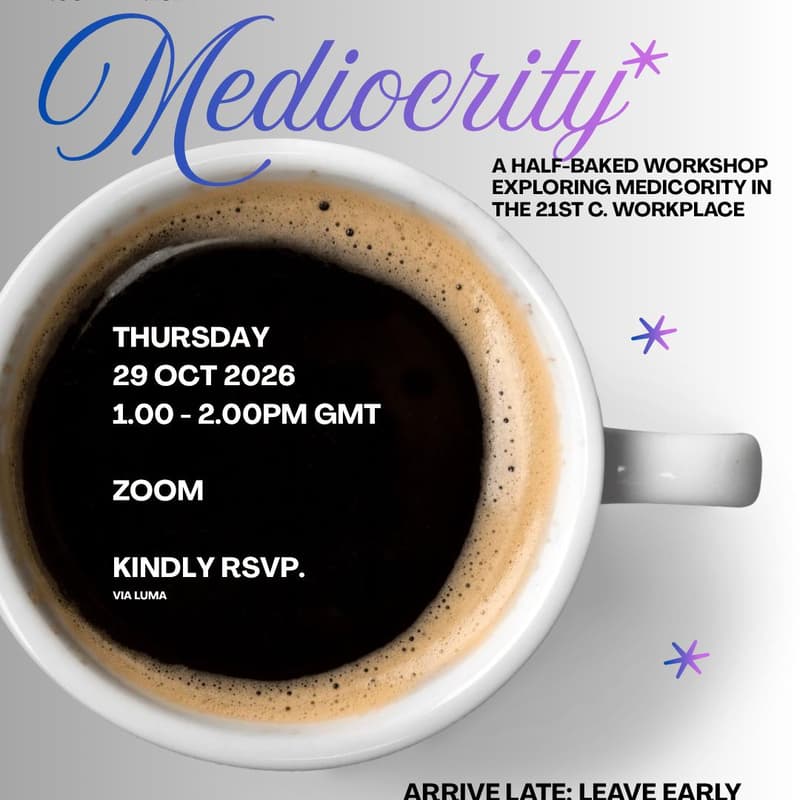
Mediocrity
A much-deserved break in your working day to go to a meeting that accomplishes nothing.
Having worked in and with hundreds of organisations over all the continents (excepting Antarctica, which does not breed mediocrity) we have observed a few water coolers in our day. Although there is never any water in the cooler, let alone any cooling.
We are interested in exploring such things as:
The relationship between purpose-led work and mediocrity: how bureaucracy, internal power dynamics, a lack of accountability, and the pursuit of personal advancement can undermine the very change organisations exist to create.
The people who seem unable to recognise it in themselves (Not us, obviously). Those who overestimate their own abilities, mistake self-importance for excellence, hard-won expertise or experience and make it known loudly in meetings, and somehow navigate organisational politics so successfully that they advance without necessarily delivering meaningful results. What happens when these individuals gain influence or power, while those with actual expertise, experience and humility become frustrated, marginalised and pushed out, zapping any energy to do any good in this world? #America is what.
Whether mediocrity is an inevitable feature of organisational life, or whether purpose-led organisations are particularly vulnerable to it. Do complex systems, grant funding and the difficulty of demonstrating impact create conditions in which mediocrity can flourish? How do internal processes drain creative energy, reward the appearance of progress over meaningful results, and leave those still committed to the mission disillusioned?
What about those that have entered careers with the energy of a 22 year old because they were 22 at the time, so that was their energy? Is the loss of faith an inevitable stage in a purpose-led career, a consequence of organisational dysfunction, or a reckoning with the gap between what we hoped to change or work on and what we can actually achieve?
We are going to cover all of these issues in 60 minutes or less so you can get back to that meeting with 43 other people to talk about AI. In fact you could keep that meeting open while we're having this meeting if Zoom and Teams would get along to let you do that.
Note! There is much thoughtful academic and industry research on this topic - this workshop is simply a time to reflect on these questions, summarize those academic articles in Claude and spit them out as our own expertise, and consider our own relationship to mediocrity.
Co-developed and hosted by:
Becky Schutt, Kate Gardner & Guests
Colleagues turned friends turned colleagues for 60 minutes only.