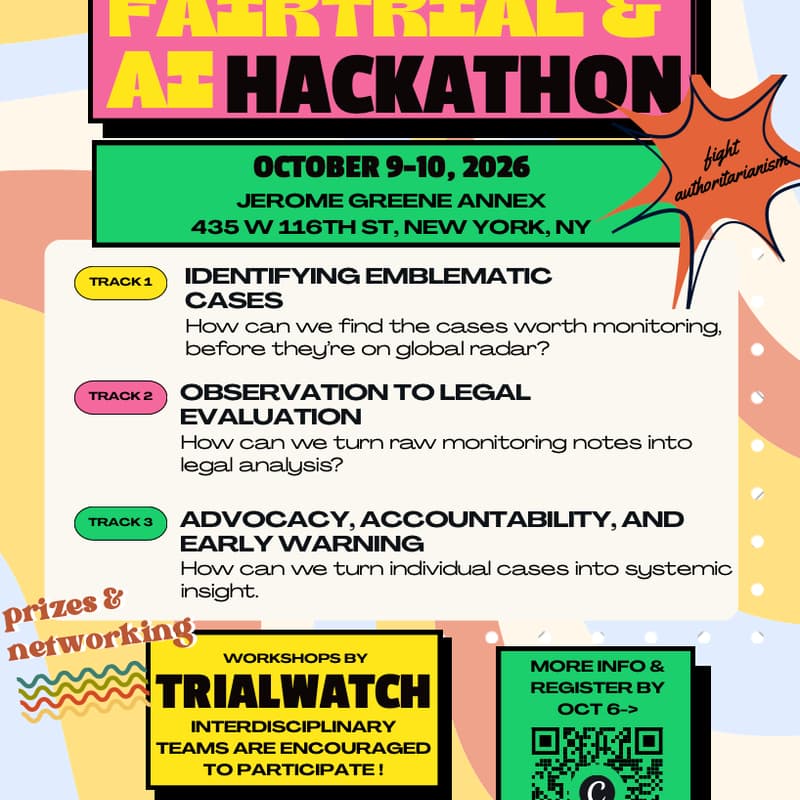
The Fair Trial Hackathon
TrialWatch (Human Rights Center) X AI Hackathon
Join the Human Rights Institute (HRI) at Columbia Law School for the Fair Trial Hackathon, where engineers, lawyers, and policy thinkers collaborate to build tools that defend the right to a fair trial. Teams of 3–5 will build the next generation of tools that strengthen fair trial monitoring, legal analysis, and human rights advocacy.
Across the world, courts are increasingly used to silence journalists, activists, and political opponents under the appearance of legality. The TrialWatch Project, run by the Human Rights Institute at Columbia University, monitors criminal trials globally, documents violations of fair trial rights, and transforms that evidence into advocacy that can change outcomes in real time.
Teams will work with real-world problem statements inspired by TrialWatch’s monitoring methodology and operational challenges. From structuring trial observation data to identifying patterns of judicial abuse and securing sensitive evidence in hostile environments, participants will explore how technology can help protect fundamental legal rights.
This event is open to students from law, engineering, data science, public policy, and related fields.
Bring your curiosity, your skills, and your commitment to justice.
Register by Oct 6th, 2026
!!!IMPORTANT!!
Only one project proposal per team is required. If you do not have a team, check the box for team registration.
Hackathon Tracks
Track 1: Identifying Emblematic Cases
Focus
Finding the cases worth monitoring, before they're on the international radar.
TrialWatch can't monitor every trial in a jurisdiction, so identifying which ones are emblematic, revealing a common tactic, setting a precedent, signaling a broader trend, happens early and mostly by hand. Teams build tools that help TrialWatch spot these cases sooner, including ones not yet drawing international attention.
Example ideas
Tools that scan news and court records for cases matching known patterns of judicial repression.
Models that learn what makes a case emblematic from TrialWatch's past monitoring decisions
Systems that track recurring tactics or charges within a jurisdiction over time
Track 2: Observation to Legal Evaluation (Prediction Models)
Focus
Transforming raw monitoring data into legal analysis.
TrialWatch lawyers review large volumes of monitoring notes, transcripts, and documents to identify violations of international fair trial standards, and that review is a bottleneck. Teams build tools that help surface potential violations, organize information in legally meaningful ways, and keep evaluation consistent across cases.
Example ideas
NLP tools that flag potential fair trial violations in monitoring notes
Dashboards linking observations directly to the international standards they may violate
Structured case review systems for human rights lawyers
Examples of other tools: https://meta-trials.vercel.app/
Track 3: Advocacy, Accountability, and Early Warning (Visualization, Automation)
Focus
Turning individual cases into systemic insight.
TrialWatch's advocacy depends on seeing patterns across trials, jurisdictions, and affected groups, not just single cases. Teams build tools that turn case level data into trends and indicators, including identifying common language across indictments and judgments (in alleged facts, legal analysis, or how defendants are described) and scraping trials TrialWatch hasn't monitored to compare against ones it has.
Example ideas
Dashboards surfacing patterns across monitored trials
Text analysis tools comparing language across indictments and judgments
Early warning systems flagging jurisdictions trending toward judicial repression
Submission Requirements
Projects should address one of the official hackathon tracks and demonstrate how the tool could support TrialWatch’s real-world monitoring and advocacy work.
Phase 1: Each team must submit a proposal for an AI use case application leveraging open source software that would run natively. The proposal must be the work and/or idea solely owned by the team members.
Phase 2 (Hackathon): Each team must submit the following by the end of the hackathon:
• A working prototype or functional concept
• A 10 min presentation describing the project
• A readme on github
Judging Criteria
Projects will be evaluated by judges from Columbia University and external experts in law, technology, and human rights. Evaluation will be based on:
Innovation: Does the project introduce a creative or novel approach to judicial monitoring?
Feasibility: Could the solution realistically be implemented within TrialWatch’s operations?
Human Rights Impact: Does the tool meaningfully strengthen the protection of fair trial rights?
Responsible AI: Does the team carefully consider potential risks, misuse, or bias?
Prizes
Top teams will receive:
Recognition awards and $50 giftcards
Potential follow-up research or development opportunities
Winning projects may also be featured in Human Rights Institute publications and future technology initiatives.
Expect hands-on support, networking, marketing, and amplification opportunities as well as prizes for the winning teams. Note that the winners will be selected overall, not per track.
Whether you are interested in AI, legal technology, data analysis, or human rights, the Fair Trial Hackathon offers an opportunity to apply your skills to one of the most urgent challenges facing justice systems today.