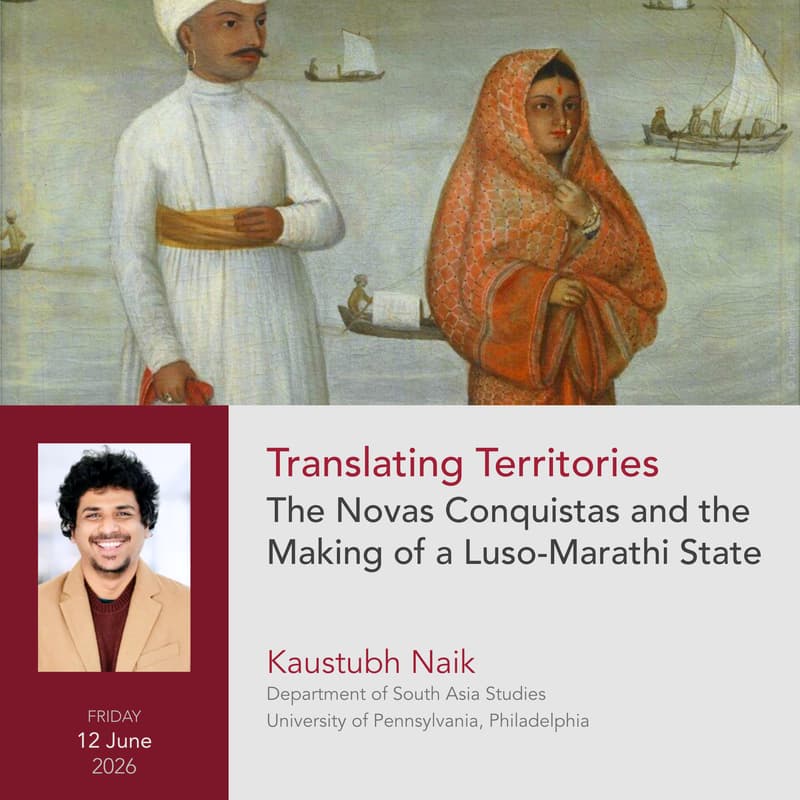
Translating Territories: The Novas Conquistas and the Making of a Luso-Marathi State
Translating Territories:
The Novas Conquistas and
the Making of a Luso-Marathi State
Kaustubh Naik
Doctoral Candidate, Department of South Asia Studies,
University of Pennsylvania, Philadelphia
Moderated by
Parag D Parobo
Associate Professor of History, Goa University, Taleigão, Goa
Translating Territories:
The Novas Conquistas and the Making of a Luso-Marathi State
When the Portuguese empire expanded into the “New Conquests” of Goa during the eighteenth century, they faced a massive challenge: they could not govern their new lands without understanding the local language. This lecture explores how Marathi became an indispensable tool of survival and statecraft for the Portuguese empire, shifting from a language used for foreign diplomacy to the everyday engine of local government.
At the heart of this story is a network of native Hindu scribes and interpreters, particularly from the Shenvi community. For generations, families like the Kamat Waghs held a near-monopoly on the role of língua do estado (State Interpreter). These multilingual scribes bridged the gap between European rulers and local chieftains, transforming traditional concepts of administration into legal Portuguese frameworks.
By the nineteenth century, this reliance on Marathi forced the colonial state to formally teach the language at the prestigious Portuguese Lyceum. Ultimately, this lecture reveals how an empire’s need to understand its subjects inadvertently empowered a sophisticated class of Hindu elites. By mastering the language of the state and safeguarding their own vernacular archives, these native intermediaries turned colonial dependency into a powerful tool for social mobility and political resistance.