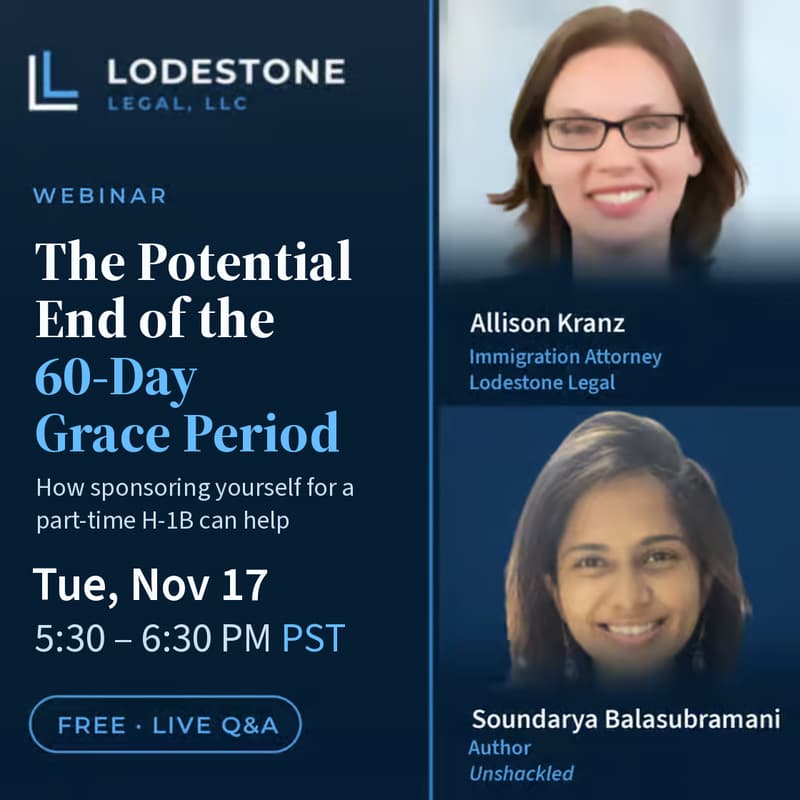
The Potential End of the 60-Day Grace Period: How Sponsoring Yourself for a Part-Time H-1B Can Help
On September 11, 2026, DHS proposed to completely eliminate the 60-day grace period currently provided to work visa holders (and their dependents) whose employment unexpectedly ends. The consequences of this potential change are incredibly harsh, as nearly all work visa categories, and dependents, are impacted: H-1B, E-1, E-2, E-3, L-1, O-1 and TN. Accordingly, if adopted, an employee with a single H-1B visa who is unexpectedly laid off on a Monday, will be unlawfully present in the U.S. by Tuesday, unless USCIS has received the employee's new visa application on the exact same day as the official termination.
Since U.S. immigration law requires foreign nationals to be in lawful status at the time their new visa application is received by USCIS, attorney Allison Kranz perceives this proposal as, "a cruel weaponization of U.S. regulation to force nearly all foreign workers to leave the U.S. upon termination." Additionally concerning, under "B. Costs of Attending Immigration Hearings," the new DHS proposal signals that USCIS may be planning to issue deportation notices, "NTAs," Notice to Appear for Removal Proceedings, to foreign nationals who fail to depart immediately unless they hold alternative status allowing them to remain in the U.S.
Join Soundarya Balasubramani and Allison Kranz, Managing Partner of Lodestone Legal, as they explain how foreign workers on H-1B visas can safeguard their futures in the U.S. by sponsoring themselves for a second, concurrent, full or part-time H-1B visa through starting a new business (and why F-1 international students may consider entering themselves into the March 2027 H-1B Lottery).
During this webinar, we'll take a deep-dive into:
DHS's proposal eliminating the 60-day grace period, and potential consequences
If the DHS proposal is adopted, how soon could it take effect
Who qualifies: first-time applicants, concurrent H-1B holders, and people between jobs
What's required for H-1B self-sponsorship
Selecting a business structure that supports your business needs, as well as your immigration goals
How a self-sponsored H-1B visa has no impact on your current H-1B, and vice versa
What to consider if you've signed a non-compete agreement with your current H-1B employer
How a self-sponsored H-1B visa can be helpful in obtaining a green card through EB-1A Extraordinary Ability
Although we plan to give you the lay of the land, attendees will strongly benefit from watching our October 6th webinar, "The Entrepreneur H-1B: How to Sponsor Yourself Through Your Own Company," prior to attending:
**Note that the DHS proposal is only a proposal currently. It is not scheduled to take effect on any particular date, but after the period of public comment ends on November 10, 2026, DHS will determine whether this proposal becomes an actual change. If DHS proceeds, it must publish the finalized rule in the Federal Register with a date for the rule change to take effect. Historically, DHS has given at least 30-day advance notice of major regulation changes.