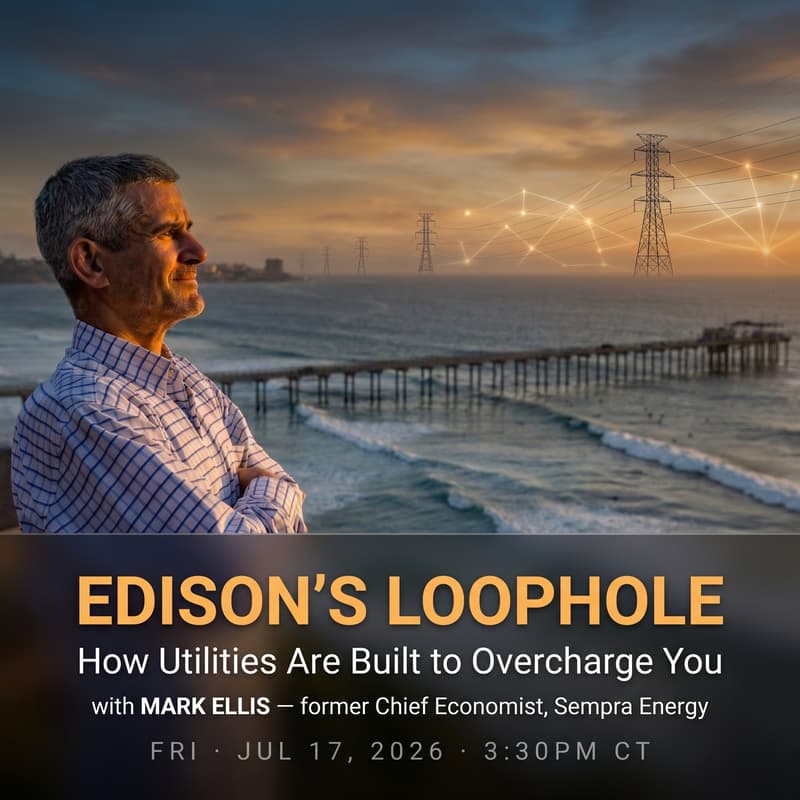
Edison's Loophole: How Utilities Are Built to Overcharge You
A conversation with Mark Ellis — former Chief Economist and Chief of Corporate Strategy at Sempra Energy, with nearly 40 years across deregulation, the rebirth of US natural gas, the Hi Folks, I've sorted 7/17/2026 at 3:30 PM CST to have an industry specialist, personal mentor and friend, and the former Chief Economist and Chief of Corporate Strategy of Sempra Energy – Mark Ellis – speak to our group. Mark has nearly 40 years of experience in the energy industry, spanning many of its major transitions and structural changes, including deregulation, the decline and rebirth of US natural gas, the development of the global LNG market, GHG regulation, and the emergence of renewables.
Mark’s primary focus now is on reforming utility monopoly regulation, which hasn't been revisited or updated since Edison’s day and is the root cause of much of the sector’s current dysfunction. Mark wrote a widely-cited paper that explains how the traditional regulatory model misaligns utility financial incentives with customers' interests. He is also the architect of Competitive Direct Equity (CDE), a proposal to replace regulator-set returns with competitively determined rates through Dutch auction mechanisms that is under active consideration in New York and Pennsylvania. Mark’s work and its implications have been examined in MS Now, BIG by Matt Stoller, Politico, AP News, Chicago Tribune, WHYY, Harper’s, Heatmap News, Inside Climate News, Los Angeles Times, and San Francisco Chronicle, raising public and political understanding of what was once an arcane regulatory footnote and putting utility return on equity at the center of live policy debate nationwide.
Mark will discuss the fundamentals of ratemaking, utilities’ unique incentive structure, and the counterintuitive implications for their strategies and interactions with customers, suppliers, and partners. He will also discuss his policy and market-based initiatives to address the misaligned incentives that arise when a service critical to the entire economy is organized as government-granted privately-owned monopolies.