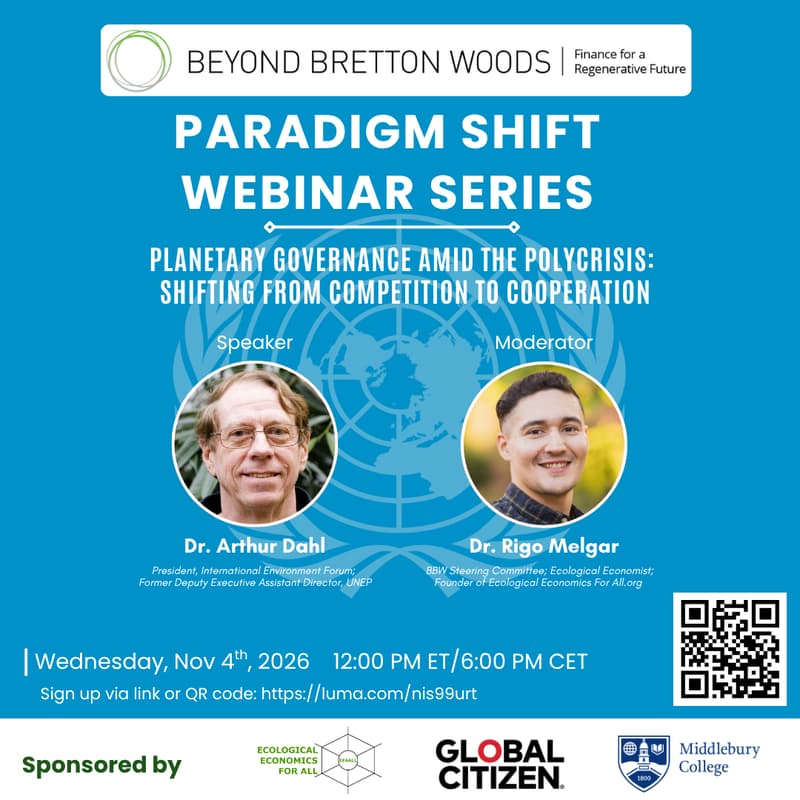
Planetary Governance Amid the Polycrisis: Shifting from Competition to Cooperation
Event Overview
There is a growing recognition of the existential threats posed by the polycrisis to the ecological foundation of socio-economic systems among academic circles, the public and private sectors. Yet, post-WWII global institutions, such as the United Nations (UN), the International Monetary Fund (IMF), and the World Bank continue to be largely ineffective in their response to the underlying drivers of the polycrisis.
It can be argued that this ineffectiveness is rooted in the structures established when they were founded, which has led to more competition, as opposed to cooperation, under a growth paradigm rooted in anthropocentrism (i.e., the false separation of humans from the rest of nature).
This growth is sustained, in part, by an addiction to fossil fuels, despite their central role in driving climate change and the breach of 6 of the 9 planetary boundaries. The growing penetration of low-carbon energy has largely added to, rather than substituted for, fossil fuels. And the recent geopolitical and inflationary crisis of the Strait of Hormuz has major countries doubling down on competition, further reinforcing the existing system.
To top it off, AI appears to become a reinforcer of the growth paradigm and our addiction to fossil fuels, while further disconnecting us from nature, enabling mass surveillance, and posing existential risks to humanity's future. Meanwhile, the UN has repeatedly failed to decisively address climate change despite 31 years of COP negotiations.
In this webinar, Dr. Arthur Dahl joins Dr. Rigo Melgar for a discussion on the opportunities and limitations of transforming global governance institutions towards an eco-centric approach that fosters cooperation and centers the post-growth goal of wellbeing within planetary boundaries. The session will draw on Dr. Dahl's decades of experience in international environmental governance, intergovernmental organizations, and his most recent book on global governance and the reform of the UN system.
Sign up to receive the webinar link
Speaker: Dr. Arthur Lyon Dahl
Dr. Arthur Lyon Dahl is the President of International Environment Forum. He is also the former Deputy Assistant Executive Director at the United Nations Environment Programme, with over 50 years experience in sustainability, international environmental assessment and governance, and systems science, including more than 20 years in intergovernmental organisations. A specialist on coral reefs and small island developing States (SIDS), he spent many years in the South Pacific and organized the Pacific Regional Environment Programme. He has published many scientific papers and books including: Island Directory, Unless and Until: A Baha’i Focus on the Environment, The Eco Principle: Ecology and Economics in Symbiosis, and In Pursuit of Hope: A Guide for the Seeker. Most recently, he has worked with two colleagues on global governance and reform of the UN system, winning the New Shape Prize of the Global Challenges Foundation in 2018, and with a book “Global Governance and the Emergence of Global Institutions for the 21st Century” being published by Cambridge University Press in January 2020.
Moderator: Dr. Rigo Melgar
Dr. Rigo Melgar is an Ecological Economist and founder of Ecological Economics For All. He also serves on the Beyond Bretton Woods Steering Committee.
Hosted by Beyond Bretton Woods (BBW), a think tank that challenges the current international financial architecture and proposes a radical paradigm shift to ensure a world with equitable, eco-centric, and regenerative systems that serve the interests of humanity and nature.
Sponsors
Sponsored by Global Citizen, Middlebury College, and Ecological Economics For All.