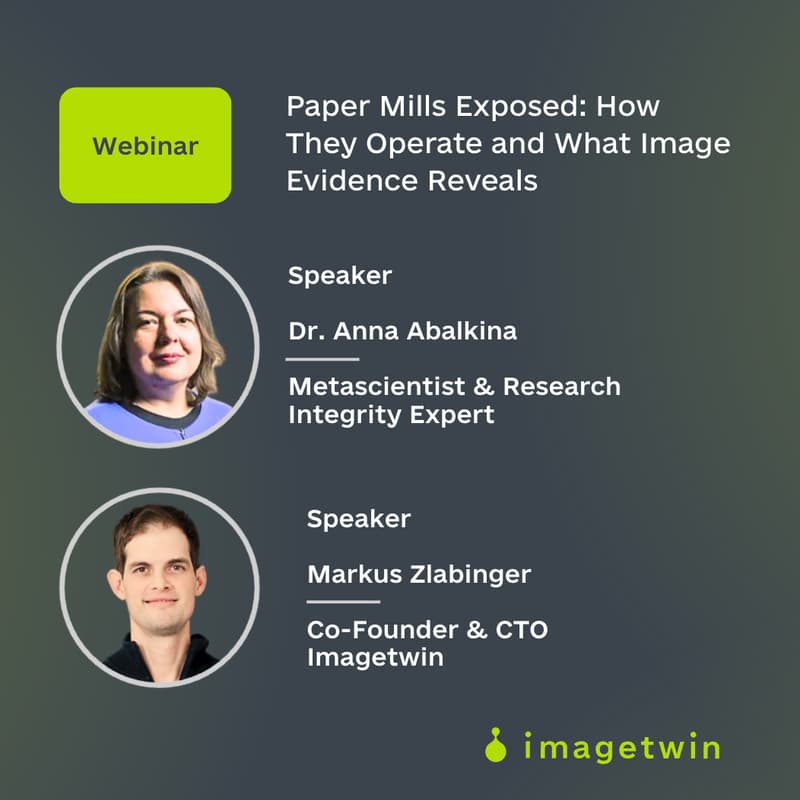
Paper Mills Exposed: How They Operate and What Image Evidence Reveals
Recently, IEEE retracted 1,417 conference papers in a single day. Nature called it a record-breaking retraction. All of them had been identified by a study led by Anna Abalkina, which traced 4,407 social media ads selling authorship slots back to 2,062 papers across 366 IEEE conference proceedings.
That study followed the ads. Paper mills also leave traces in the papers themselves, and figures are often where they show up first: reused images, recycled templates, and visuals that don't match the research they claim to show.
Join us for a conversation with Dr. Anna Abalkina, moderated by Markus Zlabinger (Co-Founder & CTO, Imagetwin). We'll look at how paper mills operate, how the IEEE case came together, and what image evidence can reveal that text checks miss.
📅 December 2, 2026
🕒 15:00 CET
📍 LinkedIn & YouTube Live
What we'll cover:
▫️ Paper mills 101: who runs them, who buys from them, and how the authorship-for-sale market works
▫️ The IEEE case: how ads on Telegram, WhatsApp and Facebook were matched to published conference papers
▫️ Image evidence: a real case where Anna identified paper mill output through its images
▫️ What image patterns can signal mass-produced papers, and why they often pass peer review
▫️ How editors and integrity teams can combine manual review with image screening at scale
▫️ What publishers, conferences and institutions should change now
Who should join:
▫️ Editors and editorial board members
▫️ Conference organizers and proceedings publishers
▫️ Research integrity officers and image integrity analysts
▫️ University research offices and libraries
▫️ Anyone concerned about the credibility of the scientific record
About the speaker:
Dr. Anna Abalkina is a research fellow at Freie Universität Berlin, investigating corruption in higher education, academic misconduct and paper mills. She was named in Nature's 10 in 2024 and co-created The Retraction Watch Hijacked Journal Checker.
👉 Register and join us live.