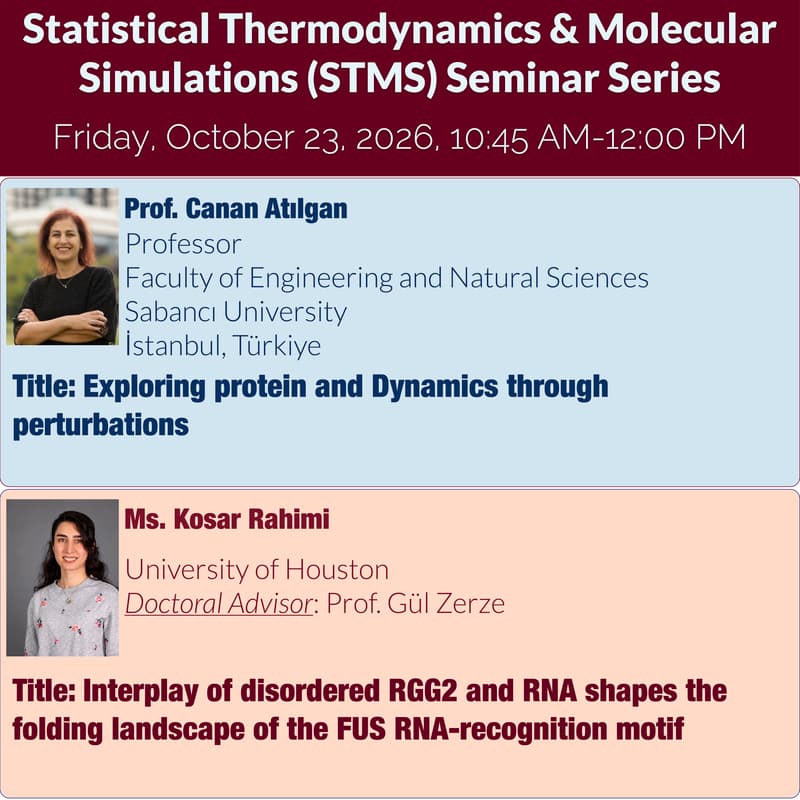
Statistical Thermodynamics & Molecular Simulations (STMS) Seminar Series: Prof. Canan Atılgan (Sabancı), Ms. Kosar Rahimi (Houston)
These seminar series are aimed at providing a virtual platform for sharing scientific research in the area of statistical mechanics, molecular simulations, and computational materials science. In early 2020, the coronavirus pandemic disrupted many large in-person scientific gatherings, including conferences and department seminars. We launched STMS in October 2020 to fill this gap, and provide a venue for dissemination of research findings and exchange of ideas in the age of COVID. We are grateful for all the excitement and support that we have received from the community since then, motivating us to continue these series beyond the pandemic. We were proud to host the 100th STMS on January 30, 2026.
Each seminar will be a 60-minute event and will comprise of a long-form (30-minute) talk by a principal investigator or a senior research scientists from academia or industry and a short-form (15-minute) presentation by a graduate student or a postdoc. The remainder of the event will be dedicated to Q&A (10 minutes for the PI, 5 minutes for the student/postdoc). Long-form speakers will be chosen by the STMS Organizing Committee, while we encourage suggestions from the community at large. Student and postdoctoral speakers can either be nominated by their advisors or can self-nominate themselves by sending a CV to the organizers. We normally hold 1-2 seminars per month, and the events take place in the last two Fridays of each month, from 10:45 AM-12:00 PM Eastern Standard Time (EST):
This event's talks:
Exploring Protein Structure and Dynamics Through Perturbations
Prof. Canan Atılgan (Sabancı)
Abstract: Proteins are dynamic molecular systems whose conformational behavior is governed by a complex interplay of molecular interactions and structural constraints. Understanding how proteins respond to perturbations can reveal the molecular determinants of conformational changes and allosteric communication. In this talk, I will discuss how the relationship between equilibrium fluctuations and perturbation response provides a framework for investigating protein dynamics. Drawing on our work with molecular simulations and reduced representations of proteins, I will illustrate how localized perturbations propagate through protein structures, influence collective motions, and identify residues that play important roles in conformational responses. I will also discuss how changes in molecular interactions, including those introduced by mutations, can alter protein dynamics and conformational behavior. Together, these studies highlight how perturbation-based approaches can provide insights into the physical mechanisms governing protein structure and dynamics.
Speaker Bio: Canan Atılgan received her B.S. and Ph.D. degrees in Chemical Engineering from Boğaziçi University. Following postdoctoral research at Florida State University, she joined Sabancı University in 1999, where she is currently Professor in the Faculty of Engineering and Natural Sciences. Her research lies at the interface of physics, biology, and network science, employing molecular simulations, network models, and machine learning to investigate protein structure, dynamics, and function. Her work spans fundamental questions in computational biophysics and applications ranging from antibiotic resistance to fluorescent biosensor design. She is an elected member of EMBO, Academia Europaea, and the Science Academy, Türkiye (Bilim Akademisi), which she served as President from 2021 to 2024. She is also engaged in science policy and initiatives promoting scientific integrity, open science, and the dissemination of scientific knowledge.
Interplay of Disordered RGG2 and RNA Shapes the Folding Landscape of the FUS RNA-Recognition Motif
Kosar Rahimi (Houston)
Abstract: RNA-binding proteins play essential roles in RNA metabolism by regulating the structure, function, and fate of their RNA targets. Fused in Sarcoma (FUS) is an RNA-binding protein involved in multiple aspects of RNA processing, particularly splicing, and its misregulation and aggregation are associated with neurodegenerative diseases, including amyotrophic lateral sclerosis (ALS) and frontotemporal dementia (FTD). The RNA-recognition motif (RRM) of FUS is particularly interesting because its structural stability is sensitive to its molecular environment, and its unfolding has been linked to amyloid fibril formation. However, how neighboring intrinsically disordered regions and RNA jointly influence RRM stability remains poorly understood.
Here, we investigate the effects of the neighboring disordered arginine-glycine–rich (RGG2) region and RNA on RRM conformational stability using atomistic molecular dynamics simulations with Multithermal-Multiumbrella On-the-fly Probability Enhanced Sampling (MM-OPES). We examine four systems: isolated RRM, RRM–RGG2, RRM/RNA, and RRM–RGG2/RNA.
Our results reveal that RGG2 stabilizes the folded RRM by introducing a highly stable, native-like basin absent in the isolated RRM. Contact analyses demonstrate that RGG2 forms multivalent interactions with several RRM secondary-structure elements, effectively acting as a stabilizing belt. Interestingly, introducing RNA changes this behavior. In the RRM–RGG2/RNA system, the most stable basin is shifted to where RNA forms persistent interactions with RGG2, particularly through its terminal nucleotides, while making limited direct contacts with the RRM. These interactions restrict RGG2 conformational flexibility and appear to compromise its stabilizing interactions with the RRM, leading to reduced stability of the central β-sheet. In contrast, at highly folded configurations, RNA interacts directly with the RRM through contact patterns resembling those formed by RGG2 in the absence of RNA. This suggests that maintaining the highly native-like RRM structure requires stabilizing interactions that can be provided by either RGG2 or RNA. Notably, removing RGG2 in the presence of RNA leads to the emergence of a highly stable, low-Q basin characterized by heterogeneous, nonnative secondary structures with altered α-helical and β-sheet content.
Together, these findings demonstrate that the disordered RGG2 region regulates both RRM folding stability and its interactions with RNA, highlighting how molecular context reshapes the conformational landscape of protein–RNA complexes. The emergence of structured, nonnative RRM configurations upon removal of RGG2 suggests that loss or disruption of RGG2-mediated stabilizing interactions could favor RRM misfolding, potentially contributing to FUS-associated aggregation.
1- Rahimi, Kosar, et al. The Journal of Physical Chemistry B 130.27 (2026): 6773-6781.
Speaker Bio: Kosar Rahimi is a Ph.D. candidate in the Department of Chemical and Biomolecular Engineering at the University of Houston, where she works with Prof. Gül H. Zerze in the Computational Biomolecular Science Lab. Her research focuses on understanding the folding and conformational dynamics of multi-domain proteins and protein–RNA interactions using atomistic molecular dynamics and enhanced sampling techniques. Her research has resulted in first-author publications in journals of the American Chemical Society (ACS) and has been recognized with several awards, most recently the 2026 AIChE Pharmaceutical Discovery, Development and Manufacturing Division Student Award. She gained industry experience at Bristol Myers Squibb, working on computational modeling in drug development. Kosar received both her B.S. and M.S. degrees in Chemical Engineering from Sharif University of Technology in Tehran, Iran.