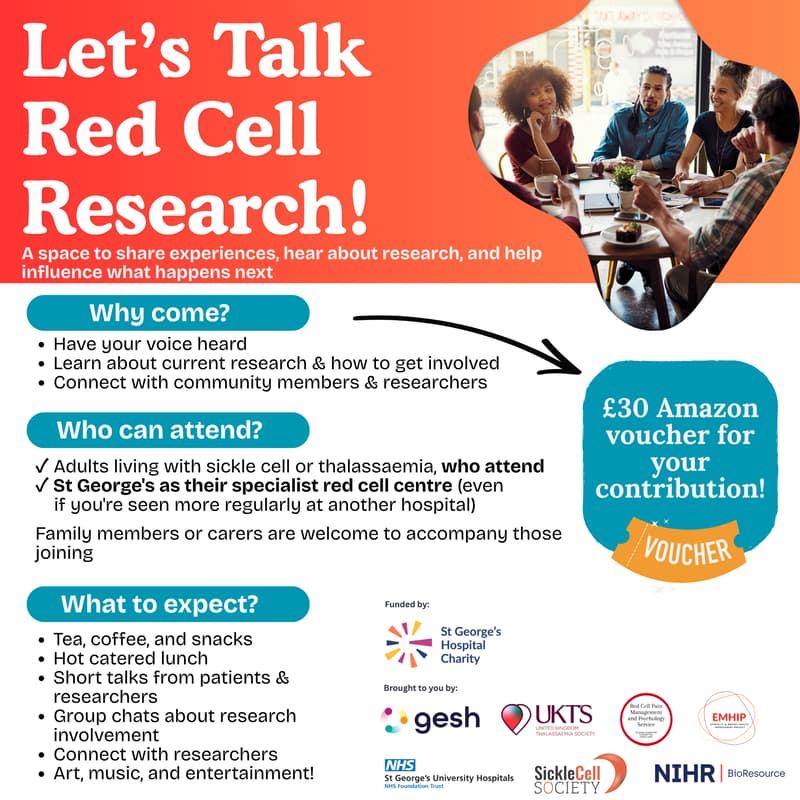
Let's Talk Red Cell Research!
Let's Talk Red Cell Research
Places are limited, so please register your interest to reserve your place!
Overview
We'd love to invite you to Let's Talk Red Cell Research, a relaxed and informal space bringing together adults living with sickle cell disorder and thalassaemia, family members and carers, healthcare professionals, and researchers.
This is a space to hear about research, share your experiences and ideas, ask questions, and help shape what happens next.
You don't need to have any previous experience of research to attend. We're interested in what matters to you, what questions you have, and what would make research more accessible and relevant to you.
Please take a moment to read the information below before deciding whether you'd like to join us. If anything is unclear, or you'd like to know more, please get in touch.
What will the event involve?
The event will use a café-style format, with short talks followed by relaxed group discussions.
You'll have the opportunity to:
Hear about current research relevant to sickle cell and thalassaemia
Learn about different ways to get involved in research
Ask questions and discuss myths, concerns or barriers around research
Meet researchers and other members of the sickle cell and thalassaemia community
Share your experiences and ideas about what matters to people living with sickle cell and thalassaemia
Help researchers understand what could make it easier and more meaningful for people to get involved in research
There will also be tea, coffee and snacks, a catered hot lunch (Right Choice Caterers: https://rightchoicecaterers.co.uk/), entertainment, art and music!
Why are we holding this event?
Research can play an important role in improving our understanding and treatment of sickle cell and thalassaemia. However, people can have questions, concerns or previous experiences that affect how they feel about research.
We want to create a space where people affected by sickle cell and thalassaemia and researchers can learn from one another, build trust and explore how communities can have a greater say in the research that happens in the future.
Who is organising this event?
This event is organised by the Red Cell Pain Management and Psychology Service at St George's Hospital, in collaboration with:
Sickle Cell Society
UK Thalassaemia Society
Ethnicity and Mental Health Improvement Programme (EMHIP)
NIHR BioResource
This event is funded by St George's Hospital Charity.
Who can attend?
You are welcome to attend if you are:
An adult living with sickle cell disorder or thalassaemia and are
Seen at St George's Hospital as your specialist haemoglobinopathy (red cell) centre, even if you are seen more regularly at another hospital.
Family members and carers are also welcome to accompany someone attending. Please register them as an attendee so that we can plan spaces and catering appropriately.
Will I be compensated?
Yes, as a thank you for your time and contribution, you will receive a £30 Amazon voucher for taking part.
What will happen to the ideas shared at the event?
Facilitators will take notes during the group discussions to help us capture the questions, experiences and ideas that come up during the event. We will also have a live illustrator from Sketchology (https://www.sketchology.co.uk) who will be capturing key themes from the day in a visual format including drawings alongside text.
After the event, we will review notes and the final illustration from Sketchology to identify common themes and important points raised by participants. This will help us understand what people share on the day and what could make research engagement better in the future.
We may use what we learn to:
Inform our project report
Help shape future research engagement activities
Share learning through presentations and other professional or community events
Potentially contribute to a publication about the project
We may also use short, anonymised quotations from the discussions to help illustrate the experiences and ideas shared.
We will not include people's names or information that could identify them when sharing these findings.
You choose what you share. You do not have to talk about personal experiences, answer any particular question, or take part in a discussion if you don't want to.
Feeding back on the event
We will ask participants to complete short feedback and demographic forms. This will help us understand what you thought of the event, what was useful, and what could be improved. This information will be used to support us in reporting on the event and how it went (e.g., project report, presentations etc.).
Taking part
Taking part in this event is voluntary. You can choose how much or how little you participate.
By registering for the event, you are agreeing to attend and to facilitators taking notes during the group discussions. These notes may be reviewed and used in the ways described above.
If you have any questions about how your contributions may be used, please contact us before the event.
Photography and video
Photographs and/or short video recordings may be taken during the event for communication, publicity and reporting about the event.
You do not have to be photographed or recorded in order to attend.
If you do not want to be photographed or recorded, please let a member of the team know when you arrive. We will make reasonable efforts to ensure that you are not included in photographs or recordings.
If an identifiable photograph or recording of you is going to be used, we will ask for your permission before using it.
Keeping in touch
We may contact you after the event with information about future research involvement opportunities, events or related activities.
This is optional and will not affect your ability to attend the event.
You can let us know when you register whether you would like to receive future communications.
Food and accessibility
Lunch and refreshments will be provided, including vegetarian options.
Please let us know about any allergies or dietary requirements when you register, so that we can make appropriate arrangements.
The event space is at ground floor level with a toilet on site.
If you have any accessibility requirements or anything else that would help you feel comfortable attending, please contact us before the event.
Want to know more or get involved?
If you have any questions about the event, what to expect, accessibility, or how your contributions will be used, please get in touch:
Stephen McIntyre
Clinical Psychologist
Red Cell Pain Management & Psychology Service
St George's University Hospitals NHS Foundation Trust
Team mobile: 07798 581198
Email: scdpain@stgeorges.nhs.uk