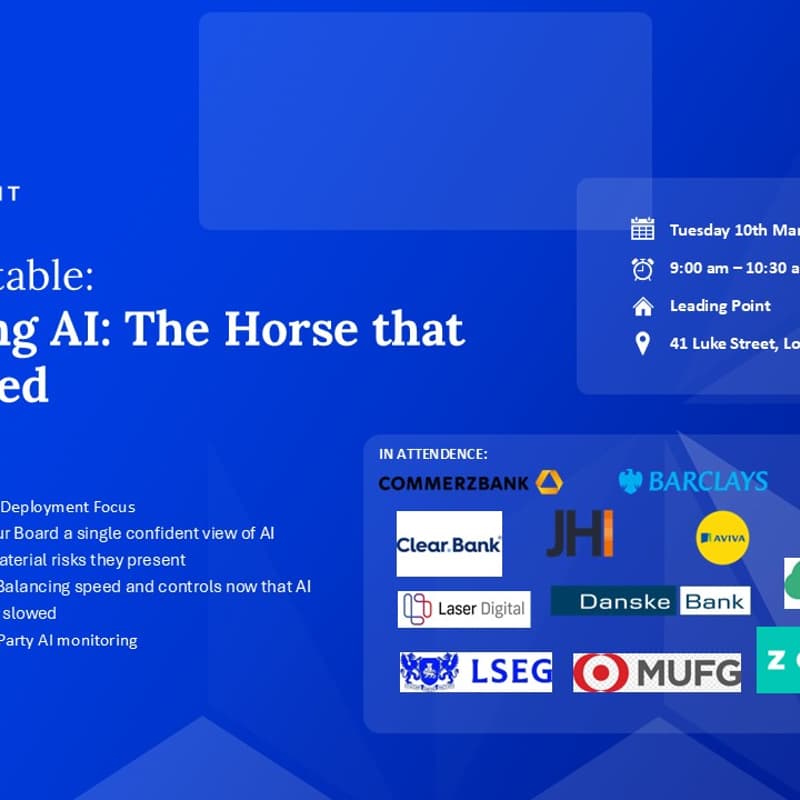
AI Roundtable - Managing AI, "The Horse that has Bolted"
AI Roundtable
Managing AI: The Horse That Has Bolted
AI adoption across financial services has already crossed the point of no return.
Generative and agentic AI tools are embedded in day-to-day workflows, adopted by engineers and business users alike, and increasingly procured through third-party platforms. In many organisations, AI is already operating in production environments, often beyond the visibility of traditional governance, risk, and control frameworks.
The challenge is no longer how to prevent AI adoption. The horse has already bolted.
This roundtable will focus on the more difficult and urgent question facing boards, risk leaders, and data executives: how do we regain control once AI is already in motion, without pulling innovation to a halt?
Drawing on live practitioner experience from across banking, insurance, asset management, and fintech, the discussion will explore how organisations are responding now that AI is scaling faster than approval processes, model validation teams, and third-party oversight can keep up.
Key themes for discussion will include
• How firms are identifying where AI is already in use, including shadow and third-party AI
• What breaks when traditional governance models meet non-deterministic and agentic systems
• How to shift from approval-based control to continuous monitoring and exception-based oversight
• Where accountability truly sits when AI decisions go wrong
• How to manage AI risk when vendors change models and behaviour without notice
• Creating safe spaces for innovation while restoring board-level confidence and visibility
This will be a closed-door, practitioner-led session held under Chatham House Rule. The focus will be on what is actually working, where firms are struggling, and the practical steps being taken to stabilise AI risk after adoption has already occurred.
If AI has already taken hold in your organisation, this session is about learning how to manage the horse, not chasing it back into the stable.