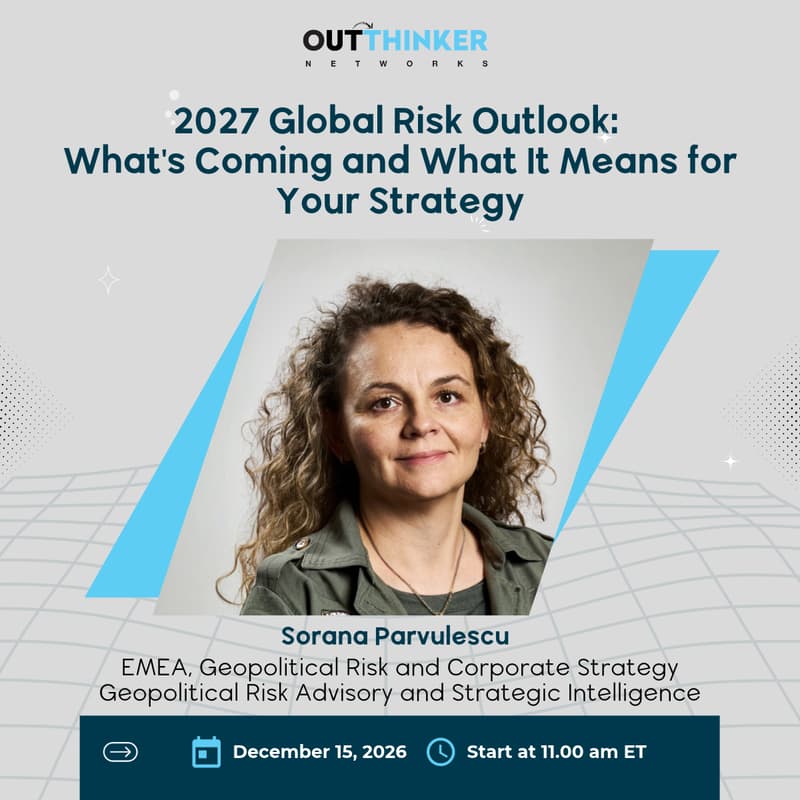

2027 Global Risk Outlook: What's Coming and What It Means for Your Strategy
For strategy leaders, the challenge is not identifying more risks. It is determining which ones could materially alter the assumptions underpinning the strategy, and what to do about them. Experience also shows that organizations are often better at preparing for the crisis that has just happened than the one that is coming next. The pandemic illustrated this vividly: before it struck, it was difficult to elevate pandemic risk onto the strategic agenda; afterwards, it became a top concern, just as its immediate likelihood was receding.
For CSOs, spotting the right risk is only half the job. They also need to frame risks and implications in a way that prompts leaders to listen and to act. This interactive roundtable will feature Sorana Parvulescu, who leads Control Risks' global geopolitical risk practice, a team of over 100 in-house geopolitical, regulatory, human rights, maritime and security risk experts across 25 offices and 5 continents. Sorana advises boards and C-suite leaders on their most important risk issues, with a focus on geopolitical and regulatory risk.
Rather than simply presenting a list of the “top risks” for 2027, Sorana will explore the developments most likely to challenge strategic assumptions, create new dependencies or require a change of course. The discussion will then turn to the group: which risks matter most across different industries, where are the less obvious exposures, and how could disruption in one sector cascade into another?
This will be a conversation, not a presentation, designed to test assumptions and compare perspectives across the room.
Things we will cover:
The geopolitical landscape in 2027: what the second half of the current US administration could mean for the operating environment for global companies.
The US-China technology contest: whether choices around AI, technology platforms and ecosystems are becoming long-term strategic decisions, rather than simply procurement or technology choices.
The rewiring of energy and trade: how the Middle East crisis is reshaping established systems and what the early signals tell us about what comes next.
The return of vertical integration: why companies are seeking greater control over critical energy, infrastructure and logistics dependencies, and what that means for corporate strategy.
From risk insight to executive action: how to frame an emerging risk so that the leaders who own the decision recognize its strategic significance and act.
How risks travel: why a disruption that appears peripheral to your industry today can become strategically consequential through second- and third-order effects.
This conversation is designed for senior strategy leaders who act as their organization's early-warning system and want a clearer view of the risks that aren't yet on their leadership's radar, along with the implications to bring into strategic planning.