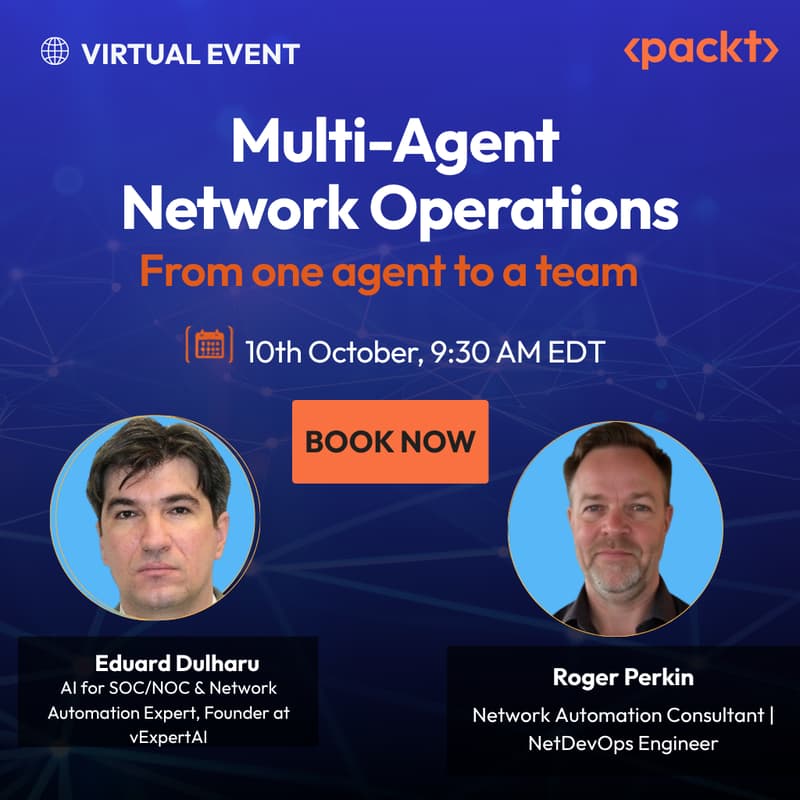

Multi-Agent Network Operations
From one agent to a team
One agent can follow a troubleshooting path. That does not mean it will find the real problem.
In network operations, the loudest signal is not always the root cause. A branch loses reachability. An interface flap shows up everywhere, but the network still does not recover because of a silent OSPF area mismatch. A single agent chases the loud log and declares false victory. A team of agents, with validation and a human approval gate, catches what the single agent missed.
This workshop takes you from one agent to a team: a coordinator plus specialists for troubleshooting, configuration, and validation. The agents divide the work, use a validated YAML playbook as the command source of truth, and require human approval before any network change.
Why attend?
If you work in network operations, SRE, DevOps, cloud, or platform engineering, you already know the pressure of incident work. You need speed, but you cannot afford guesswork.
This session shows a safer multi-agent pattern for network operations: agents can investigate, hand off work, validate findings, and keep the engineer in control.
See why one agent may stop too early during troubleshooting
Use coordinator and specialist roles to divide the investigation
Run commands from a trusted playbook instead of free-form LLM output
Use validation to catch missed root causes
Keep a human approval gate before any network change
What you will build
You will build a working multi-agent network operations pipeline that investigates and resolves a realistic incident.
A coordinator agent that manages the investigation
Troubleshooting, configuration, and validation specialists
Agent-to-agent handoff through a message protocol
Deterministic command execution through a YAML playbook
A human approval gate for proposed network changes
How the labs work
Student labs run in the browser through Google Colab against a high-fidelity incident simulator. There are no installs, no cloud accounts, and nothing to break during setup. Every student runs the labs themselves.
Real Arista cEOS in Containerlab is shown as an instructor demo using the same agents and identical code.
What you will learn
When to move from one agent to a team
How a coordinator and specialists divide network operations work
How agents coordinate through a message protocol
How configuration and validation specialists fit into the workflow
How deterministic execution works through a validated playbook
How human-in-the-loop approval keeps changes controlled
What the production path looks like for MCP, scaling agents, and observability
Who should attend?
Network engineers, SREs, DevOps engineers, cloud engineers, platform engineers, and technical teams with 3+ years of experience who are comfortable reading Python and want to understand multi-agent workflows for network operations.
Prerequisites
You should be comfortable reading Python. No machine learning background is required.
This is designed as a sequel to building or watching a single network agent being built, such as Sif’s “Build AI Agents for Network Operations.”
The stack is free and browser based: Google Colab, Python, Ollama or a shared model endpoint, and a simulator with the same interface as Arista cEOS and Containerlab.
What you will take away
A working multi-agent pipeline you built
A coordinator plus specialists resolving a realistic network incident
A clear view of when one agent is not enough
A message protocol pattern for agent coordination
A deterministic command pattern using a validated playbook
A human approval gate for any network change
Scope
This is not an ML training or fine-tuning workshop. It is not a single-agent-from-scratch course and it is not a RAG course. It does not teach auto-remediation, because every change passes through a human gate.
Final takeaway
Real incidents are rarely solved by chasing the first loud signal. This workshop shows how a team of agents can divide the work, validate the answer, and keep humans in control of every network change.