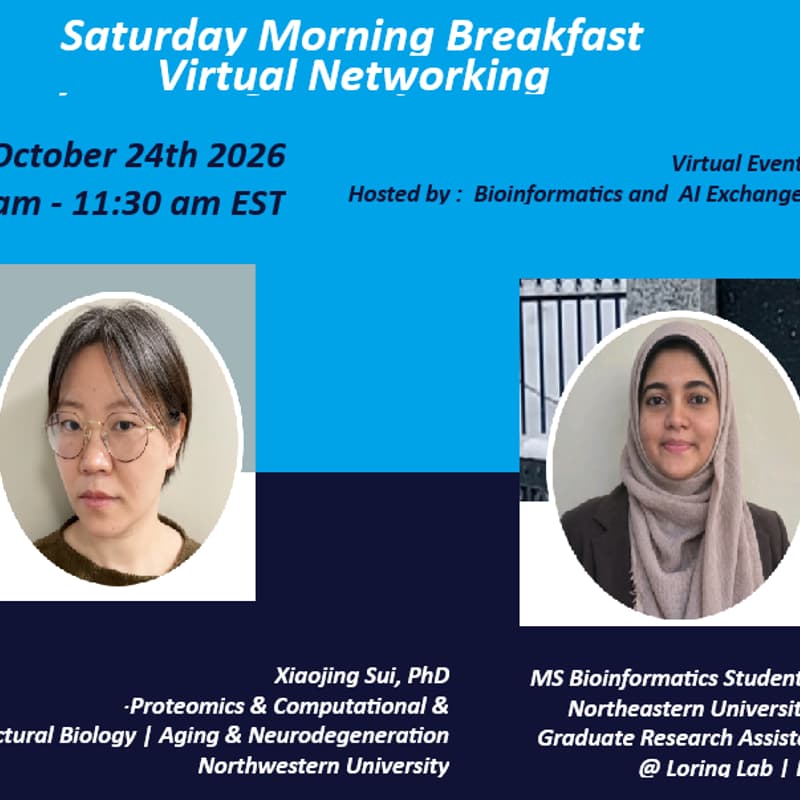
Saturday Morning Breakfast Short Talks and Virtual Networking
Join us for a Saturday morning virtual breakfast networking event to meet new colleagues, hear about interesting work and network.
Featured Speakers:
Xiaojing Sui
Dr. Sui is an aging and proteomics researcher who earned her PhD at the University of Melbourne and conducted independent postdoctoral research at Northwestern University. Recently recognized as a Rising Star in Proteomics and Metabolomics by the Journal of Proteome Research, she investigates how changes in protein structure contribute to aging, neurodegeneration, and loss of cellular resilience. In her talk, “Structural Proteomics Uncovers Systemic Conformational Remodeling in Early Aging and Stress,” she will present findings from quantitative structural proteomics studies in C. elegans, revealing that nearly one-third of the proteome undergoes structural changes early in aging, well before physiological decline. Her research also demonstrates how localized protein stress can trigger organism-wide structural instability, highlighting the interconnected nature of proteostasis and identifying new opportunities to understand and potentially intervene in aging-related dysfunction.
Aleena Iraqui
Aleena Iraqui is an M.S. Bioinformatics student and Zanghi-Dow Fellow at Northeastern University whose research bridges computational biology, machine learning, and clinical data science. As a visiting graduate student at the Broad Institute of MIT and Harvard, she applied causal inference and survival analysis to electronic health records to investigate the potential of diabetes medications in dementia prevention. Her work also spans drug discovery, neurobiology, and epilepsy classification, and she has led award-winning teams at several AI and biotechnology hackathons. In her talk, “Trials We Can't Run: Target Trial Emulation and the Future of Evidence from Real-World Data,” she will explore how target trial emulation can help researchers draw more reliable causal conclusions from observational health data when randomized clinical trials are impractical or impossible. Drawing on her research comparing metformin and sulfonylureas using the NIH All of Us cohort, she will discuss the strengths and limitations of this approach and its role alongside AI and emerging methodologies in accelerating the generation of trustworthy, human-relevant medical evidence.